
BILL OF EXCHANGE
Bill of exchange is legally defined as an unconditional order in writing addressed by one person to another, signed by the person to whom it is addressed, to pay on demand or at a fixed or determined future time a sum certain in money to the order of a specified person or to the bearer.
PARTS OF THE BILL OF EXCHANGE
DRAWER: Is the one who draws/writes the bill of exchange.
DRAWEE: He/she is the person to whom the bill is addressed. He becomes an acceptor as soon as he has signified this undertaking to comply with the order contained in the bill.
PAYEE: Is a person or firm to whom or to whose order payment is to be made.
SPECIMEN OF BILL OF EXCHANGE
| 100,000 SAME 15TH JAN 2013 Three months after the date pay ALLY BAKARI or his order The sum of one hundred thousand shillings (100,000) CHAMBO DAUDI EMIL FAHMI |
From the example:
- Emil Fahmi – Is the drawer
- CHAMBO DAUDI – Is the drawee
- Ally Bakari or his order – Is the payee
ADVANTAGES OF THE BILL OF EXCHANGE
- It enables an exporter/creditor to obtain cash soon after goods are dispatched.
- The creditor may get money by discounting the bill.
- The date of payment is fixed, and if payment is not made, a creditor can sue on the evidence of the bill of exchange he/she holds.
- The debtor also benefits by getting credit facilities.
THE FOLLOWING ARE SOME USEFUL ILLUSTRATIVE PROBLEMS ON BILLS TRANSACTION UNDER THE FOLLOWING CIRCUMSTANCES
- Where the bill received is retained by the drawer.
- Where the drawer endorses the bill (more than one endorsement).
- Where the drawer endorses the bill (only one endorsement).
- Where the bill is endorsed by drawer and then discounted by the endorsee.
- Dishonoured bill.
- Renew the bill.
BILL RECEIVABLE
The person to receive the money on the bill of exchange regards it as a bill receivable.
Therefore, when a trader draws a bill of exchange on his customer, he records the details of the bill in the Bill Receivable book.
When the drawer receives back the bill of exchange, he can act in one of the following ways:
- Hold the bill of exchange until maturity.
- Discount the bill.
- Transfer the bill to another person who then acquires all the rights to it.
PAYMENT OF THE BILL ON MATURITY
a. On the books of the drawer
i. When goods are sold on credit:
DR: Personal a/c with sales amount
CR: Sales A/C
ii. When drawee accepts the bill of exchange:
DR: Bills receivable with value of the bill.
CR: Drawee
iii. When bill is made on maturity (honoured):
DR: Cash at Bank
CR: Bill receivable
b. In the books of drawee
i. When goods are bought on credit:
DR: Purchases with the value of goods
CR: Drawer’s a/c
ii. When bill drawn by the drawer is accepted:
DR: Drawer with the amount
CR: Bill payable
When at maturity the bill is paid off:
DR: Bills payable
CR: Cash at Bank
Example
Goods have been sold by Hashimu to Mussa on 1st for 200,000. A bill has been drawn up by Hashimu and accepted by Mussa, the date of maturity being 31st March. Hashimu keeps the bill of exchange until maturity then presents it for payment. The bill was honoured.
Required;
Show journal entries and accounts in the books of Drawer and Drawee.
In the books of Drawer (Hashimu)
| DR SALES A/C CR | |
|---|---|
| 1/1 Musa | 200,000 |
| Being goods sold on credit. | |
| DR MUSSA A/C CR | |
|---|---|
| 1/1 sales | 200,000 |
| Being bill of exchange accepted. | |
| DR BILL RECEIVABLE A/C CR | |
|---|---|
| 1/1 Mussa | 200,000 |
| 31/3 Bank | 200,000 |
| DR BANK A/C CR | |
|---|---|
| 31/3 bill receivable | 200,000 |
In the books of Drawee (Mussa)
| DR PURCHASES A/C CR | |
|---|---|
| Hashimu | 200,000 |
| Being goods purchased on credit. | |
| DR HASHIMU A/C CR | |
|---|---|
| Purchases | 200,000 |
| Being bill of exchange accepted. | |
| DR BILL PAYABLE A/C CR | |
|---|---|
| Hashimu | 200,000 |
| Being bill of exchange accepted. | |
| DR BANK A/C CR | |
|---|---|
| Bill payable | 200,000 |
| Being bill of exchange honoured. | |
JOURNAL ENTRIES
| DATE | DETAILS | DR | CR |
|---|---|---|---|
| 1-Jan | i. Musa | 200,000 | |
| Sales | 200,000 | ||
| Being goods sold on credit. | |||
| 1-Jan | ii. Bills receivable | 200,000 | |
| Mussa | 200,000 | ||
| Being bill of exchange accepted. | |||
| 31/3 | iii. Bank | 200,000 | |
| Bills receivable | 200,000 | ||
| Being bill of exchange honoured. | |||
EXERCISE
Jumanne bought goods from Mwakipesile valued at Tshs 4,900/= on 1st Feb 1986. The bill was for three months credit. The bill was drawn by Mwakipesile and accepted by Jumanne on the same date. On the due date, the bill was paid by the drawee on maturity date.
Required:
a) Ledger account
b) Journal entries in the books of Jumanne


IF THE BILL OF EXCHANGE IS DISCOUNTED AT THE BANK
Example
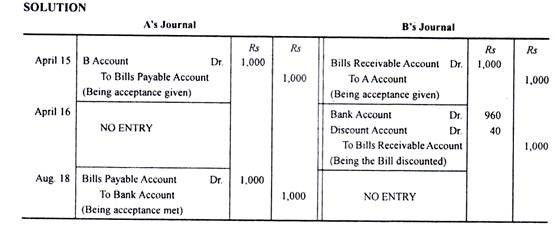
Simple sold goods to Tembo on 1st April for 300,000 and drew a bill of exchange to him on that date for 3 months which he accepted. On 2nd April Simba discounted the bill. The discount charge being 4,000. The bill was honoured.
Required;
Show journal entries in the books of Drawer and Drawee.
JOURNAL ENTRIES
| Date | Details | DR | CR |
|---|---|---|---|
| 1/4 | Temba Sales Being: Goods sold on credit | 300,000 | |
| 1/4 | Bill Receivable Temba Being B.E. Accepted | 300,000 | |
| 2/4 | Bank Bill Receivable Being: B.E discounted | 300,000 | |
| 2/4 | Discount Charges Bank Being: Discount charges transferred to P&L | 4,000 | |
| 2/4 | Profit and Loss Discount Charges Being: Discount charges transferred to P&L | 4,000 |
NOTE
No entry is made on the books of the drawer concerning the discount for the bill of exchange.
DISHONORED BILL OF EXCHANGE
When the debtor (acceptor) fails to make payment on maturity, the bill is said to be dishonoured.
ACCOUNTING ENTRIES
In the books of drawer:
- i) When the bill is dishonoured by drawee:
- DR: Personal A/C (Drawee) with the value of the bill
- DR: Bill receivable
- ii) When noting charge is paid by drawee:
- DR: Drawee A/C with the amount of noting charge
- CR: Bank or Cash A/C
- iii) When noting charge is transferred to drawer’s A/C:
- DR: Cash or Bank
- CR: Drawee account
In the books of drawee:
- i) When at maturity the bill is dishonoured:
- DR: Bill payable A/C with the value of the bill
- CR: Drawer A/C
- ii) When the bill plus noting charge are paid off:
- DR: Drawer A/C
- DR: Noting charge A/C
- CR: Cash/Bank with the amount
Example
On 1st June Twaha sold goods to Pinda for 500,000. A bill of exchange with maturity date of August was drawn up and accepted by Pinda.
On August, the bill of exchange was presented to Pinda but he failed to pay it and the bill is therefore dishonoured. The bill is noted with an entry of 20,000 which was initially paid by Twaha.
Required:
Show the accounting entries in the books of Twaha and Pinda.
JOURNAL ENTRIES
| Date | Details | DR | CR |
|---|---|---|---|
| 10/5 | Salum a/c Sales a/c Being: Goods sold on credit | 200,000 | |
| 13/6 | Salum a/c Bill receivable Being B.E dishonoured | 200,000 | |
| 13/6 | Noting charge a/c Bank Being noting charge paid by drawer | 20,000 | |
| 13/6 | Salum a/c Noting charges a/c Being charge transferred to drawee | 20,000 |
RENEWING A BILL OF EXCHANGE
Definition
To renew a bill of exchange means to extend the credit period by the duration of the bill. This happens when the acceptor (drawee) of the bill may not be in a position to honour the bill on presentation and it may be mutually arranged that he accepts a fresh bill (new bill) in place of the existing one. Interest is usually added to the new bill as compensation for the delayed payment.
In the books of drawer (seller):
- When the bill is dishonoured:
- DR: Debtor (drawee) account
- CR: Bill receivable account
- When the drawee debtor accepts a new bill:
- DR: Bills receivable account
- CR: Debtor (drawee) account
- Interest on the new bill:
- DR: Debtor (drawee) account
- CR: Interest receivable account
- When the bill is honoured by the debtor:
- DR: Bank account
- CR: Bills receivable account
Example
On 1st Jan 1981 Peter sold goods to Abdallah valued at Tshs 4,000/= on three months credit. On 1st April 1981 Peter presented his bill to the bank but the bill was dishonoured and he paid 25/= as a charge on dishonoured bill. It was arranged that he accept a fresh bill in place of the existing one. The interest of 50/= was charged. Abdallah honoured the bill.
Required:
Show the ledger account and journal in the books of Peter.

DISCUSSION QUESTIONS
On 1st Feb 2001 Salome, for her own accommodation, draws upon Thomas a bill for Tshs 5,000/= for three months. The bill is accepted by Thomas. On due date, Thomas meets the bill but her bank account didn’t have sufficient funds to meet the bill. Instead, she pays Tshs 2,000/= in cash and gives a bill for two months for 3,000/= plus interest of 4% per annum. This is duly met on maturity.
Required:
a) Give the journal entries in the books of Salome ignoring narration.
b) Post to the relevant ledger account.