


SET CONCEPTS
REVIEW OF THE P.5 WORK
- Complement of sets and shading regions of complement.
- Finding number of subsets and proper subsets.
- Simple application of sets.
Week Two lesson 1 and 2
APPLICATION OF SUBSETS
Finding the number of elements when given the number of subsets or proper subsets
Examples
 1. Given that set A has 16 subsets. How many members has set A?

 2n = No. of subsets 2 16
 2n = 16 2 8

 2n = 24 2 4
 N = 4 2 2
1
Set A has 4 elements 16 = 24

 2. Given that set Z has 63 proper subsets. Find the number of elements in set Z.
2n -1= No. of subsets 2 64
 2n – 1= 63 2 32


 2n -1+1= 63+1 2 16
2n = 64 2 8

 2n = 26 2 4
 N = 6 2 2
1
Set Z has 6 elements 64 = 26
MK mtcs bk 7 page 2 – 4, MK mtcs bk 6 page 16, Fountain Primary mtcs bk 6 page 13 – 14.
Week Two lesson 3 and 4
Drawing and representing information on a Venn diagram
1. Given that n (A) = 10, n (B) =15 and n (AnB) = 6.
Represent the above information on a Venn diagram.


 a) Find
- n(A – B)
= 10 – 6
= 4
b) Find; c) Find n(AnB)1
i) n(B-A) = 4 + 9
= 15 – 6 = 13
= 9
Mk Primary Mathematics Bk 6 page 23.
2. Study the Venn diagram below and use it to answer the questions that follow.


Find
a) n(I) b) n(J) c) n(InJ)1
= 12 + 5 = 12 + 15 = 5 + 15
= 17 = 27 = 20
MK mtcs Bk 6 page 25.
Week Two lesson 5 and Week Three lesson one
Application of sets
1. In a class of 50 pupils, 20 like English (E), 28 like Science (S), x like both subjects while 7 do not like any of the two subjects.
a) Represent the above information on the Venn diagram below.

 n(
n( )=50
)=50
b) How many pupils like both subjects?
7 + 20 – x + x + 28 – x = 50
27 + 28 – x = 50
55 = x = 50
55 -55 – x = 50 – 55
 =
= 

X = 5
c) Find the number of pupils who like only one subject.
= (20 – x) + (28 – x)
= (20 – 5) + (28 – 5)
15 + 23
38 pupils
MK mtcs Bk 6 page 29, Understanding mtcs Bk 6 page 14, Fountain Primary mtcs Bk 6 page 16.
Week three lesson 2 and 3
Probability
This is how likely something is to happen. It’s the chance of an event or something happening.
Examples
1. Given that uncle Tom will visit us next week. What is the probability that he will visit on a day starting with letter “T”?
Sample space = {Monday, Tue, Wed, Thur, Fri, Sat, Sun}
Expected outcomes = {Tue, Thur}
Probability (T) = 
Or 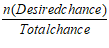
Probability = 
2. If a coin is tossed at once. What is the probability of a Head showing up?
Probability (H) = n (Desired outcome)
Total outcome
=
- If a die is tossed once, what is the probability that a number greater than 2 will show up?
Sample space = {1, 2, 3, 4, 5, 6}
Numbers greater than 2 = {3, 4, 5, 6}
Probability (H) = n (Desired outcome)
Total outcome
= 
Mk bk 6 page 30, MK bk 7 page 191, fountain Primary mtcs bk 6 page 20.
Week Three lesson 4
Application of probability
Examples
1. The probability of picking a red pen out of a bag is . What is the probability of picking a blue pen from the same bag?
Probability =1 – 
= –
– 
= 
Probability (Blue pen) = 
2. In a bag there are 3 red cards, 4 green cards and 5 Blue cards. What is the probability of picking a blue card from the bag?
Probability = 
= 
Probability (Blue) = 
Week Three lesson 5
WHOLE NUMBERS
REVIEW OF P.5 WORK
- Place values and values of whole numbers up to millions.
- Writing figures in words up to millions.
- Rounding off whole numbers.
- Roman numerals up to 2000.
Week Four lesson 1,2,3 and 4
Expanding numbers using powers or exponents.
Examples.
1. Expand 345692 using powers of base ten
(3×10⁵ )+(4×10⁴ )+(5×10³ )+ (6×10² )+(9×101 )+(2×100)
2. Using powers of base ten expand 475.
(4×10² )+(7×101)+(5×100)
3. Find the expanded number when given (9×10⁴) + (1×10³) + (7×10²) + (3×101) + (5×100)
(9x10x10x10x10) + (1x10x10x10)+ (7x10x10)+ (3×10)+ (5×1)
90000 + 1000 + 700 + 30 + 5
91735
Week Four lesson 5
OPERATION ON WHOLE NUMBERS
REVIEW OF P5 WORK
- Review on addition, subtraction, multiplication and division of whole numbers.
Week four Lesson 1,2 and 3.
BASES
Addition and subtraction of Bases
1. Add 2. Add
232four 563eight
+ 123four
+ 347eight


3. Subtract 4. Subtract
212three 333five
-121three – 244five
Week four lesson 4

Changing from one base to another.
Examples
1. Change 112three to decimal base or base ten.
2 1 0
 1 1 2three OR 112three
Ones
Threes
Three threes
(1×32) + (1×31) + (2×30) (1x3x3) + (1×3) + (2×1)
 1x3x3 + 1×3 + 2×1 9 + 3 + 2
9 + 3 + 2 14ten
14ten
2. Convert 212four

 From base four Base ten Base five
 212four
one
fours
four fours
(2x4x4) + (1×4) + (2×1)
32 + 4 + 2
= 38ten


 Base No Rem


 5 38 3
 5 7 2
5 7 2
 5 1 1
5 1 1
0 123five
Week Five lesson 5 and Week Six lesson 1
Finding the unknown base
1. Find the value of x
21x = 13ten

 21x = 13ten
 Ones
Ones
 x
x
(2xX) + (1×1) = 13
2x + 1 = 13
2x + 1 – 1 = 13 – 1
 =
= 
x = 6
\ X is base six
2. Calculate the value of y in 32y =43five


 32y 43five

 Ones ones

 y fives
(3xy) + (2×1) = (4×5) + (3×1)
3y + 2 = 20 + 3
3y + 2 = 23
3y +2-2 = 23 – 2
 =
= 
y = 7
\ y is base seven
Mk mtcs Bk 7 page 37.
Fountain primary mtcs Bk 6 page 231.
Week Five lesson 2
Standard or Scientific notation
– The standard form leaves only one digit to the side of the whole numbers.
– That one digit must be a counting number.
– The new decimal fraction should be multiplied by the power of 10.
– When the standard form is worked out, it should give the original number.
Examples
1. Express 1489 in standard or scientific notation.
1 4 8 9 = 1.489 x 10³
2. Express 43006 in scientific notation.
4 3 0 0 6 = 4.3006 x 10³
3. Write 0. 0 0 4 5 3 in standard form.
0.00453 = 4.53 x 10⁻³
4. What is 0.8945 in scientific notation?
0.8945 = 8.945 x 10⁻¹
MK mtc Bk 7 page 50.
Week Five lesson 3
INDICES
Laws of indices
Given ab a is the base
b is the power / index / exponent
NB 1: The first law of Indices
The first Law of indices states that when multiplying powers of the same base, keep the base constant and add the powers.
Examples
1. Simplify 42 x 45 2. Simplify P3 x P6
= 42 x 45 = P3 x P6
= 4(2 + 5) = P (3 + 6)
= 47 = P9
NB 2: The second law of Indices.
The second Law of indices states that when dividing powers of the same base, keep the base constant and subtract the powers.
1. Simplify 67 ÷ 63 2. Simplify 129÷ 127
= 67-3 =129-7
= 64 = 122
Week six lesson 4 and 5
NB 3: The law of Indices.
The third Law of indices states that when equating power of the same base, we ignore the base and equate the powers.
Examples
1. Solve for x in 2. Solve for y in 3y = 27

 2x = 25 3y = 33 3 27

 \ x = 5 y = 3 3 9
 3 3
3 3
1
27 = 33
3. Solve 2x x 33 = 108
2x x 3 x 3 x 3 = 108
2x x 27 = 108
27 27
2x = 4
 2x = 22
x = 2
MK mtcs Bk 6 page 7, 53 – 54
MK mtcs Bk 6 page 95
Week Seven lesson 1 and 2
NUMBER PATTERNS AND SEQUENCES
REVIEW OF P.5
- Types of numbers.
- Squares and square roots of numbers.
- L.C.M and G.C.F of numbers.
- Representing prime factors on the Venn diagram
Week Seven lessons 2, 3 and 4
Relationship between LCM and GCF and the product of the numbers
Product of the numbers = LCM x GCF
1. Given that the LCM of 16 and y is 48 and their GCF is 4. Find the value of y.
Product of numbers = LCM x GCF
16 x y = 48 x 4
 =
= 
y = 3 x 4
y = 12
2. The product of the two numbers is 60 and their GCF is 6. Find their LCM.
LCM x GCF = Product of the numbers
LCM x 6 = 60
 =
= 
LCM = 10
Primary mtcs for Uganda bk 6 page 52.
Week eight lesson1
Application of LCM
Examples
1. Find the smallest number that can be exactly divided by 6 or 8 leaving a remainder of 3.
LCM of 6 and 8.
 M6 = {6, 12, 18, 24, 30…}
M8 = {8, 16, 24, 32, 40 …}
Number = LCM + Remainder
= 24 + 3
= 27
2. What is the smallest number of pancakes that can be shared among 8 0r 9 boys leaving a remainder of 5 pancakes?
M8 = {8, 16, 24, 32, 40, 48, 56, 64, 72…}
M9 = {9, 18, 27, 36, 45, 54, 63, 72, 81…}
Number = LCM + Remainder
= 72 + 5
= 77 pancakes
3. At Bako Primary school, two bells are rung at intervals of 30 minutes and 40 minutes respectively to change lessons.
a) After how many hours will the bells be rung together?


 LCM of 30 and 40
 2 30 40
 2 15 20 LCM= 2 x 2 x2 x 3 x 5
 2 15 10 = 8 x 15
 3 15 5 = 120 minutes
 5 5 5 60 minutes = 1 hour
1 1 I minute =  hr
hr
120 minutes =  hr
hr
= 2 hours
The two bells will be rung after 2 hours.
b) If the bells were first rung together at 8:15am. At what time will they be rung together again?
Hrs Mins
8 : 15am
+ 2 : 00
10 : 15am
They will be rung at 10:15am.
Primary mtcs for Uganda Bk 6 page 53.
Week eight lesson 2and 3
Divisibility test
1. Test for 9
A number is divisible by 9 if sum of the digits is divisible by 9. Examples 198: 1+9+8= 18 and 18 is divisible by 9.
2. Test for 11
A number is divisible by 11 if the difference between the sum of the digits in even places and the sum of the digits in the odd places is 0 or divisible by 11.
Example 743589
743589: Sum of numbers in the odd position = 7+3+8= 18.
Sum of numbers in the even position = 4+5+9= 18
The difference between the sum of numbers in the even and odd places is 18 – 18= 0
Therefore 743589 is divisible by 11.
Week eight lesson 4
CONSECUTIVE COUNTING, WHOLE, EVEN, ODD NUMBERS
EXAMPLES
1. The sum of 3 consecutive counting or natural number is 93. What are these numbers?
Let the 1st counting number be a.
1st | 2nd | 3rd | SUM |
a | a + 1 | a + 2 | 93 |
a + a + 1 + a + 2 = 93
a + a + a + 1 + 2 = 93
3a + 3 = 93
3a + 3 – 3 = 93- 3
 =
= 
a = 30
1st | 2nd | 3rd |
a 30 | a + 1 30 + 1 31 | a + 2 30 + 2 32 |
\ the numbers are 30, 31 and 32.
2. Find the four consecutive even numbers whose sum is 172.
Let the 1st even number be y.
1st | 2nd | 3rd | 4th | SUM |
y | y + 2 | y + 4 | y + 6 | 172 |
y + y + 2 + y + 4 + y + 6 = 172
y + y + y + y + 2 + 4 + 6 = 172
4y + 12 = 172
4y + 12 – 12 = 172 – 12
 =
= 
y = 40
1st | 2nd | 3rd | 4th |
y 40 | y + 2 40+2 42 | y + 4 40+4 44 | y + 6 40+6 46 |
\
The numbers are 40, 42, 44 and 46.
3. The total of 3 consecutive odd numbers is 69. Find the range of these numbers.
Let the first no. be x.
1st | 2nd | 3rd | Total |
x | x + 2 | x + 4 | 69 |
x + x+ 2 + x + 4 = 69
x + x+ x + 2 + 4 = 69
3x + 6 = 69
3x + 6 – 6 = 69 – 6
 =
= 
x = 21
1st | 2nd | 3rd |
x 21 | x + 2 21 + 2 23 | x + 4 21 + 4 25 |
\
The numbers are 21, 23 and 25.
Mk mtcs Bk 6 page 76-86.
Fountain mtc Bk 6 page 68.
Week eight lesson 5 and Week nine lesson1
More about consecutive counting, odd, even numbers
1. The sum of the consecutive even numbers is 54. Find the numbers, given that y is the largest number.
1st | 2nd | 3rd | Total |
y – 4 | y – 2 | y | 54 |
y-4 + y-2 + y = 54
y + y + y – 4 – 2 = 54
3y – 6 = 54
3y – 6 + 6 = 54 + 6
 =
= 
y = 20
1st | 2nd | 3rd |
y – 4 20 – 4 16 | y – 2 20 – 2 18 | y 20 |
The numbers are 16, 18 and 20.
2. The median of 3 consecutive even numbers is n. find the number if their total is 24.
1st | 2nd | 3rd | Total |
n – 2 | n | n + 2 | 24 |
n – 2 + n + n + 2 = 24
n + n + n + 2 – 2 = 24
 =
=
n = 8
1st | 2nd | 3rd |
n-2 8 – 2 6 | n 8 | n + 2 8 + 2 10 |
\ The numbers are 6, 8 and 10.
Week nine lesson 2