


Simple classification of substances Questions
1. The diagram below shows the heating curve of a pure substance. Study it and answer the
questions that follow:
(a) What physical changes are taking place at points X and Z? (b)Explain what happens to the melting point of sodium chloride added to this substance
2. (a) State two differences between luminous flame and non-luminous flame
(b) It is advisable to set a Bunsen burner to luminous flame prior to an experiment.
Explain
3. The paper chromatography of a plant extract gave the following results:
Solvent | Number of spots |
X | 6 |
Y | 2 |
Z | 3 |
(a) Which is the most suitable solvent for purifying the extract? Explain
(b) Ball pen cannot be used to mark solvent front in the above chromatography. Explain
4. Name the process which takes place when:
(a) Solid Carbon (Iv) Oxide (dry ice) changes directly into gas
(b) A red litmus paper turns white when dropped into chlorine water
(c) Propene gas molecules are converted into a giant molecule
5. A sample of copper turnings was found to be contaminated with copper (II) oxide. Describe
how a sample of copper metal can be separated from the mixture
6. Copper (II) oxide and charcoal are black solids. How would you distinguish between the
two solids?
7. a) What is chromatography?
b) Give two applications of chromatography
8. The two elements P and R were separately burned in air, the products gave the results
recorded in the table below:
ELEMENTS PHYSICAL STATE AT ROOM TEMPERATURE | P SOLID | R SOLID |
Physical states of products | White solid powder only | Colourless gases L and M |
Nature of solutions in water | Basic | L strongly acidic M slightly acidic |
(a) Suggest the identity of element R. ……………………………………………..……..
(b) Describe how the nature of the solutions of the of the oxides were determined
9 The diagram below represents a paper chromatography for the three brands of soft drinks
containing banned artificial food additives.
4 1 | 6 2 | 7 5 3 | |
A | B | C | |
BRANDS OF SOFT DRINKS | |||
A and C found to contain the banned artificial food additives. Which numbers indicate the
banned artificial food additives?
10. Without using any laboratory chemical, describe a simple laboratory experiment to distinguish
between calcium hydrogen carbonate and sodium hydrogen carbonate
11. Substance Q has a melting point of 15oC and boiling point of 70oC.
(a) On the same axes, draw the melting point and boiling point graph for Q and the room
temperature
(b) State the physical state of substance Q at room temperature
12. Cooking oils comprise of a mixture of compounds which have a boiling point range
of 23oC to 27oC.
(i) What evidence is then to support the statement that cooking oil is a mixture?
(ii)Name another experimental technique that could be used to confirm your answer
in part (i) above
13. A form 1 student carried out the separation as shown in the set-up below:-
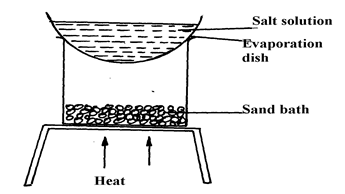
(i) Identify the method above………………………………………………………………………
(ii) Give one of its disadvantages
(iii) Name a mixture which can be separated by the set-up above
14. What is meant by melting point and boiling point of a substance?
15. The apparatus below were used by a student to study the effect of heat on hydrated
copper II sulphate
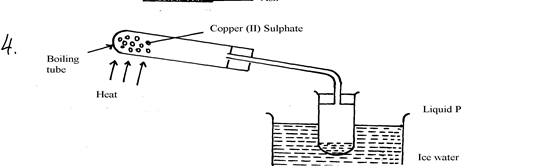
(a) What is the role of the ice cold water ……………
(b) Name liquid P …………………………………………………………
(c) What observation is made in the boiling tube
17. The diagram below shows chromatograms of blood samples obtained from three athletes.
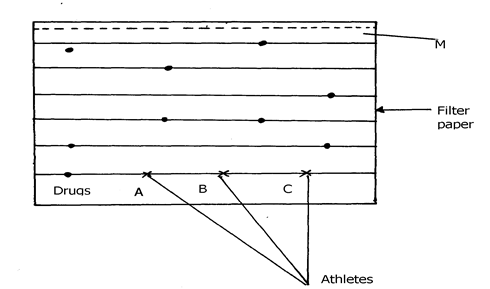 One athlete used illegal drug to improve performance in competition.


(a) Name the line marked M ………………………………………………….
(b)Identify the athlete who used illegal drug ……………… ……………………….
18. Classify the following processes as chemical changes or physical changes
Process
physical or chemical
Neutralization ………………………………………
Sublimation ………………………………………
Fractional distillation ………………………………………..
Displacement reaction …………………………………………
19. Give two reasons why a luminous flame is not used for heating purposes
20. Classify the following processes as chemical changes or physical changes
Process
physical or chemical
Neutralization ………………………………………
Sublimation ………………………………………
Fractional distillation ………………………………………..
Displacement reaction …………………………………………
21. Give two reasons why a luminous flame is not used for heating purposes
22. State two criteria for determining the purity of a substance
Substance | Water | Concentrated sulphuric(VI)acid | Concentrated sodium hydroxide |
Ethene | Slightly soluble | Soluble | Insoluble |
Ammonia | Very soluble | Very soluble | Very soluble |
Hydrogen | Slightly soluble | Insoluble | Insoluble |
23. Study the information in the table below and answer the questions.
i) A mixture contains ethene, Hydrogen and ammonia gases. Explain how a sample of
hydrogen gas can be obtained from this mixture.
24. a)i) The diagram below show spots of a pure substance A, B, and C on a chromatography
paper. Spot D is that of a mixture
After development A, B, and C were found to have moved 8cm, 3cm and 6cm respectively.
D had separated into two spots which had moved 6cm and 8cm
On the diagram above;
I. Label the baseline (origin)
II. Show the positions of all the spots after development
ii) Identify the substances present in mixture D
b) Describe how solid ammonium chloride can be separated from a solid mixture of
ammonium chloride and anhydrous calcium chloride
c) The table below shows liquids that are miscible and those that are immiscible
Liquid | L3 | L4 |
L1 | Miscible | Miscible |
L2 | Miscible | Immiscible |
Use the information given in the table to answer that questions that follow;
i) Name the method that can be used to separate L1 and L2 from a mixture of the two
ii) Describe how a mixture of L2 and L4 can be separated
25. A student left some crushed fruit mixture with water for some days. He found the mixture
had fermented. He concluded that the mixture was contaminated with water and ethanol with
boiling point of 100oC and 78oC respectively. The set-up of apparatus below are used to separate
the mixture.
(i) Name the piece of apparatus labelled W
(ii) What is the purpose of the thermometer in the set-up?
iii) At which end of the apparatus W should tap water be connected?……………………………
(iv) Which liquid was collected as the first distillate? Explain
(v) What is the name given to the above method of separating mixture?
(vi) State two applications of the above method of separating mixtures
(vi) What properties of the mixture makes it possible for the component to be separated
by the above methods?
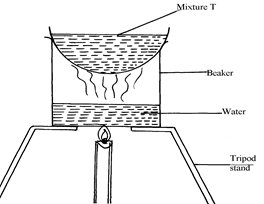 26. The set-up below was used to separate a mixture:-
(a) Name the apparatus missing in the set-up
(b) Give one example of mixture T
(c) What is the name of this method of separation
27. a) The diagram below shows a set – up used by a student to find out what happens
when Copper (II) sulphate crystals are heated.


(i) State the observations made when the blue copper (II) sulphate crystals are heated.
(ii) Identify liquid Y and write an equation for its formation.
b) Pellets of sodium hydrogen and anhydrous Copper (II) sulphate were put in separate Petri-
dishes and left in the open for two hours. Explain the observation in each Petri-dish.
28. The chromatography below shows the constituents of a flower extract using an organic solvent:-
(a) (i) Name a possible organic solvent you can use for this experiment
(ii) State one property that makes the red pigment to move the furthest distance from M
(iii) Describe how one could get a sample of yellow pigment
(iv) On the diagram indicate solvent front
(b) Describe how Aluminium chloride can be separated from a mixture of aluminium chloride
and sodium chloride
29. Study the information below and answer the questions that follow:
Solid | Cold water | Hot water |
R | Soluble | Soluble |
V | Insoluble | Insoluble |
S | Insoluble | Insoluble |
Describe how the mixture of solid R, S, and V can be separated
30. Given a mixture of lead (II) oxide, ammonium chloride and sodium chloride, describe how this
mixture can be separated to obtain a sample of each.
31. The setup below was used to separate two miscible liquids Q and T
(Boling points; Q =98° C, T=78°C)
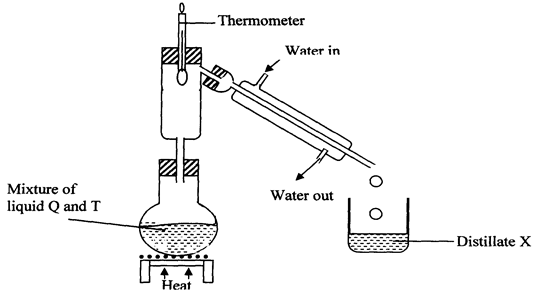
(a) Identify the mistakes in the setup above
(b)Identify Distillate X
32. Name the process which takes place when:
a) Solid Carbon (IV) oxide (dry ice) changes directly into gas.
b) A red litmus paper turns white when dropped into chlorine water.
c) Propene gas molecules are converted into a giant molecule.
33. The following diagram shows a paper chromatogram of substances A, B, C, and D which
are coloured
(a) Indicate the solvent front on the chromatogram
(b) Which substance is pure? ………………………………………..
(c) Substance E is a mixture of C and D. Indicate its chromatogram in the diagram
34. Study the information below and answer the following questions. A mixture contains three
solids A, B, and C. The solubility of these solids in different liquids is as shown below:-
Solid | Water | Alcohol | Ether |
A | Soluble | Insoluble | Insoluble |
B | Insoluble | Soluble | Very soluble |
C | Soluble | Soluble | Insoluble |
Explain how you will obtain sample C from the mixture
35. State and explain the observations made when iodine crystals is heated in a boiling tube?
2. Simple classification of substances Answers
1. a) X – melting point √ ½
Z – Boiling point √ ½ b) Its melting point is lowered and becomes less sharp due to the introduction of an impurity √1
2. Luminous flame produces soot while non- luminous flame does not√1
Luminous flame is yellow in colour while non- luminous flame is blue in colour
OR accept any correct answer
b) The luminous flame is moderately hot and is clearly visible hence no danger is posed
3. a) X
Gives the greatest number of spots hence the greatest number of pure substances √ 1
b) The ink is made of more than one pure substance hence will also undergo chromatography
4. (a) sublimation
(b) Bleaching action
(c) Polymerization
5. Adds excess dilute hydrochloric acid/ sulphuric (vi) acid
Filter to obtain copper metal
Wash with distilled water
6. To separate samples of CUO and charcoal in test tubes, dilute mineral acid is added with
shaking CUO black dissolves to form blue solution ½
Charcoal does not dissolve in dilute mineral acids
7. a) Is the process for the separation of a mixture of solutes by their different rates of movement
over a porous medium caused by moving solvent
b) – Separation of dyes
– To analyse and identify mixtures of substances which are difficult to separate by
other means
– Used to analyze dyes in food colouring (Any two each one mark)
8 a) Element R – Sulphur
b) Mix solid P oxide with water
put blue and litmus paper, Blue litmus paper remains blue, red litmus paper changes to blue.
Put blue and red litmus papers in water
Blue changes to red, red remain red.
9. 5 and 4 BOTH MUST BE CORRECT
10. EITHER
- In separate test tubes, boil about 5cm3 of each solution.
- Sodium hydrogencarbonate solution remains colourless forms no precipitate
- Calcium hydrogencarbonate solution changes from colourless to white precipitate
OR
2NaHCO3aq Na2CO3 + CO2(g)n + H2O(e)
Ca (HCO3)2
(aq) CaCO3(s) + CO2
(g) + H2O(e)
HEAT must be mentioned or implied.
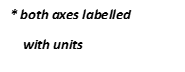
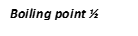
 11. a)





b) Liquid

 12. (i) Range of boiling points / no sharp boiling points
(ii) Carry out fractional distillation
 13. (i) Evaporation
 (ii) Uses a lot of fuel
(iii) Any soluble salt and water
14. Melting points is the specific √ ½ constant temperature√ ½ for a particular substance when a solid √ ½
change to a liquid√ ½
16. (a) To cool/condense vapour. √1 (1 mk)
(b) Water. √1 (1 mk) 3
(c) Blue solid √1 changes to white solid. √1 (1 mk)
17. (a) Solvent front √
(b) C √
18. a) Chemical √ ½
b) Physical √ ½
c) Physical √ ½
d) Chemical √ ½
19. – Smoky/ sooty √
– Not hot enough √
20. a) Chemical √ ½
b) Physical √ ½
c) Physical √ ½
d) Chemical √ ½
21. – Smoky/ sooty √
– Not hot enough √
22. – Boiling point
– Melting point
– Density
– Refractive index
23. i) Pass the mixture of gases through concentrated sulphuric (vi) acid √ ½ . Ammonia and
ethane will dissolve √ ½
– Hydrogen √ ½ being insoluble √ ½ is then obtained
24. a) i)
ii) A and C
b) Since NH4CL sublimes but CaCL2 does not, sublimation process would do. Heat the
mixture, NH4CL sublimates into vapour and condences on the upper cooler parts of the test
tube. CaCL2 remains at the bottom of the heating tube
c) i) Fractional distilation
ii) Separating funnel method 8
Since the two liquids are immiscible pour the mixture into the separating funnel and
allow to settle. The denser liquid will settle down and the less dense one will form
the second layer on top. Open the tap and run out the liquid in the bottom layer leaving
the second layer in the funnel
25. (i) Condenser
(ii) To indicate when a liquid is boiling, a thermometer reads a constant temperature
(iii) A

 (iv) Ethanol
Reason:- It has a lower boiling of 78oC compared to water with a boiling point of 100oC
 or – The liquid with the lower boiling point boils first and its vapours are condensed
and the condenser to  be collected as the first distillate
(v) Fractional distillation
(vi) – To separate components of crude oil
- To isolate O2 and N2 from air
- To manufacture spirits


(vii)- They are immiscible liquids
- They have different but close boiling points

26. (a) Wire gauze
(b) Sodium chloride solution (or any named slat solution)
(c) Evaporation
27. a) i) – Colourless liquid is seen on the cooler parts of the test tube. 1 mk.
– Blue crystals change to a white powder. 1 mk
ii) Water 1 which was originally water crystallization.
CuSO4 , 5H2O(s) CuSO4(s) + 5H2O(l) 1
b) NaOH(s) absorbs water from the air and forms a solution. It is a deliquescent substance. 1 Anhydrous CuSO4 absorbs water from air to form hydrated Copper (II) sulphate which is blue
but no solution is formed 1 it is hygroscopic
28. a)i)Ethanol, acetone (any organic solvent)
ii) Its most soluble in the solvent and less sticky
iii) – Cut out the yellow pigment
- put in organic solvent to dissolve the pigment
- filter and evaporate the filtrate to get the pigment
iv)Above the red pigment and below the edge.
b)-Heat the mixture aluminum chloride sublime and collect be cooler part of the tube
and sodium chloride left at bottom of the tube
– Scratch the condense alcl3 place in a beaker
(c)Add cold water to the mixture, and stir to dissolve R. Filter to get solid S and V on residue . Evaporate the future to get R. put S and in no water and stir to dissolve and filter to get S as residue evaporate future to get V
29. Add cold water to the mixture, and stir to dissolve R. Filter to get solid S and V on residue . Evaporate the future to get R. put S and in no water and stir to dissolve and filter to get S as residue evaporate future to get V
30. Heat the mixture Ammonium chloride sublimes and is collected on the cooler parts. Add water
to the remaining mixture, stir and filter. Lead (ii) Oxide remains as residue. Evaporate the
filtrate to dryness to obtain sodium chloride
31. a) – Fractionating column must have beads
– Wrong cold water circulation in the condenser
b) T
32. a) Sublimation. 1 (3 mks
b) Bleaching 1
c) Polymerisation 1
33.
(a) See Diagram above
– Solvent front should be slightly above the furthest pigment
 (b) C
(b) C
– It contains only one pigment
34 . – Add either to the mixture. Stir and filter
– Add alcohol to the residue, stir and filter
 – Evaporate to filtrate to obtain C
35. – Black crystals changes directly into purple vapour√1
– The iodine crystals (sublimes) changed directly into a purple vapour without passing
liquid state and changed back to black iodine crystals on the upper cooler parts of boiling
tube√ (Correct colour must be stated 2 mks


