

CHAPTER FOUR
EQUILIBRIUM AND CENTRE OF GRAVITY
Centre of Gravity
Centre of gravity or C.G is the point of balance of a body through which the total weight of the body seems to act. For regularly shaped bodies, the C.G is at the geometric centre of the body. For irregular bodies, their weight still acts at the centre of gravity, and the law of moments can be used to determine the weight of the body.
Example
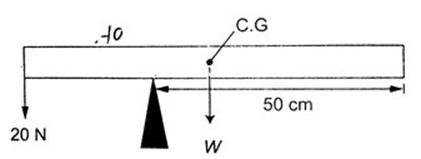
The figure below shows a uniform bar of weight ‘W’ and length 80 cm. If a force of 20 N keeps it in balance, determine the weight ‘W’ of the bar.
Solution
Taking moments about the pivot:
- Clockwise moments = W × 20 cm
- Anticlockwise moments = 20 × 30 cm
Since clockwise moments = anticlockwise moments,
20 W = 600, therefore W = 30 N.
Parallel Forces and Equilibrium
For a body to be in equilibrium (neither moving nor rotating) under the action of parallel forces, the following conditions must be satisfied:
- The sum of upward forces must be equal to the sum of downward forces.
- The sum of clockwise moments equals the sum of anticlockwise moments. These are called the first and second conditions of equilibrium respectively.
Examples
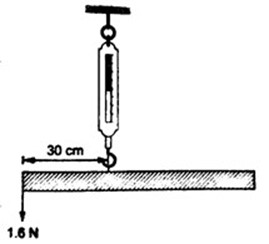
 A uniform rod of length 1.0 m is hung from a spring balance as shown and balanced in a horizontal position by a force of 1.6 N. Determine:
- a) The weight of the rod
- b) The reading of the spring balance
Solution
a) Let the weight of the rod be ‘W’. W acts at the 50 cm mark. Taking moments about the point of suspension:
- Clockwise moments = W × 0.2 m = 0.2 W Nm
- Anticlockwise moments = 1.6 × 0.3 = 0.48 Nm
Using the law of moments, anticlockwise moments = clockwise moments:
0.48 = 0.2 W, hence W = 2.4 N.
b) Upward forces = downward forces
Downward force = W + 1.6 N = 2.4 + 1.6 = 4.0 N
Upward force = reading of the spring balance = 4.0 N.
A uniform rod 1.0 m long weighs 5 N. It is supported horizontally at one end by a spring balance, and the other end rests on a table as shown below. A mass of 2 kg is hung from the rod as shown. Determine:
- Reading of the spring balance
- Reaction force, F, from the table
Solution
- The 2 kg mass and the weight of the rod (5 N) give clockwise moments, while the spring balance provides anticlockwise moments.
Clockwise moments = (2 × 10) × 0.4 + (5 × 0.5) = 10.5 Nm
Anticlockwise moments = S × 1 (reading of the spring balance)
1 × S = 10.5, hence S = 10.5 N.
- Upward forces = downward forces
Downward forces = (2 × 10) + 5 = 25 N
Therefore, F + 10.5 = 25, hence F = 14.5 N.
 A uniform rod of length 1.0 m is hung from a spring balance as shown and balanced in a horizontal position by a force of 1.6 N. Determine:
Stability
This term explains how easy or difficult it is for an object to topple over when a force is applied to it. Factors affecting stability include:
- Base area – the bigger the base area, the more stable the object.
- Position of the centre of gravity – the higher the centre of gravity, the less stable the body will be.
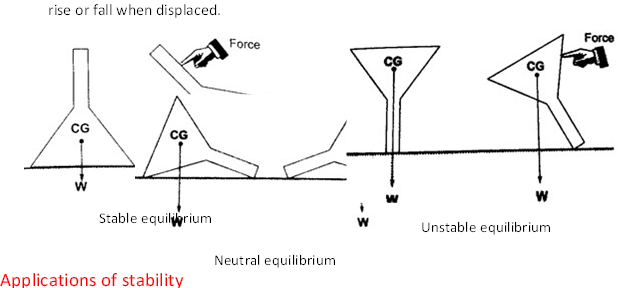
States of Equilibrium
- Stable equilibrium – if a body is displaced by a small force, it returns to its original position.
- Unstable equilibrium – if a body is displaced by a small force, it topples over and does not return to its original position.
- Neutral equilibrium – a body is at rest in whichever position it is placed.
Stability concepts are used mainly in the design of motor vehicles, for example:
- Racing cars – they have a low and wide wheelbase to increase their base area.
- Double-decker buses – they are manufactured with a low centre of gravity by mounting their chassis and engines as low as possible.


