Specific Objectives
By the end of this topic, the learner should be able to:
- Calculate the length of an arc and a chord;
- Calculate lengths of tangents and intersecting chords;
- State and use properties of chords and tangents;
- Construct tangents to a circle;
- Construct direct and transverse common tangents to two circles;
- Relate angles in alternate segments;
- Construct circumscribed, inscribed, and escribed circles;
- Locate the centroid and orthocentre of a triangle;
- Apply knowledge of circles, tangents, and chords to real-life situations.
Content
- Arcs, chords, and tangents
- Lengths of tangents and intersecting chords
- Properties of chords and tangents
- Construction of tangents to a circle
- Direct and transverse common tangents to two circles
- Angles in alternate segments
- Circumscribed, inscribed, and escribed circles
- Centroid and orthocentre
- Application of knowledge of tangents and chords to real-life situations
Length of an Arc

The arc length marked in red is given by the formula:
Example
Find the length of an arc subtended by an angle θ at the centre of a circle of radius 14 cm.
Solution
Length of an arc = rθ (where θ is in radians)
Example
The length of an arc of a circle is 11.0 cm. Find the radius of the circle if the arc subtends an angle θ at the centre.
Solution
Arc length = rθ
Therefore, 11 = rθ
Example
Find the angle subtended at the centre of a circle by an arc of 20 cm, if the circumference of the circle is 60 cm.
Solution
θ = (arc length) / r
But circumference = 2πr = 60 cm
Therefore, r = 60 / (2π)
Chords
A chord of a circle is a line segment that joins two points on the circle. A diameter is a chord that passes through the centre of the circle. The radius is the distance from the centre of the circle to the circumference.
Perpendicular Bisector of a Chord
A perpendicular drawn from the centre of the circle to a chord bisects the chord.


Note:
- A perpendicular drawn from the centre of the circle to a chord divides the chord into two equal parts.
- A straight line joining the centre of a circle to the midpoint of a chord is perpendicular to the chord.
The radius of a circle with centre O is 13 cm. Find the perpendicular distance from O to the chord if AB is 24 cm.

Solution
OC bisects chord AB at C.
Therefore, AC = 12 cm.
In triangle OAC, by Pythagoras theorem:
OM = √(OA² – AC²) = √(13² – 12²) = √(169 – 144) = √25 = 5 cm.
Parallel Chords
Any chord passing through the midpoints of all parallel chords of a circle is a diameter.

Example
In the figure below, CD and AB are parallel chords of a circle and are 2 cm apart. If CD = 8 cm and AB = 10 cm, find the radius of the circle.

Solution
- Draw the perpendicular bisectors of the chords to cut them at K and L.
- Join OD and OC.
- In triangle ODL, DL = 4 cm and KC = 5 cm.
- Let OK = x cm.
- Therefore, by Pythagoras theorem, (OD)² = (OK)² + (DL)²
In triangle OCK:
- (OC)² = (OK)² + (KC)²
- Substituting values, (OC)² = x² + 25
- (OD)² = x² + 16
- Since OD = OC (radii), x² + 16 = x² + 25
- 4x = 5
- x = 1.25
Using the equation for radius:
r = √(x² + DL²) = √(1.25² + 4²) = √(1.5625 + 16) = √17.5625 ≈ 4.19 cm.

Intersecting Chords
In general, for two chords intersecting inside a circle:

Example
In the figure above, AB and CD are two chords that intersect in a circle at E. Given that AE = 4 cm, CE = 5 cm, and DE = 3 cm, find AB.
Solution
Let EB = x cm.
By the intersecting chords theorem: AE × EB = CE × ED
4 × x = 5 × 3
4x = 15
x = 3.75 cm
Since AB = AE + EB,
AB = 4 + 3.75 = 7.75 cm.
Equal Chords
- Angles subtended at the centre of a circle by equal chords are equal.
- If chords are equal, they are equidistant from the centre of the circle.


Secant
A chord that is extended outside a circle is called a secant.

Example
Find the value of AT in the figure below. AR = 4 cm, RD = 5 cm, and TC = 9 cm.
Solution
Using the secant-tangent theorem:
AC × AT = AR × AD
(x + 9) × x = (5 + 4) × 4
(x + 9)(x) = 9 × 4
x² + 9x = 36
x² + 9x – 36 = 0
(x + 12)(x – 3) = 0
Therefore, x = -12 or x = 3 (reject negative value)
AT = 3 cm.

Tangent and Secant
Tangent
A line which touches a circle at exactly one point is called a tangent line. The point where it touches the circle is called the point of contact.
Secant
A line which intersects the circle in two distinct points is called a secant line (usually referred to as a secant). The figures below: A shows a secant while B shows a tangent.

A B
Construction of a Tangent
- Draw a circle of any radius and centre O.
- Join O to any point P on the circumference.
- Produce OP to a point P outside the circle.
- Construct a perpendicular line SP through point P.
- The line SP is a tangent to the circle at P as shown below.

Note:
- The radius and tangent are perpendicular at the point of contact.
- Through any point on a circle, only one tangent can be drawn.
- A perpendicular to a tangent at the point of contact passes through the centre of the circle.
Example
In the figure below, PT = 15 cm and PO = 17 cm. Calculate the length of PQ.

Solution:
OT = 8 cm (by Pythagoras theorem)
Properties of Tangents to a Circle from an External Point
If two tangents are drawn to a circle from an external point:
- They are equal in length.
- They subtend equal angles at the centre.
- The line joining the centre of the circle to the external point bisects the angle between the tangents.

Example
The figure below represents a circle with centre O and radius 5 cm. The tangent PT is 12 cm long. Find:
- Length OP
- Angle TPO

Solution
- Join O to P.
- Calculate OTP = cos⁻¹(5/12) ≈ 0.9231 radians.
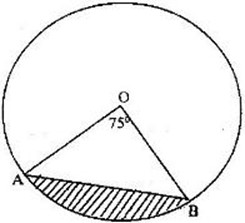
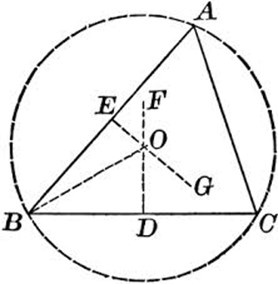
Therefore, Direct (exterior) common tangents and transverse (interior) common tangents The common-tangent problem involves finding the length of a tangent segment that touches two circles. This can be a common external tangent (tangent lies on the same side of both circles) or a common internal tangent (tangent lies between the circles). The solution method is the same for both. Given the radius of circle A is 4 cm, the radius of circle Z is 14 cm, and the distance between the two circles is 8 cm. You end up with a right triangle and a rectangle; one side of the rectangle is the common tangent. The hypotenuse of the triangle is the sum of the radii and the distance between the circles: 4 + 8 + 14 = 26 cm. The width of the rectangle equals the radius of the smaller circle, 4 cm. One leg of the triangle is the radius of the larger circle minus 4, or 14 – 4 = 10 cm. Using the Pythagorean Theorem: Alternatively, recognizing the 5:12:13 right triangle family, multiply 12 by 2 to get 24 instead of using the theorem. Because opposite sides of a rectangle are congruent, BY is also 24, which is the length of the common tangent. Note the location of the hypotenuse: in a common-tangent problem, the segment connecting the centres of the circles is always the hypotenuse of a right triangle. The common tangent is always a side of a rectangle, not a hypotenuse. Do not mistake the segment connecting the centres of the circles as a side of a right angle; it is never one. This lesson explains how to construct a common exterior tangent line to two circles in a plane such that neither circle lies inside the other, using a ruler and compass. Given two circles in a plane such that neither lies inside the other, construct the common exterior tangent line using a ruler and compass. Given two circles (Figure 1a), we want to construct the common exterior tangent line AB. Connect the tangent point A of the first circle with its centre P and the tangent point B of the second circle with its centre Q (Figures 1a and 1b). The radii PA and QB are both perpendicular to the tangent line AB, so PA and QB are parallel. Draw the segment CQ parallel to AB through Q until it intersects radius PA at C (Figure 1b). Quadrilateral CABQ is a parallelogram (a rectangle), so opposite sides QB and CA are congruent. Point C divides radius PA into segments CA and PC. The segment QC is tangent to the auxiliary circle centred at P with radius PA. The construction steps are: All these steps can be performed using a ruler and compass. The problem is solved. Find the length of the common exterior tangent segment to two given circles in a plane, given their radii and the distance d between their centres. Neither circle lies inside the other. Using Figure 1b from Problem 1, the common exterior tangent segment |AB| is congruent to side |CQ| of rectangle CABQ. Triangle DELTAPCQ is right-angled with hypotenuse d and one leg equal to the difference of the radii. Therefore, the length of the common exterior tangent segment |AB| is: |AB| = √(d² – (r₁ – r₂)²) Note the solvability condition d > |r₁ – r₂|, which ensures that neither circle lies inside the other. Find the length of the common exterior tangent segment to two circles with radii 6 cm and 3 cm, and the distance between their centres is 5 cm. Using the formula: |AB| = √(5² – (6 – 3)²) = √(25 – 9) = √16 = 4 cm. The length of the common exterior tangent segment is 4 cm. Two circles touch each other at a point if they have a common tangent at that point. Point T is shown by the red dot. The angle which the chord makes with the tangent is equal to the angle subtended by the same chord in the alternate segment of the circle. Angle a = Angle b The blue line represents the angle which chord CD makes with tangent PQ, equal to angle b subtended by the chord in the alternate segment. If a tangent segment and a secant segment are drawn to a circle from an external point, then the square of the length of the tangent equals the product of the length of the secant with the length of its external segment. In the figure above, TW = 10 cm and XW = 4 cm. Find TV. TW² = TX × TV 10² = (10 + 4) × TV 100 = 14 × TV TV = 100 / 14 ≈ 7.14 cm. Centre O is called the ex-centre. AO and CO are called external bisectors. End of topic Did you understand everything? If not, ask a teacher, friends, or anybody and make sure you understand before going to sleep! 1. The figure below represents a circle with diameter 28 cm and a sector subtending an angle of 750 at the centre. Find the area of the shaded segment to 4 significant figures. 2. The figure below represents a rectangle PQRS inscribed in a circle with centre O and radius 17 cm. PQ = 16 cm. Calculate: 3. In the figure below, BT is a tangent to the circle at B. AXCT and BXD are straight lines. AX = 6 cm, CT = 8 cm, BX = 4.8 cm, and XD = 5 cm. Find the length of: (a) XC (b) BT 4. The figure below shows two circles each of radius 7 cm, with centres at X and Y. The circles touch each other at point Q. Given that 5. The figure below shows a circle with centre O and radius 7 cm. TP and TQ are tangents to the circle at points P and Q respectively. OT = 25 cm. Calculate the length of chord PQ. 6. The figure below shows a circle with centre O and a point Q outside the circle. Using a ruler and a pair of compasses, locate a point on the circle such that angle OPQ = 90o. 7. In the figure below, PQR is an equilateral triangle of side 6 cm. Arcs QR, PR, and PQ are arcs of circles with centres at P, Q, and R respectively. Calculate the area of the shaded region to 4 significant figures. 8. In the figure below, AB is a diameter of the circle. Chord PQ intersects AB at N. A tangent to the circle at B meets PQ produced at R. Given that PN = 14 cm, NB = 4 cm, and BR = 7.5 cm, calculate the length of: (a) NR (b) ANTwo Tangents to a Circle


Tangent Problem
How to solve it:


How to Construct a Common Exterior Tangent Line to Two Circles
Problem 1
Solution
Figure 1a. Problem 1
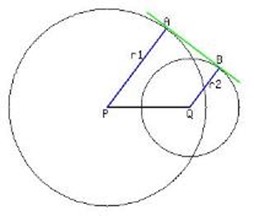
Figure 1b. Solution to Problem 1

Figure 1c. Construction Step 3

Problem 2
Solution
Example 1
Solution
Answer
Contact of Circles

Internal and External Tangents
Note:


Alternate Segment Theorem

Note
Illustrations

Tangent–Secant Segment Length Theorem

Example
Solution
Circles and Triangles
Inscribed Circle

Circumscribed Circle
Escribed Circle

Note:
Past KCSE Questions on the Topic