


Specific Objectives
By the end of the topic the learner should be able to:
- (a) State the geometric properties of common solids;
- (b) Identify the projection of a line onto a plane;
- (c) Identify skew lines;
- (d) Calculate the length between two points in three-dimensional geometry;
- (e) Identify and calculate the angle between
- (i) Two lines;
- (ii) A line and a plane;
- (iii) Two planes.
Content
- (a) Geometrical properties of common solids
- (b) Skew lines and projection of a line onto a plane
- (c) Length of a line in 3-dimensional geometry
- (d) The angle between
- (i) A line and a line
- (ii) A line and a plane
- (iii) A plane and a plane
- (iv) Angles between skew lines
Introduction
Geometrical properties of common solids
- A geometrical figure having length only is one-dimensional.
- A figure having area but no volume is two-dimensional.
- A figure having vertices (points), edges (lines), and faces (planes) is three-dimensional.
Examples of three-dimensional figures
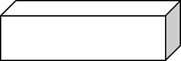 Rectangular Prism
A three-dimensional figure having 6 faces, 8 vertices, and 12 edges.
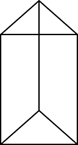 Triangular Prism
A three-dimensional figure having 5 faces, 6 vertices, and 9 edges.
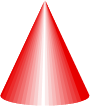 Cone
Cone
A three-dimensional figure having one curved face and a circular base.
 Sphere
A three-dimensional figure with no straight lines or edges; perfectly round.
 Cube
Cube
A three-dimensional figure measured by its length, height, and width. It has 6 faces, 8 vertices, and 12 edges.
 Cylinder
A three-dimensional figure having 2 circular faces and one curved surface.
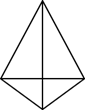 Rectangular Pyramid
A three-dimensional figure having 5 faces, 5 vertices, and 8 edges.
Angle between a line and a plane
The angle between a line and a plane is defined as the angle between the line and its projection onto the plane.
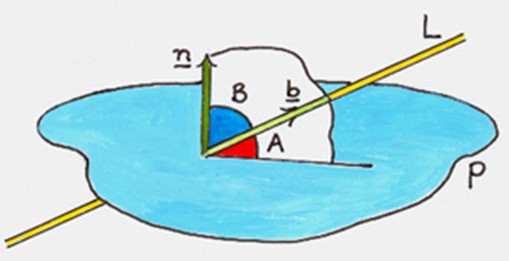
The angle between the line L and its projection (shadow) on the plane is angle A. Hence, the angle between the line and the plane is A.
Example
The angle between a line, r, and a plane, π, is the angle between r and its projection onto π, denoted r’.
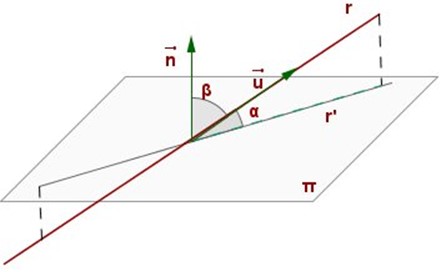 The height is 4 m.
Example
Suppose r’ is 10 cm. Find the angle.
Solution: To find the angle, we use the tangent function.
Angle Between Two Planes
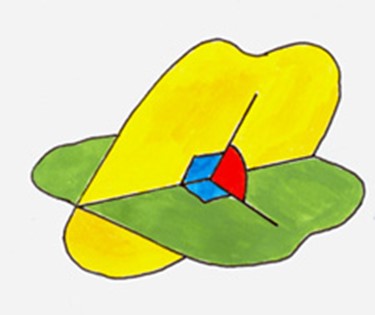
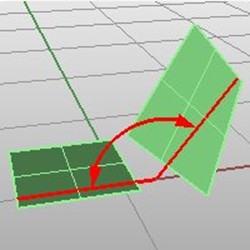
Any two planes are either parallel or intersect in a straight line. The angle between two planes is the angle between two lines, one on each plane, both perpendicular to the line of intersection at the point of intersection.
Example
The figure below shows PQRS, a regular tetrahedron with side length 4 cm, and M is the midpoint of RS.
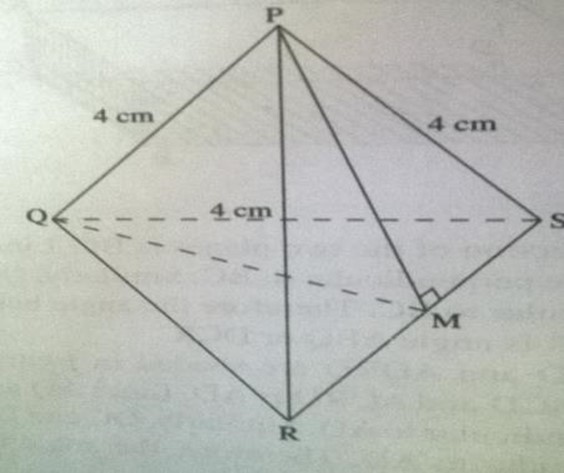
- Show that PM is cm long, and that triangle PMQ is isosceles.
- Calculate the angle between planes PSR and QRS.
- Calculate the angle between line PQ and plane QRS.
Solution
- Triangle PRS is equilateral. Since M is the midpoint of RS, PM is the perpendicular bisector.
cm = cm
Triangle MQR is right angled at M.
cm = cm
- The required angle is in triangle PMQ. Use the cosine rule to calculate it.
- The required angle is in triangle PQM. Since triangle PMQ is isosceles, angle PMQ = angle PQM (109.46°).
End of topic
Did you understand everything? If not, ask a teacher, friends, or anybody and make sure you understand before going to sleep! |
Past KCSE Questions on the topic
1. The diagram below shows a right pyramid VABCD with V as the vertex. The base of the pyramid is rectangle ABCD, with AB = 4 cm and BC = 3 cm. The height of the pyramid is 6 cm.
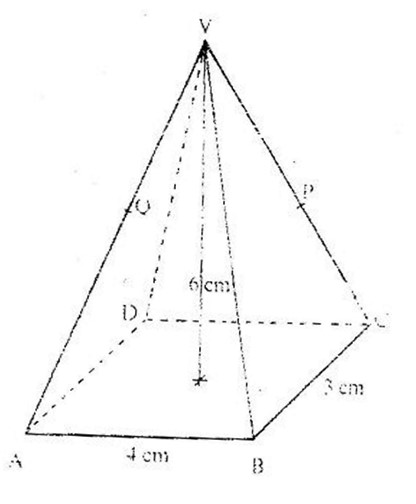
(a) Calculate the:
- Length of the projection of VA on the base.
- Angle between the face VAB and the base.
(b) P is the midpoint of VC and Q is the midpoint of VD.
Find the angle between the planes VAB and the plane ABPQ.
2. The figure below represents a square-based solid with a path marked on it.
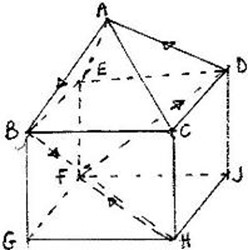
Sketch and label the net of the solid.
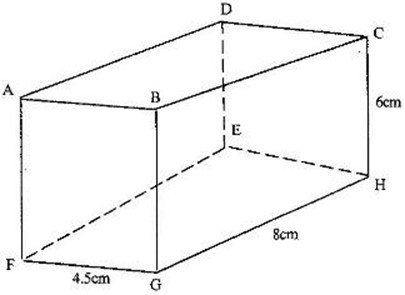
3. The diagram below represents a cuboid ABCDEFGH in which FG = 4.5 cm, GH = 8 cm, and HC = 6 cm.
Calculate:
- (a) The length of FC.
- (b) (i) The size of the angle between the lines FC and FH.
- (ii) The size of the angle between the lines AB and FH.
(c) The size of the angle between the planes ABHE and FGHE.
4. The base of a right pyramid is a square ABCD of side 2a cm. The slant edges VA, VB, VC, and VD are each of length 3a cm.
(a) Sketch and label the pyramid.
(b) Find the angle between a slanting edge and the base.
5. The triangular prism shown below has the sides AB = DC = EF = 12 cm. The ends are equilateral triangles of sides 10 cm. The point N is the midpoint of FC.
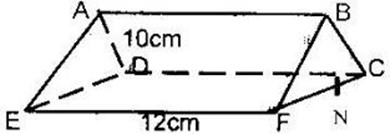
Find the length of:
- (a) (i) BN
- (ii) EN
- (b) Find the angle between the line EB and the plane CDEF.


