


PHOTOGRAPH WORK
A photograph is an image of an object, person, or scene recorded by a camera on a light-sensitive film or paper.
Types of Photographs
1. Ground Photographs
Taken from the ground. They are of two types:
Ground Horizontals – taken with the camera at the same level as the object. They are of two types:
Ground close-ups/particular view photographs – taken from the ground with a camera focused on one particular object.
Ground General View Photographs – taken from the ground with the camera focused on general scenery.
Ground Obliques – taken from the ground with a camera slanting or held at an angle.
2. Aerial Photographs
Taken from the air, e.g., from aircraft, balloons, or satellites. They are of two types:
Aerial Obliques – taken from the air with the camera tilted towards the ground.
Vertical Aerial Photographs – taken from the air with the camera directly above the object or scenery.
Parts of a Photograph
| Left background | Centre background | Right background |
| Left middle ground | Centre middle ground | Right middle ground |
| Left foreground | Centre foreground | Right foreground |
Uses of Photographs
- Used in learning geography because they bring unfamiliar features into the classroom, enabling students to understand them better.
- Photographs showing vegetation and human activities can be used to deduce the climate of an area.
- Aerial photographs show vital information on land use.
- Photographs showing land-forming processes help us to understand those processes.
Limitations in the Use of Photographs
- Coloured photographs are generally expensive to produce.
- Black and white photographs don’t show the real colours of objects or scenery, e.g., it’s difficult to distinguish ripe coffee berries from green ones.
- Some aerial photographs have objects which are far away and hence unclear, which may lead to wrong interpretation.
- Vertical aerial photographs are difficult to interpret without special instruments like stereoscopes.
- Photographs are difficult to interpret if they are blurred because it’s difficult to distinguish objects which look similar, e.g., wheat and barley.
Interpretation of Photographs
Means to explain the meaning of the objects or features on a photograph. It involves the following:
Determining the Title
Photographs show human activities, physical features, natural catastrophes, etc., e.g., nomadic pastoralism, drought, flooding, etc. When determining the title, examine the photograph carefully and apply the knowledge you have learnt in geography.
Estimating Time
In the tropics, shadows are short at noon and longest in the morning and afternoon.
If the camera is facing south and the shadow is cast to the right, it’s in the morning; if cast to the left, it’s in the afternoon.
Estimating Season
Dry season
- Bright clear skies
- Dry vegetation
- Harvesting
- Light clothes, e.g., shirts and T-shirts, since temperature is high (also an indication of high temperature).
Rainy season
- Rain clouds
- Luxuriant vegetation
- Young crops
- Flowering plants
- Weeding
- Heavy clothing, e.g., pullovers or jackets, since temperatures are low (also an indication of cool season).
Determining Compass Direction
If it’s in the morning and the shadow of a flagpole is cast to the left, the photographer is facing north; if cast to the right, he was facing south.
If it’s in the morning and the shadow is facing towards you, the photographer was facing east; if taken in the afternoon and the shadow is facing towards you, the photographer was facing west.
Interpretation of Physical Features on Photographs
Relief
Flat land
- Rice crop
- Irrigation
- Combine harvesters
- Swamps
- Meanders
- Oxbow lakes
- Inselbergs (isolated hills)
Hilly/Mountainous landscape/Highland Area
- Steep slopes
- Terraced landscape
- Tea, wheat crops which grow at high altitude
- Rapids
- Waterfalls
- Interlocking spurs
Drainage
Youthful Stage
- Rapids
- Waterfalls
- Interlocking spurs
Middle Stage
- Meanders
- Oxbow lakes
Lower Stage
- Deltas
- Distributaries
- Meanders and oxbow lakes
- Flood plain
Vegetation
Natural
- Indigenous species
- Dense undergrowth
- Trees grow haphazardly
- Different species of trees
- Not of the same height
Planted
- Exotic species
- In rows
- Little undergrowth
- Same species
- Same heights
Tropical Rain Forests
- Trees
- Broad leaves
- Umbrella shaped
Marshes
- Swamps
Savannah Grassland
- Grass and short trees (woodland)
Desert Vegetation
- Thorny leaves
- Baobab and acacia
- Scrub-land covered with shrubs and underdeveloped trees (shrubs)
Climate
High Temperatures and Low Rainfall
- Sugar cane
- Grass
- Sisal
- Scrub and bush land vegetation
- Dense forests
- Light clothes
Cool Temperature and High Rainfall (Sufficient, Reliable and Well Distributed)
- Tea
- Coffee
- Wheat
- Dairy farming
Soils
Acidic and Volcanic Soils
- Coffee
- Tea
Clay Soils
- Rice
Black Cotton Soils
- Cotton
- Rice
Loamy Soil
- Horticultural crops
Human Activities and Evidence
Settlement
Group of dwellings where people live.
Rural Settlements
- Semi-permanent houses
- Farming or fishing activity
- Uneven distribution of settlements
- Presence of villages
Urban Settlements
- Permanent buildings
- Storied buildings
- Heavy traffic presence
- Regular street patterns
Agriculture/Farming
Subsistence Farming
- Temporary and permanent houses
- Small pieces of land
- Mixed cropping
- Simple implements
- Local and exotic breeds of livestock
Crop Farming
- Crops
- People preparing land or weeding or harvesting
Commercial Crop Farming
- Cash crops
- Machinery
- Feeder routes
- Processing factories
Plantation Farming
- Single crop on extensive piece of land e.g., tea, coffee, etc.
- Many labourers
- Nucleated settlement within farms
Livestock Rearing
Nomadic Pastoralism
- Cattle grazing in a grassland or semi-arid region
Dairy Farming
- Zero grazing
- Cattle with big udders
Ranching
- Paddocks
- Wind mills
Mining
- Quarry
- Large open pits
- Large excavators
- Lorries carrying loads of rocks
Industrial Manufacturing
- Buildings with large chimneys
- People engaged in processing activities such as Jua kali artisans
Lumbering
- People cutting trees using power saws
- People loading timber into lorries
- Logs piled near a saw mill
- Forests with stumps
- Logs floating on a river
Transport
Motor Transport
- Vehicles on roads
Railway Transport
- Railway line
- Trains
Air Transport
- Flat tarmacked piece of land
- Aircraft
Water Transport
- Boats
- Ships
- Ferries
Communication
- Telephone lines
- Telephone booths
- Post office
- Satellite masts
- T.V and radio stations
Sketching Diagrams from Photographs
- Draw a rectangle the same size as the photograph.
- Divide it into squares using faint lines.
- Subdivide the photograph into 9 sections.
- Insert the features in their exact positions using simple lines guided by the squares.
- Label the important features, e.g., vegetation, land use, prominent buildings, transport, and communication.
- Give the sketch a suitable title.
Graphs
Two-dimensional drawings which show relationships between two types of data representing two items, also called variables. These are dependent variable which is affected by the other, e.g., temperature (on y-axis), and independent variable whose change is not affected by the other, e.g., altitude (on x-axis).
Steps
- Draw x and y axes.
- Choose a suitable scale to accommodate the highest and lowest values.
- Plot the values accurately using faint dots.
- Join the dots using a curved line. If it’s a bar graph, the dots should be at the middle of the top line. Years should also be at the middle. Decide on the width of the bars.
- In data without continuity, e.g., crop production, there should be gaps between bars; for data with continuity, e.g., rainfall, bars should not have gaps.
- Draw vertical lines on either side of the dot, then draw a horizontal line to join them with the dot.
- Shade uniformly if representing only one type of data and differently if representing more than one type of data.
- In combined line and bar graphs, temperature figures are plotted on the right-hand side of the y-axis while rainfall on the left.
- Don’t start exactly at zero.
- Include temperature and rainfall scales.
- Start where the longest bar ends.
What a Well-Drawn Graph Should Have
- Title
- Scale/scales
- Labelled and marked x and y axes starting at zero.
- Key if required, e.g., in comparative bar graphs.
- Accurately plotted points and lines, curves, or bars properly drawn.
Simple Line Graph
Advantages
- Easy to construct
- Easy to interpret
- Easy to read/estimate exact values
- Shows trend or movement over time
Disadvantages
- Doesn’t give a clear impression of the quantity of data.
- May give false impression on the quantity, especially when there was no production.
- Poor choice of vertical scale may exaggerate fluctuations in values.
- Difficult to find exact values by interpolation.
Simple Bar Graph/Histogram
Advantages
- Easy to construct.
- Easy to interpret.
- Easy to read.
- Gives a clear visual impression of the quantity of data.
Disadvantages
- Poor choice of vertical scale may cause exaggeration of bars.
- Doesn’t show continuity/variation of data over time.
- Unsuitable technique when values exist in continuity.
- Not possible to obtain intermediate values from the graph.
Combined Line and Bar Graph
Advantages
Easy to construct.
Easy to read.
It shows relationship between two sets of data.
Disadvantages
- Difficult to choose suitable scale when values of variables differ by great magnitude.
- Considerable variation of data represented by the line may cause the line to obscure the bars, thus obscuring the relationship.
- Doesn’t show relationship between the same sets of data of more than one place.
Temperature and Rainfall for Thika
| Month | J | F | M | A | M | J | J | A | S | O | N | D |
| Temp(°C) | 24 | 24 | 23 | 22 | 19 | 17 | 17 | 18 | 19 | 20 | 22 | 23 |
| Rainfall(mm) | 109 | 122 | 130 | 76 | 52 | 34 | 28 | 38 | 70 | 108 | 121 | 120 |
Analysis and Interpretation
- The month with the heaviest rainfall is May.
- The month with the lowest rainfall is July.
- The hottest months were January and February.
- The months with the lowest temperature were June and July.
Crop Production in Kenya in the Years 2001 and 2002
| Crop | Amount in metric tonnes | ||
| 2001 | 2002 | ||
| Tea | 300,000 | 500,000 | |
| Coffee | 120,000 | 80,000 | |
| Wheat | 120,000 | 150,000 | |
| Maize | 250,000 | 400,000 | |
Value of Export Crops from Kenya (Ksh million)
| Crop | 1997 | 1998 | 1999 | 2000 | 2001 |
| Tea | 24126 | 32971 | 33065 | 35150 | 34485 |
| Coffee | 16856 | 12817 | 12029 | 11707 | 7460 |
| Horticulture | 13752 | 14938 | 17641 | 21216 | 19846 |
If the data has large figures, e.g., 195,262, plot in 1000s = 195; 184,988 = 185.
You can draw comparative/group/multiple line and bar graphs from the data.
Comparative/Group/Multiple Line Graph

Advantages
- Simple to construct
- Suitable when comparing trends or movements
- Comparison of items is easy because the graphs are drawn using a common axis
- It’s easy to read exact values from each graph
Disadvantages
- Number of items which can be represented is limited
- Crossing of lines may make interpretation and comparison difficult and confusing.
- Total amount of variable can’t be established at a glance.
Comparative Bar Graph
Advantages
- Easy to construct
- Easy to read and interpret
- Easy to compare similar components within different bars
- Gives a good impression of totality
- Individual contribution made by each component is clearly seen
- Differences in quantity of components are clearly seen
Disadvantages
- Doesn’t show trend of components over time
- Not easy to compare components where bars are many
- Not suitable for many components
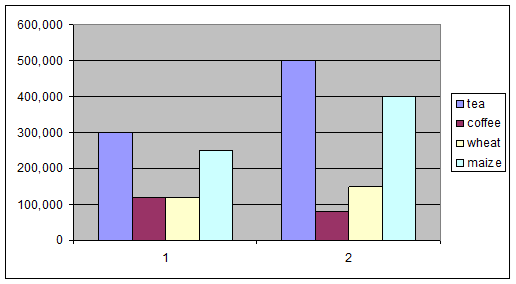
Divided Bars or Rectangles
Production of Sugarcane in 1000 tonnes of 5 major factories in Kenya
| Factory | Production (000 tonnes) | Length in cm |
| Sony | 50 | 0.5 |
| Nzoia | 100 | 1 |
| Chemilil | 200 | 2 |
| Muhoroni | 250 | 2.5 |
| Mumias | 400 | 4 |
| Total | 1000 | 10 |
Reported Visitor Arrivals by Continent for the Year 2000
| Continent | No. of visitors | Length of strip (cm) |
| Africa | 153,904 | 1.5 |
| America | 77,271 | 0.8 |
| Asia | 58,784 | 0.6 |
| Europe | 663,906 | 6.6 |
| Other | 82,672 | 0.8 |
| Total | 10.3 |
Look for a convenient scale, say 1 cm represents 100,000 visitors
- Draw a divided rectangle 10 cm long to represent the data.
- Show your calculations.
It should have the following:
- Title
- Different shades
- Key
- Width of 2 cm
Analysis and Interpretation
- Factory leading in sugar production is Mumias.
- The 2nd leading is Muhoroni.
- Factory with the lowest production of sugar is Sony.
- Calculation of percentages.
Advantages
- Easy to construct
- Easy to compare components because they are arranged in ascending or descending order.
- Takes less space than when the data is presented using graphs.
- Each component’s proportion to the total can easily be seen at a glance.
Disadvantages
- Can’t be used for large data.
- Only one unit of measurement can be used.
- Difficult to assess values of individual components.
- The visual impression isn’t as good as pie charts.
Exercise
Temperature and Rainfall for Kisumu
| Month | J | F | M | A | M | J | J | A | S | O | N | D |
| Temp(°C) | 19 | 20 | 20 | 18 | 20 | 19 | 19 | 18 | 18 | 18 | 18 | 18 |
| Rainfall(mm) | 18 | 38 | 66 | 127 | 114 | 84 | 112 | 104 | 69 | 56 | 38 | 31 |
- Draw a bar graph to represent rainfall figures.
- Calculate the mean monthly temperature for the place.
- Calculate the mean annual temperature range.
- Calculate the annual rainfall totals.
Additional Exercise
| Temp/Day | Mon | Tue | Wed | Thurs | Fri | Sat | Sun |
| Max °C | 28 | 27 | 28 | 26 | 29 | 29 | 26 |
| Min °C | 18 | 18 | 20 | 16 | 22 | 21 | 19 |
- Calculate the diurnal/daily temperature range for Tuesday.
- Calculate the mean daily temperature for Sunday.
- Suppose at 40 °C air can hold 60g/m³ of water vapour and the maximum vapour it can hold is 70g/m³. Calculate the relative humidity.
- (a) Calculate the time at Lamu 70°E when time at GWM is noon.
(b) Calculate the longitude of Watamu whose time is 6 pm when time at GWM is 9 am.
- Students from a certain school obtained the following marks in their end of term geography examination:
74, 52, 48, 60, 48, 32, 80, 67, and 85.
Calculate the following:
- Median
- Mode
- Mean
- State their advantages and disadvantages.
- (a) Calculate the scale given that the ground distance is 200 km while the distance on the map is 20 cm.
(b) A student measured the length of a road on a map from point A to B and found it to be 3.6 cm. Use a scale of 1:50000 to calculate the actual/ground distance in km.
- Students intend to carry out a field study of a forest around their school.
- State two ways in which they’d prepare themselves.
- State two objectives they’d have formulated for their study.
- List two problems they’d have encountered in the field.
- State two follow-up activities they would have after the field study.


1 Comment