


THE THEORY OF MONEY
Money refers to anything of value which is generally acceptable by the whole society to act as a medium of exchange.
Money is accepted not for its own sake but because others will accept it in exchange for goods and services. Therefore, demand for money is a derived demand.
It is a legal tender meaning that everyone in the country concerned must accept it in settlement of debts.
IMPORTANT TERMS
- Legal tender.
Is money for a specific country which must by law be accepted for the discharge of debts.
Refers to the total stock of money and includes foreign currencies which are not generally acceptable for the discharge of debts.
- Token money.
Refers to the coins whose metal value is less than face value. Intrinsic value of money is the commodity value of materials used to make money.
Extrinsic value of money – Is the value of money in terms of its ability to purchase goods and services.
- Fiat money.
Is issued by the directive of the government irrespective of the level of economic activity e.g. money printed to finance the car.
Fiduciary issue – Is the money which is issued and not backed by gold.
- Quasi money/near money.
Refers to risk-free assets which are easily converted into cash e.g. bonds, foreign currencies.
Refers to ease with which an asset can be converted into cash. Liquid assets are those which are easily converted into cash with no risk of cash loss e.g. cash is the most liquid asset.
Liquidity – Refers to the difficulty with which assets are converted to cash. Liquid assets are less profitable than illiquid assets e.g. long term bond earns more interest than short term bond.
FEATURES OR CHARACTERISTICS OF GOOD MONEY
- It must be generally acceptable in the society i.e. all the people in the country must be confident that it will be accepted by others.
- It must be easy to transport e.g. it must not be heavy in relation to its value.
- It must be divisible to smaller denomination to make possible smaller transactions e.g. Tanzania currency is divided into 50/=, 100/=, 1000/=, 5000/=, 20000/=, 50000/=, and 100,000/=.
- It must be durable i.e. money must not be perishable so as to function as a store of value.
- Must be relatively scarce as money must be relatively scarce in order to maintain its value otherwise it would lose its value if it is plenty and people prefer to keep their wealth in form of property.
- Homogeneity: One piece of money i.e. money should be similar, for instance a ten shilling note should be similar to all other ten shilling notes used in a country.
TYPES AND EVOLUTION OF MONEY
Money is classified according to how it evolved in history as follows:
- Barter system. This was the earliest form of exchange where commodities were exchanged directly for other commodities.
- Use of commodities of high use value e.g. salt, tobacco, corn, etc. They were used to determine the value of other commodities. Such commodities were used because of their value and ability to satisfy human wants. However, they are perishable and even bulky.
- Use of durable commodities of iron, copper, gold, cowrie shells, silver, etc. However, not all commodities were scarce hence they could not be a good medium of exchange.
- Use of rare materials i.e. gold and silver which were used because of their scarcity and durability.
- Paper money. In the beginning, people used to deposit their gold with the goldsmiths, the custodians of gold who were living at that time. In turn, the goldsmith could give them receipts which they were to use to get back their gold. Later, people started to use receipts to settle debts and obligations because such receipts were as good as gold. In the beginning, paper money was as good as gold because it was fully backed by gold.
- Deposit money: This is created by commercial banks in the process of accepting deposits and lending using cheques (Credit creation).
ADVANTAGES OF BARTER ECONOMY OVER MONETARY ECONOMY
- It preserves foreign exchange i.e. it enables exchange to take place without working for exchange.
- It widens the market of commodities.
- It encourages trade among less developed countries which lack foreign currencies.
- The effect of price fluctuation is avoided since bargaining is in terms of physical quantities.
DISADVANTAGES OF BARTER ECONOMY
- There is no generally acceptable means of settling debt and obligations.
- There is no measure of value reflecting the relative quantities and qualities of commodities to be exchanged.
- There is no standard of deferred payment or means to facilitate payments of debts and transactions to future time.
- There was nothing to facilitate specialization to take place since there is no generally acceptable way of paying wages, rent, and interest.
- There is a problem of transporting the bulky commodities to use in exchange.
- Most commodities appear in plenty and therefore lose value easily.
- Most of the commodities are not divisible to smaller denomination to make smaller transactions possible.
- It is difficult to get commodities which are homogeneous to use as means of settling obligations.
- Problems of double coincidence.
VALUE OF MONEY
The value of money means the purchasing power of money i.e. the amount of commodities a unit of money can purchase. The value of money depends on the price level. If the price is higher, the value of money is lower and if the price is lower, the value of money is higher.
EFFECTS OF CHANGE IN THE VALUE OF MONEY
- Effect when the value of money increases.
a) The business activities will be stimulated due to increase in purchasing power.
b) There will be less risk to produce (loss) due to sureness of producers to market their products.
c) Profit margin rises due to increase in revenue as a result of increase in purchasing power in the economy.
d) Output also rises.
Producers will be stimulated to increase output due to increased input.
e) Cost of production becomes low hence production increases.
- Effect when the value of money decreases.
1. Cost of production increases or rises hence reducing production.
2. It becomes difficult to adjust wages.
3. Purchasing power of individuals will decrease due to increase in price of goods and services hence affects living standard of people.
4. Profit margin will decrease due to increased cost of production.
DEMAND FOR MONEY
Refers to the willingness of people to hold money in cash rather than other assets like bonds, bills, and other government securities.
The question “Why do people hold money?” can be explained by the following:
- The quantity theory of money.
- The Keynesian demand for money theory.
THE QUANTITY THEORY OF MONEY
According to Prof. Irving Fisher, money is like other commodities in the market.
As the quantity supplied increases, the price increases i.e. the value of money will decrease and when the quantity supplied decreases, the prices will decrease, hence the value of money increases.
NOTE:
According to Fisher, the value of money depends on quantity of money in circulation or level of transaction e.g. when the quantity of money is doubled, the price will also be doubled but the value of it will fall by half.
The theory can be explained by the following equation:
MV = PT
Where,
- M = Stock of money.
- V = The velocity of money in circulation.
- P = General price level.
- T = Level of transaction.
MV = Amount of money spent on purchasing commodities.
PT = Value of goods and services sold in an economy.
ASSUMPTIONS OF THE THEORY:
- Velocity of money should remain constant.
- The proportion of increase/decrease in price is inversely proportional to the quantity supply of money.
- Number of transactions should remain constant.
- Absence of hoarding i.e. all the money in circulation should be used for transactions.
- Quantity and velocity should be credit for transaction.
- There is no barter trade i.e. operating in monetary economy.
CRITICISM OF THE QUANTITY THEORY OF MONEY:
The quantity theory of money has been rejected or criticized on the following basis:
- The theory is based on weak assumptions because all variables are assumed to be constant i.e. V & T. In actual sense, the velocity of money and number of transactions do not remain constant when the quantity of money changes.
- Prices of different commodities do not change at the same time as the theory explains; prices change differently on condition of demand and supply.
- The theory is based on the supply side ignoring the demand side of money i.e. it is both demand and supply of money which determines price.
- It is just a truism and not a theory. The theory is inadequate because it does not consider the interest rate which is the basis of monetary theories.
- The theory ignores the influence of the government in the price level through price ceiling and price floor.
- Fisher considers money as a medium of exchange and ignores the direct exchange of goods for goods which exist in some parts of different money.
- Increase in price can be brought about by scarcity (e.g. existence of monopoly market) but not necessarily due to increase in money supply.
KEYNESIAN THEORY OF DEMAND FOR MONEY
According to Lord John M. Keynes, these are the main reasons as to why people hold money (demand):
- Transaction motive.
- Speculation motive.
- Precautionary motive.
TRANSACTION MOTIVE
Money is demanded for facilitating the day-to-day uses i.e. to buy everyday requirements such as food, clothes, etc.
MT = K; Y; K > 0
Where,
- MT = Demand of money for transaction.
- Y = Consumer’s income.
- K = Constant of fixed nation.
Alternative:
MDT = F(Y)
The quantity of money demanded for transactional motive is directly proportional to the person’s income.
Also, the longer the payment period, the more money for transaction and vice versa.
PRECAUTIONARY MOTIVES
Individuals hold extra money as a precaution against unforeseen events or circumstances e.g. sickness, etc. This additional money held to meet unexpected events in the future is said to be held for precautionary motives depending on person’s nominal income related to income.
SPECULATIVE MOTIVES
If money is held in excess amount required for transaction and precautionary motive, then it is held for speculation purposes. Speculative demand depends on the future trend of the interest rate; investors convert their assets into investments e.g. purchasing bonds rather than money in cash when interest rate is low. Investors prefer to convert assets into cash.
Therefore, demand for money for speculative motive is inversely related to interest rate i.e.
MDS = K(I); K > 0
Where,
- MDS = Demand of money for speculative motive.
- I = Interest rate.
People hold money for earning income through speculation. This depends on the rate of interest.
Graph for illustration.

From the graph, when the rate of interest is expected to fall from Or2 to Or1, speculators convert bonds to cash and therefore demand for money increases from M1 to M2 to avoid capital loss. When the rate of interest is expected to increase from Or1 to Or2, speculators buy bonds and hence demand less money (OM2). This liquidity trap shows the point below which the interest rate would be too low to encourage speculation to invest in bonds and as a result only money is held.
FINANCE MOTIVE
People hold money to finance ongoing investments in which capital has been sunk. Such money held would constitute the variable costs of such investment.
NB: Determinants of demand for money in addition to Keynesian demand for money theory are:
GENERAL PRICE LEVEL
When demand for money is high because of the low value of money, demand for money is low because of the high value of money.
Generally, M2DT, P & S = F(Y, I).
Where:
- MD/T = Demand for money
- P = Precautionary motive
- S = Speculative motive
- T = Transactional motive
- Y = Consumer’s income
- I = Interest rate
MONEY SUPPLY
Refers to the money in circulation plus money in current savings and time deposit accounts.
M2 = M1 + saving and time deposits.
= M1 + SD + TD.
Where:
- M1 = CC + DD
- CC = Currency in circulation
- DD = Demand deposits
This definition treats money as medium of exchange and therefore considers only money which in reality is available to be used to facilitate exchange.
MONEY SUPPLY
Refers to the volume of money in an economy. There are several definitions of money supply as follows:
- Narrow definition of money supply.
Money supply as money in hands of the public plus money on demand deposits (current account).
M1 = CC + DD
Where:
- CC = Currency of circulation
- DD = Demand deposits
This definition treats money as a medium of exchange and therefore considers only money which in reality is available to be used to facilitate exchange.
- BROADER DEFINITION OF MONEY SUPPLY.
Refers to the money circulation plus money in current, savings and time deposited accounts.
M2 = M1 + saving and time deposits.
= M1 + SD + TD.
Where:
- M1 = CC + DD
- S = Saving
- TD = Time deposits
This takes money to be a store of value.
Others definition: includes the definitions of others like bonds and foreign currencies.
i.e. M3 = M2 + M1 + near money (Quasi)
TYPES OF MONEY SUPPLY
Exogenous (discretionary) supply of money.
This is determined by the monitoring authority which may be central bank or ministry of finance. Exogenous supply of money is usually assumed fixed.
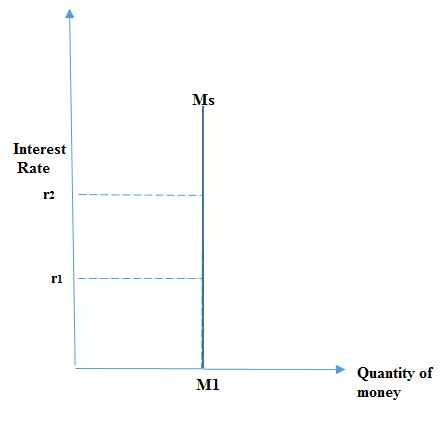
Endogenous (Automatic) supply of money:
This depends on the level of economic activities e.g. output of interest etc.
DETERMINANTS OF MONEY SUPPLY
- Printing more money by monitoring authority.
When the government runs short of money, more money can be printed to finance them. This is called financed accommodation.
- Demonetization is withdrawing all money in circulation reduces money supply.
2. Government borrowing from the central Bank.
This also implies printing of money since the central bank has no money to lend.
- When the central bank buys the securities (e.g. bonds) from the public money supply increases but when the central bank sells securities to the public, money supply is reduced.
- Balance of payments (BOP) surplus: when export exceeds imports, the surplus foreign exchange is converted to local currency. Such money circulates in the economy and vice versa during balance of payment deficit.
- Foreign capital inflow e.g. tourists who exchange foreign currencies into local currency spend during their stay in the country and vice versa during capital outflow.
- Special deposits
If increased or if imposed by the central bank reduces money supply.
- Credit by commercial banks.
This act by commercial banks using the cheque facility expands to result into greater volume of credit than the amount originally lent out. The increase in money supply in the currency.
- This is the rate at which the central banks charge commercial banks for the loan given to them.
- The increase in interest rate to the public. The increase in interest rate will discourage borrowing and encourage saving hence decrease in supply and vice versa when the bank decreases.
6. Selective credit control i.e.
If few factors get credit, money supply reduces while if credit is not restricted, money supply increases.
INFLATION
Refers to the continuous or persistent increase in the general price level of all commodities in an economy.
It can be measured by either NCPI (National Consumer Price Index) or GDP (deflator) e.g. GDP deflator
P-1 = Pt – 1= 1998=120.7
P-2= Pt = 1999 = 131.0
Qn: Find the inflation rate:
Inflation rate is defined simply as the velocity of the increase in general price levels and it is given by:
P = (Pt – (Pt – 1)) / Pt-1
Where:
- Pt = current price
- Pt – 1= Base year price
- P = Inflation rate.
TYPES OF INFLATION
Types of inflation can be classified according to its causes and rate of spread or intensity.
Types of inflation according to its causes
- Demand pull inflation.
- Cost push inflation.
Other types of inflation are:
i) Imported.
ii) Structural.
DEMAND PULL INFLATION

From the diagram,
Increase in aggregate demand from D0 to D1 leads to increase in price from P0 to P1 which is the inflation point.
CAUSES OF DEMAND PULL INFLATION
- Rapid increase in population.
The higher the population, the higher demand of goods and services.
- Decrease in government taxes.
Leads to increase in personal disposable income which increases the purchasing power of an individual.
- Increase in wages or income of an individual.
Increase in people income leads to increase in purchasing power.
- Increase in government expenditure.
This will lead to increase in supply of money; increased people will increase the rate of purchasing power which is in aggregate demand.
- Increase in capital inflow through exports leading to increase in money supply.
- Printing more money by the government through expansion of monetary policies.
- Increase in exports of essential goods which leads to increase in foreign exchange hence more supply of money which increases aggregate demand.
- Decrease in imports of essential goods which lead to increase in aggregate demand for such goods.
- Decrease in output as a result of restriction by monopolists causes artificial shortage in an economy which will cause increase in demand for those goods.
MEASURES TO CONTROL DEMAND PULL INFLATION
- Increase in taxation (direct) will reduce personal disposable income.
- Reduction in government expenditure; this will reduce supply of money in the economy.
- Reduction in wages of workers.
- Increase in importation of essential goods so as to reduce the problem of scarcity.
- Use restrictive monetary policies i.e. contractionary monetary policies that reduce money supply in the economy.
- Discourage rapid population pressure so as to reduce the demand for goods and services.
- Encourage saving which will reduce aggregate goods demand.
COST PUSH INFLATION
Is the kind of inflation caused by increase in cost of production i.e. increase in wage, rent, interest, also increased cost of equipment which can be used for production process.
From the graph, increases in price of factors of production leads to the decrease in the supply of goods and services from Oyo to Oy.
CAUSES OF COST PUSH INFLATION
- High cost of raw materials especially those which are imported.
- High advertising cost.
- High wages to workers.
- Trade unions.
- Increase in transport cost due to increase in price of fuel in the world market.
CLASSIFICATION OF INFLATION ACCORDING TO THE DEGREE OF INTENSITY (SPEED)
- Creeping or mild or gradual inflation.
This refers to the slow increase in general price level. The increase in the general price level is less than 3%. It encourages production and it does not distort relative prices or income severely.
- Walking or trotting or moderate inflation.
This is where the increase in the general price level is a single digit or less than 10% per annum. It is a warning to the government to put measures to control it before it goes out of hand.
- Running inflation.
This is when prices increase at the rate of 10 – 20 percent per year/annum. It requires strong measures to control it.
- Hyperinflation or runaway or galloping inflation.
This is the rapid rise in the general price level where inflation ranges from 20% to even more than 100% per annum.
Inflation becomes uncountable and prices rise many times every day. Money loses value and people prefer to hold real goods or assets than money.
OTHER FORMS OF INFLATION:
Wages – wages inflation.
This occurs due to inter-firm or inter-sector or common wages among workers. A rise in wages in one sector or firm causes revision of wages in similar occupations in the economy. As enterprises increase wages, total cost and prices also increase.
STRUCTURAL OR DEMAND SHIFT INFLATION:
- This occurs as a result of a combined element of cost push and demand pull inflation.
It occurs when there is a structural change in elements of situation e.g.
- In a situation where some industries are expanding while others are declining. In the case of expanding industries, higher wages have to be paid in order to attract labour. Increasing wages cause inflation as a result of increase in cost of production.
- Increase in production may result in the increase in demand for goods and services.
CAUSES OF STRUCTURAL INFLATION:
- Temporary breakdown of economic sectors like agricultural sector and industry sectors.
- Shortage of productive inputs i.e. if factors of production are in shortage. There will be low production in the economy hence aggregate demand being greater than aggregate supply.
- Political instabilities. This will discourage production.
- Speculation by business. This causes artificial shortage by holding their goods expecting that they will get more money in the future.
- Shortage of foreign exchange to increase importation.
- Poor transport system to reach goods in all parts of the country.
MEASURES TO CONTROL STRUCTURAL INFLATION
- Improvement of transport system so as to enable goods and services to reach all parts of the country.
- Modernization of agriculture so as to improve agricultural activities.
- Provision of productive input i.e. factors of production should be available at cheap prices.
- Creation of goods in a conducive atmosphere which promotes production.
- Price control measures i.e. there should be price commission which will be responsible in setting minimum and maximum prices (price ceiling and price floor).
IMPORTED INFLATION
Is a type of inflation which is the result of imported goods and services from a country which is affected by inflation.
CAUSES OF IMPORTED INFLATION:
- Importation of goods of high prices from countries experiencing inflation.
- Rising prices in international market.
- Import shortage.
- Inelastic demand for imports.
- Protection against imports i.e. through import duties.
- Expansionary monetary policies which lead to high import demand.
EFFECTS OF INFLATION
- Effects on production.
Production takes place in two periods: short run and long run.
- Effect of inflation in the short run.
In the short run, increase in the price will encourage production because producers will sell their products at higher price.
At this period:
- a. Wages or salaries cost adjust slowly.
- b. Fixed charges such as rent, electricity, water supply and other charges adjust slowly.
- c. Contracts and supply of raw materials cover long period until further orders are placed. The producer will use profit earned to increase production and possibly employment to stimulate demand.
- Effect of inflation in the long run.
Inflation will discourage production as the money value falls hence all the cost of production will rise causing negative effects on production.
- Effects of inflation in the long run.
Producers or profit earners gain most during inflation as profit margin increases considerably during inflation but in short run only.
Wages and salary earners lose during inflation although not as much as fixed earners. Their losses will eventually be reduced due to wages and salary adjustment.
During inflation, the value of savings falls i.e. rate falls; this discourages saving and encourages spending.
Lenders
During inflation, lenders tend to lose due to the fact that they are paid back their money when its value is low.
Social-political effects
Inflation also affects social and political affairs in the economy such as:
- Crimes
- Unemployment
- Political instability
EFFECTS OF INFLATION (GENERALLY)
Negative effects of inflation
- Agriculturalists lose because prices of agricultural commodities tend to lag behind inflation. Their savings, welfare, and productivity fall.
- Workers suffer when there is inflation because wages tend to lag behind inflation.
- The standard of living of fixed income consumers (like pension earners those who depend on past savings) falls.
- It discourages people from saving in financial institutions because of fear that their money would lose value. Financial institutions are forced to increase the rate of interest and this increases cost of borrowing and leads to further inflation.
- It reduces the purchasing power of the majority since it redistributes income from the majority peasants and workers to the minority (business people).
- Creditors lose because they are paid back in an inflated currency. This discourages lending by individuals and financial institutions.
- It leads to political unrest and demand for high salaries by workers. Therefore, it increases people’s failure to meet the high cost of living.
- Inflation leads to balance of payment (BOP) problems of discouraging exports and encouraging imports. Exports reduce because buyers dislike buying from a country where prices are high. Imports increase because outsiders like to sell in a country where prices are higher.
- Inflation may be used against the production of exports whose prices are determined on the world market. Prices remain fixed whereas costs of production increase in the domestic currency. People shift to production for domestic markets to fetch higher prices.
- Where there is hyperinflation, there is need to revise plans for tax structure and contracts to match with the new price structures. This is time-consuming and can lead to failure to achieve objectives of plans and programs.
- Inflation leads to rural-urban migration since it becomes less profitable to grow crops in rural areas.
People shift to towns to start businesses. This discourages agriculture in rural areas and leads to urban unemployment and development of slums in towns.
- It undermines the external value of the currency which calls for devaluation of the currency. This makes importation of raw materials difficult.
- It leads to black market e.g. to create artificial shortages.
POSITIVE EFFECTS OF INFLATION
Hyperinflation is undesirable in the economy. However, mild inflation may be healthy to the economy in the following ways:
- It increases the profit level of businesses (commercial producers) since cost of production rises lower than price of commodities. This encourages investments.
- It makes workers and peasants work harder to maintain their standard of living after the increase in prices which may provide incentives for people to engage in economic activities.
- It reduces the level of unemployment, since there would be a lot of money to spend and stimulate production and to invest and create more jobs.
- It encourages business people to get loans since they would expect money to have lost value at the time of paying back.
- It encourages people to produce goods to sell in the domestic market where price is high.
- By encouraging urbanization, it leads to an increase in demand for food which encourages agriculture.
POLICY FOR INFLATION
Policies for inflation are mainly macroeconomic policies which aim at stability, efficiency, and fair distribution of wealth. A policy of inflation depends on the causes of inflation. Policy instruments should reduce aggregate demand and increase supply.
- A tight (restrictive) monetary policy. This involves the use of various tools of monetary policy to reduce money supply and curb consumption e.g. increase in bank rates, selling securities to the public, increasing reserve rates etc. Reduce money supply and aggregate demand. At the extreme, the government can also demonetize the currency by declaring the old one useless and new one.
- Fiscal policy – This includes the reduction of government expenditure and increase of taxes to reduce aggregate demand. A surplus budget where the government collects more revenue than its expenditure is a strong tool. The government can also do internal borrowing to reduce money supply and also postpone repayment of internal debts to the time when inflation is controlled.
- Reorganization of distribution channels of goods – e.g. restoring scarce commodities and rationalization of major distribution channels.
According to the kinked demand curve, it does not pay for the oligopoly to raise or lower prices.
Depreciation and Appreciation of a Currency
- Depreciation of a currency.
Is when there is a decrease in the value of the domestic currency in relation to the foreign currency purely caused by the market forces of demand and supply of the currency.
E.g. when it was 1 ksh = 10 Tshs.
And then it was 1 ksh = 20 Tshs.
From the above example, the Tanzania Tshs has depreciated.
Effects of depreciation of a currency
- Increase in exports and they become cheaper.
Import decreases as they become more expensive.
- As exports increase and imports decrease, the deficit in the balance of payment reduces.
- Depreciation stimulates more production and hence promotion of the domestic industries plus creating more employment opportunities.
- Appreciation of the currency
This is when there is an increase in the value of domestic currency in relation to the foreign currency purely caused by the market forces of demand and supply of the currency.
E.g.: when 1 ksh was 10 Tshs and then later on it was
1 ksh was 6 Tshs, so the Tanzania Tshs has appreciated.
EFFECTS OF APPRECIATION OF A CURRENCY
- Exports reduce as they become more expensive.
- Imports increase as they become cheaper.
- As imports increase and exports reduce, the deficit in the balance of payment increases resulting in balance of payment problems.
- Production contracts and results in increase in unemployment.
Value of Money
Value of Money is the purchasing power of money which is reflected through the amount of goods and services a cent of a currency can purchase.
Value of money can increase or decrease. For example, during inflation, value of money decreases and during deflation the value of money increases.
Measuring changes in value of money
Changes in the value of money are measured through price index.
Price index is a figure which measures the relative changes in the price of various commodities from one period to another period. That is to say from the base to the current year.
NOTE:
Price index can as well be called the cost of living index as it gives a picture of changes in the cost of living in a certain area from one period to another. Price indices can be producer’s price index, wholesaler’s price index, retailer’s price index, etc.
TABLE SHOWS MEASURING CHANGES IN VALUE OF MONEY
| Commodity | Price in 1970 (Shs) | Price in 1980 (Shs) | Price relative |
|---|---|---|---|
| A | 20 | 25 | 125 |
| B | 5 | 10 | 200 |
| C | 15 | 30 | 200 |
| D | 40 | 50 | 125 |
| E | 200 | 450 | 225 |
| Σn=5 | ΣPR=875 |
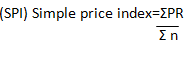
Formula:

ΣPR = Price relative for each commodity
Σn = Total number of commodities
P1 = Price in current year
P0 = Price in the base year


Weighted Price Index
This is the price index which considers the weight assigned to various commodities and under this, most important commodities are assigned high weights than those which are less important.
| Commodity | Weight | P x in 1970 | P x 1980 | PR | W x PR |
|---|---|---|---|---|---|
| A | 5 | 20 | 25 | 125 | 625 |
| B | 4 | 5 | 10 | 200 | 800 |
| C | 2 | 15 | 30 | 200 | 400 |
| D | 3 | 40 | 50 | 125 | 375 |
| E | 10 | 200 | 450 | 225 | 2250 |
| Æ© | 4450 | ||||
| Æ©W | 24 | ||||
Formula: WPI = Æ©WPR / Æ©W
Weight Price Index = 4450 / 24 = 185.4
185.4% – 100% = 85.4%
So the general price level increased by 85.4%
Laspeyres Price Index (LPI)
This is a base year weight price index; therefore, it uses the base year value as its weights.
LPI = (Æ©PnQo / Æ©PoQo) x 100
Where:
- Æ© = summation
- Po = Price in the base year
- Pn = Price in the current year
- Qo = Quantity in the base year
| Items | Qty (Kgs) | P x (Shs) | Qty (Kgs) | P x (Shs) | ||||
|---|---|---|---|---|---|---|---|---|
| 1998 | 1998 | 2000 | 2000 | |||||
| Beans | 2 | 3.2 | 2 | 40 | ||||
| Sugar | 5 | 2.0 | 10 | 1.5 | ||||
| Meat | 2 | 5.0 | 1 | 25.0 | ||||
| Rice | 3 | 1.0 | 8 | 5.0 | ||||
| Maize flour | 2 | 1.0 | 3 | 7.0 | ||||
Interpretation
- Price increased by 201%
- Cost of living increased by 201%
- Standard of living declined by 201%
- Saving capacity declined by 201%
Paasche’s Price Index (PPI)
This is a current year weight price index which is calculated by:
PPI = (Æ©PnQn / Æ©PoQ0) x 100
Where:
- Æ© = Summation
- Pn = Price in the current year
- Po = Price in the base year
- Qn = Quantity in the current year
Using the previous table:
PPI = Æ©PnQn / Æ©PoQ0 x 100
Æ©PnQn = (4.0 x 2) + (1.5 x 10) + (25.0 x 1) + (5.0 x 8) + (7.0 x 3)
= 8 + 15 + 25 + 40 + 21
= 109
Æ©PoQn = (3.2 x 2) + (2.0 x 10) + (5 x 0.1) + (1.0 x 8) + (1.0 x 3)
= 6.4 + 20 + 5 + 8 + 3
= 42.4
PPI = 109 / 42.4 x 100%
PPI = 257.0754 – 100%
PPI ≈ 157%
Interpretation
- Price increased by 157%
- Cost of living increased by 157%
- Standard of living declined by 157%
- Saving capacity declined by 157%
Importance of Price Index
- It is important in measuring changes in the general price level between the base and the current year; therefore, it is from the price index that it can be known whether the prices increase, reduce or remain the same.
- Price indices are also important in knowing changes in the value of money over time. Therefore, it can be known whether the value of money has increased or reduced.
- Price indices are also important in measuring the cost of living between the base and the current year. Therefore, it is from price index that it can be known whether the cost of living has increased or decreased.
- Price index is also important in measuring the standard of living between the base and the current year. Therefore, it can be known whether the standard of living has increased or decreased.
- Price indices are also important to the government and to the employees in the wage policy as it gives a picture on the cost of living and standard of living and hence creating a basis for wage revision.
- Price indices are also important in measuring terms of trade, position of the country by use of the price index for export and price index for imports. Therefore, price indices are important in showing changes in the terms of trade position of the country.
- Price indices are also important in deflating National income from nominal to real through the use of the GDP deflator.
- Price indices are also important in comparing the cost of living and standard of living between countries.
Problems experienced in measuring and use of price index
- Choice of the base year
It is difficult to get a base year in which prices are relatively stable; this is due to the fact that there are normally ups and downs in the prices.
- Difficulty in selection of a common representative basket of commodities from the wide range of commodities.
- The data problem.
It is difficult and unreliable data on prices and quantities as many consumers do not keep a record of their expenditures.
- There are several ways/methods that can be used to calculate price index but which give different answers; this creates a problem in the interpretation.
- Change in the prices may be as a result of improvement in quality which may be interpreted as inflation but which is not.
- Index numbers have limited use for a long period of time due to the fact that tastes and preferences change.
Steps taken in compiling price index
- Choice of an area where the data is to be collected.
- Choice of a common representative basket of commodities.
- Collection of data on prices and quantities.
- Tabulation of the data.
- Choice of the appropriate formula and computation.
- Interpretation.



1 Comment