

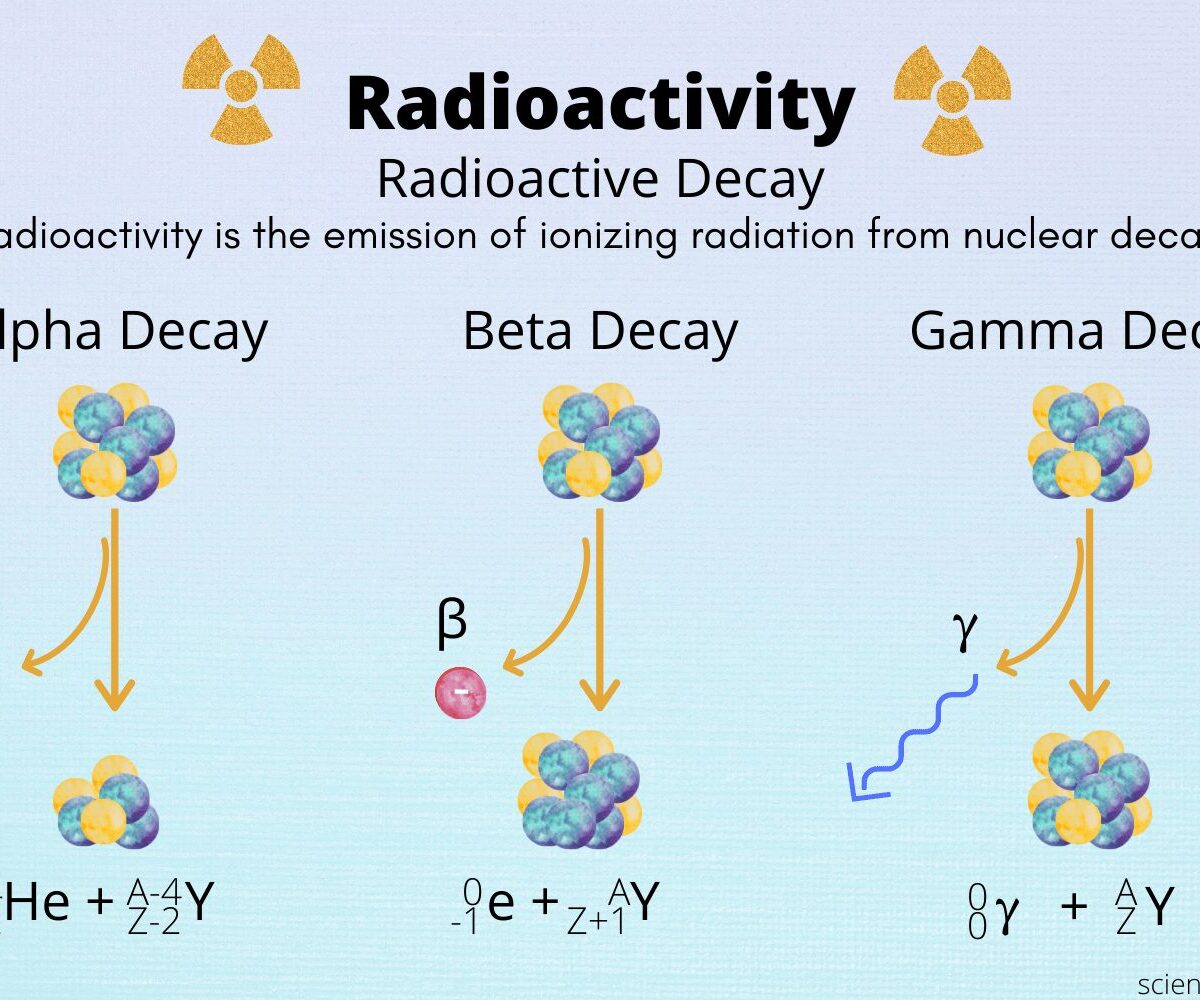
Radioactivity
A: Introduction / Causes of Radioactivity
Radioactivity is the spontaneous disintegration or decay of an unstable nuclide. This process occurs naturally without any external influence.
A nuclide is an atom with a defined mass number (the total number of protons and neutrons), atomic number (number of protons), and a definite energy state.
Unlike chemical reactions that involve electrons in the energy levels surrounding the nucleus, radioactivity takes place within the nucleus of an atom.
A nuclide is considered stable if its neutron-to-proton ratio (n/p) is equal to one (n/p = 1). Stability is achieved when the forces within the nucleus are balanced.
All nuclides tend to attain n/p = 1 by undergoing radioactive decay if they are unstable.
Examples:
- Oxygen nuclide with 168O has 8 neutrons and 8 protons, giving an n/p = 1. It is therefore stable and does not decay.
- Chlorine nuclide with 3517Cl has 18 neutrons and 17 protons, resulting in n/p = 1.0588. It is unstable and decays to try to attain n/p = 1.
- Uranium nuclide with 23792U has 206 neutrons and 92 protons, giving n/p = 2.2391. It is more unstable than 23592U and decays more readily.
- Chlorine nuclide with 3717Cl has 20 neutrons and 17 protons, n/p = 1.1765, making it more unstable than 3517Cl and more prone to decay.
- Uranium nuclide with 23592U has 143 neutrons and 92 protons, n/p = 1.5543, more stable than 23792U but still decays to attain stability.
All unstable nuclides naturally try to attain nuclear stability through the emission of:
(i) Alpha (α) particle decay
The alpha (α) particle has the following characteristics:
- It is positively charged, similar to protons.
- It has a mass number of 4 and atomic number of 2, equivalent to a helium nucleus (42He2+).
- It has very low penetrating power and can be stopped by a thin sheet of paper.
- It has high ionizing power, causing significant damage to living cells.
- When a nuclide undergoes α-decay, its mass number decreases by 4 and atomic number decreases by 2.
Examples of alpha decay:
21084Po → 20682Pb + 42He2+
22688Ra → 22286Rn + 42He2+
23892U → 23490Th + 42He2+
23892U → 23088Ra + 2 42He2+
21084U → 17064W + 10 α
21092U → 18680W + 6 α
(ii) Beta (β) particle decay
The beta (β) particle has the following characteristics:
- It is negatively charged, like electrons.
- It has no mass number and an atomic number of -1, equivalent to a fast-moving electron (0-1e).
- It has medium penetrating power and can be stopped by a thin sheet of aluminium foil.
- It has medium ionizing power, causing less damage to living cells than alpha particles.
- When a nuclide undergoes β-decay, its mass number remains the same, but its atomic number increases by 1.
Examples of beta decay:
2311Na → 2312Mg + 0-1e
23490Th → 23491Pa + 0-1e
20770Y → 20773Pb + 3 0-1e
146C → 147N + 0-1e
10n → 11H + 0-1e
42He → 41H + 2 0-1e
22888Ra → 22890Th + 4 β
23290Th → 21282Pb + 2 β + 5 α
23892U → 22688Ra + 2 β + 3 α
21884Po → 20682Pb + 4 β + 3 α
(iii) Gamma (γ) particle decay
The gamma (γ) particle has the following characteristics:
- It is neutral, having no electric charge.
- It has no mass number or atomic number and is equivalent to electromagnetic waves.
- It has very high penetrating power and can be stopped only by a thick block of lead.
- It has very low ionizing power, causing minimal damage to living cells unless exposure is prolonged.
- When a nuclide undergoes γ-decay, its mass number and atomic number remain unchanged.
Examples of gamma decay:
- 3717Cl → 3717Cl + γ
- 146C → 146C + γ
The sketch diagram below shows the penetrating power of the radiations from a radioactive nuclide.
radioactive nuclide sheet of paper aluminium foil thick block of lead
(radiation source) (blocks α-rays) (blocks β-rays) (blocks γ-rays)
α-rays β-rays γ-rays
The sketch diagram below illustrates the effect of electric and magnetic fields on the three radiations from a radioactive nuclide.

Radioactive disintegration or decay naturally produces the stable 20682Pb nuclide or isotope of lead. Below is the 23892U natural decay series. Identify the particle emitted in each case.

Write the nuclear equation for the disintegration from:
(i) 23892U to 23490Th
23892U → 23490Th + 42He2+
23892U → 23490Th + α
(ii) 23892U to 22284Rn
23892U → 22284Rn + 4 42He2+
23892U → 22284Rn + 4α
23090Th undergoes alpha decay to 22286Rn. Find the number of α particles emitted. Write the nuclear equation for the disintegration.
Working:
23090Th → 22286Rn + x 42He
Using mass numbers:
230 = 222 + 4x → 4x = 230 – 222 = 8
x = 8 / 4 = 2 α
Using atomic numbers:
90 = 86 + 2x → 2x = 90 – 86 = 4
x = 4 / 2 = 2 α
Nuclear equation:
23090Th → 22286Rn + 2 42He
21482Pb undergoes beta decay to 21484Rn. Find the number of β particles emitted. Write the nuclear equation for the disintegration.
Working:
21482Pb → 21484Rn + x 0-1e
Using atomic numbers only:
82 = 84 – x → -x = 82 – 84 = -2
x = 2 β
Nuclear equation:
21482Pb → 21484Rn + 2 0-1e
23892U undergoes beta and alpha decay to 20682Pb. Find the number of β and α particles emitted. Write the nuclear equation for the disintegration.
Working:
23892U → 20682Pb + x 0-1e + y 42He
Using mass numbers only:
238 = 206 + 4y → 4y = 238 – 206 = 32
y = 32 / 4 = 8 α
Using atomic numbers only and substituting the 8 α (above):
23892U → 20682Pb + 8 42He + x 0-1e
92 = 82 + 16 – x
→ 92 – (82 + 16) = -x
x = 6 β
Nuclear equation:
23892U → 20682Pb + 6 0-1e + 8 42He
29892U undergoes alpha and beta decay to 21483Bi. Find the number of α and β particles emitted. Write the nuclear equation for the disintegration.
Working:
29892U → 21083Bi + x 42He + y 0-1e
Using mass numbers only:
298 = 214 + 4x → 4x = 298 – 214 = 84
y = 84 / 4 = 21 α
Using atomic numbers only and substituting the 21 α (above):
29892U → 21483Bi + 21 42He + y 0-1e
92 = 83 + 42 – y
→ 92 – (83 + 42) = -y
y = 33 β
Nuclear equation:
29892U → 21483Bi + 21 42He + 33 0-1e
B: Nuclear Fission and Nuclear Fusion
Radioactive disintegration or decay can be initiated artificially in an industrial laboratory through two nuclear methods:
- Nuclear fission
- Nuclear fusion
a) Nuclear fission
Nuclear fission is the process in which a fast-moving neutron bombards a heavy unstable nuclide, causing it to split into lighter nuclides, releasing three daughter neutrons and a large quantity of energy.
This process is the fundamental principle behind nuclear bombs and nuclear reactors.
The released daughter neutrons become fast-moving neutrons themselves, bombarding other heavy unstable nuclides, releasing more daughter neutrons and energy, thus setting off a chain reaction.
Examples of nuclear equations showing nuclear fission:
10n + 23592U → 9038Sr + 14354Xe + 3 10n + a
10n + 2713Al → 2813Al + γ + a
10n + 2814Al → 1111Na + 42He
01n + 147N → 146C + 11H
10n + 11H → 21H + a
10n + 23592U → 9542Mo + 13957La + 2 10n + 7 a
b) Nuclear fusion
Nuclear fusion is the process in which smaller nuclides combine to form larger or heavier nuclides, releasing a large quantity of energy.
This process requires very high temperatures and pressure to overcome the repulsive forces between the positively charged nuclei.
Nuclear fusion is the fundamental process behind solar or sun radiation.
For example, two hydrogen nuclei fuse on the sun’s surface to form a helium nucleus, releasing energy in the form of heat and light.
Examples of fusion reactions:
21H + 21H → 32He + 10n
21H + a → 32He
21H + 21H → a + 11H
4 11H → 42He + a
147H + a → 178O + 11H
C: Half-Life Period (t1/2)
The half-life period is the time taken for a radioactive nuclide to spontaneously decay or disintegrate to half its original mass or amount.
It is usually denoted as t1/2.
The rate of radioactive decay is constant for each nuclide and is independent of external conditions.
The table below shows the half-life periods of some elements.
| Element/Nuclide | Half-life period (t1/2) |
| 23892U | 4.5 x 10⁹ years |
| 146C | 5600 years |
| 22988Ra | 1620 years |
| 3515P | 14 days |
| 21084Po | 0.0002 seconds |
The shorter the half-life, the more unstable the nuclide or element.
The half-life period is determined using a Geiger-Muller counter (GM tube), which is connected to a ratemeter that records the count rates per unit time. This count rate represents the rate of decay or disintegration of the nuclide.
If the count rate falls by half, the time taken for this fall is the half-life period.
Examples:
a) A radioactive substance gave a count of 240 counts per minute, but after 6 hours the count rate was 30 counts per minute. Calculate the half-life period.
If t1/2 = x, then:
240 → x → 120 → x → 60 → x → 30
From 240 to 30 = 3 half-lives = 6 hours
Therefore, x = t1/2 = 6 / 3 = 2 hours
b) The count rate of a nuclide fell from 200 counts per second to 12.5 counts per second in 120 minutes. Calculate the half-life period.
If t1/2 = x, then:
200 → x → 100 → x → 50 → x → 25 → x → 12.5
From 200 to 12.5 = 4 half-lives = 120 minutes
Therefore, x = t1/2 = 120 / 4 = 30 minutes
c) After 6 hours the count rate of a nuclide fell from 240 counts per second to 15 counts per second. Calculate the half-life period.
If t1/2 = x, then:
240 → x → 120 → x → 60 → x → 30 → x → 15
From 240 to 15 = 4 half-lives = 6 hours
Therefore, x = t1/2 = 6 / 4 = 1.5 hours
d) Calculate the mass of nitrogen-13 remaining from 2 grams after 6 half-lives if the half-life period is 10 minutes.
If t1/2 = x, then:
2 → x → 1 → 2x → 0.5 → 3x → 0.25 → 4x → 0.125 → 5x → 0.0625 → 6x → 0.03125
After the 6th half-life, 0.03125 g of nitrogen-13 remains.
e) What fraction of a gas remains after 1 hour if its half-life period is 20 minutes?
If t1/2 = x, then:
60 / 20 = 3 half-lives
1 → x → 1/2 → 2x → 1/4 → 3x → 1/8
After the 3rd half-life, 1/8 of the gas remains.
f) 348 grams of a nuclide A was reduced to 43.5 grams after 270 days. Determine the half-life period.
If t1/2 = x, then:
348 → x → 174 → 2x → 87 → 3x → 43.5
From 348 to 43.5 = 3 half-lives = 270 days
Therefore, x = t1/2 = 270 / 3 = 90 days
g) How old is an Egyptian Pharaoh in a tomb with 2 grams of 14C if the normal 14C in a present tomb is 16 grams? The half-life period of 14C is 5600 years.
If t1/2 = x = 5600 years, then:
16 → x → 8 → 2x → 4 → 3x → 2
3 half-lives = 3 × 5600 = 16800 years
h) 100 grams of a radioactive isotope was reduced to 12.5 grams after 81 days. Determine the half-life period.
If t1/2 = x, then:
100 → x → 50 → 2x → 25 → 3x → 12.5
From 100 to 12.5 = 3 half-lives = 81 days
Therefore, x = t1/2 = 81 / 3 = 27 days
A graph of activity against time is called a decay curve. It shows how the activity of a radioactive isotope decreases over time.
A decay curve can be used to determine the half-life period since the activity decreases by half at equal time intervals.
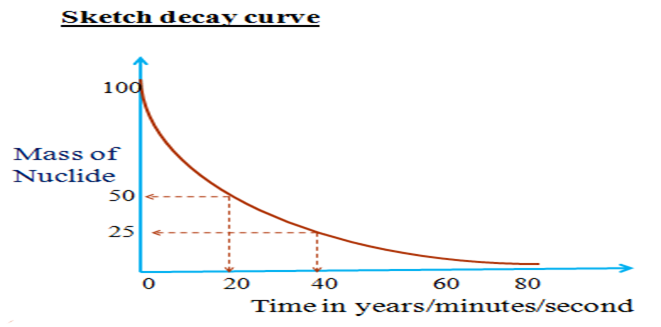
(i) From the graph, determine the half-life period of the isotope.
From the graph, t1/2 corresponds to activity changes from:
(100 – 50) → (20 – 0) = 20 minutes
(50 – 25) → (40 – 20) = 20 minutes
Thus, t1/2 = 20 minutes
(ii) Why does the graph tend to ‘0’?
Smaller particles will continue to disintegrate or decay to half their original amount, but there can never be zero particles remaining.
D: Chemical vs Nuclear Reactions
Nuclear and chemical reactions share the following similarities:
- Both involve the subatomic particles: electrons, protons, and neutrons in an atom.
- Both involve these particles trying to make the atom more stable.
- Both involve some form of energy transfer, release, or absorption from or to the environment.
However, nuclear and chemical reactions have the following differences:
- Nuclear reactions mainly involve protons and neutrons in the nucleus, while chemical reactions mainly involve outer electrons in the energy levels.
- Nuclear reactions form a new element, whereas chemical reactions do not form new elements.
- Nuclear reactions involve the evolution or production of large quantities of heat or energy, while chemical reactions produce or absorb smaller quantities.
- Nuclear reactions are accompanied by a loss in mass (mass defect) and do not obey the law of conservation of matter. Chemical reactions do not involve mass loss and obey this law.
- The rate of nuclear decay is independent of physical conditions such as temperature, pressure, purity, and particle size. The rate of chemical reactions is dependent on these conditions.
E: Application and Uses of Radioactivity
Radioisotopes are applied in various fields, including:
- Medicine: Treatment of cancer by radiotherapy to kill malignant tumors. Sterilization of surgical instruments using gamma radiation.
- Agriculture: Tracing metabolic processes in plants and animals by feeding them radioisotopes.
- Food preservation: Using X-rays to kill bacteria in tinned food, extending shelf life.
- Chemistry: Studying reaction mechanisms by replacing atoms with radioisotopes. For example, discovering the source of oxygen in photosynthesis.
- Dating rocks/fossils: The amount of 14C in living organisms is constant. After death, 14C decays, allowing age determination based on remaining amounts.
F: Dangers of Radioactivity
All rays emitted by radioactive isotopes have an ionizing effect that can alter the genetic makeup of living cells.
Exposure to these radiations can cause chromosomal and genetic mutations.
Living organisms should not be exposed to radioactive substances for prolonged periods.
Radioactive isotopes are also used to generate large, inexpensive electricity in nuclear reactors.
Workers in nuclear reactors must wear protective gear made of thick glass or lead sheets to shield against radiation.
Accidental radiation leaks can occur, causing environmental disasters, such as the 1986 Chernobyl explosion and the 2011 nuclear leak in Japan.
The immediate and long-term effects of exposure to radioactive waste on humans are a major concern for environmentalists.
G: Sample Revision Questions
The figure below shows the behavior of emissions by a radioactive isotope X. Use it to answer the following questions:
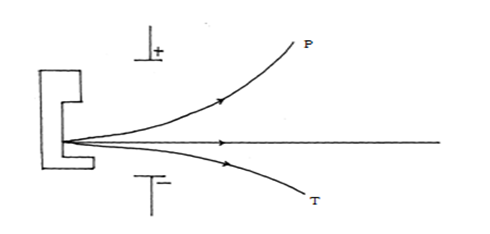
(a) Explain why isotope X emits radiations. (1 mark)
– It is unstable or has an n/p ratio greater or less than one.
(b) Name the radiation labeled T. (1 mark)
Alpha particle
(c) Arrange the radiations labeled P and T in increasing order of ability to be deflected by an electric field. (1 mark)
T → P
(d) Calculate the mass and atomic numbers of element B formed after 21280X has emitted three beta particles, one gamma ray, and two alpha particles.
Mass number:
212 – (0 beta + 0 gamma + (2 × 4) alpha) = 204
Atomic number:
80 – (-1 × 3) beta + 0 gamma + (2 × 2) alpha = 79
(e) Write a balanced nuclear equation for the decay of 21280X to B using the information in (d) above.
21280X → 20479B + 2 42He + 3 0-1e + γ
Identify the type of radiation emitted from the following nuclear equations:
(i) 146C → 147N + ………
β – Beta
- 11H + 10n → 21H + ……
γ – Gamma
(iii) 23592U → 9542Mo + 13957La + 10n + ……
7 β – seven beta particles
- 23892U → 23490Th + … …
α – alpha
- 146C + 11H → 157N + ……
γ – gamma
X grams of a radioactive isotope takes 100 days to disintegrate to 20 grams. If the half-life period of the isotope is 25 days, calculate the initial mass X of the radioisotope.
Number of half-lives = 100 / 25 = 4
20g → 40g → 80g → 160g → 320g
Original mass X = 320g
Radium has a half-life of 1620 years.
(i) What is half-life?
The half-life period is the time taken for a radioactive nuclide to spontaneously decay or disintegrate to half its original mass or amount.
(ii) If one milligram of radium contains 2.68 x 10¹⁸ atoms, how many atoms disintegrate during 3240 years?
Number of half-lives = 3240 / 1620 = 2
1 mg → 0.5 mg → 0.25 mg
If 1 mg → 2.68 x 10¹⁸ atoms
Then 0.25 mg → 0.25 × 2.68 x 1018 = 6.7 x 10¹⁷
Number of atoms remaining = 6.7 x 10¹⁷
Number of atoms disintegrated = (2.68 x 10¹⁸ – 6.7 x 10¹⁷) = 2.01 x 10¹⁸
The graph below shows the mass of a radioactive isotope plotted against time.

Using the graph, determine the half-life of the isotope.
From the graph, 10 g to 5 g takes 8 days.
From the graph, 5 g to 2.5 g takes 16 – 8 = 8 days.
Calculate the mass of the isotope decayed after 32 days.
Number of half-lives = 32 / 8 = 4
Original mass = 10 g
10 g → 5 g → 2.5 g → 1.25 g → 0.625 g
Mass remaining = 0.625 g
Mass decayed after 32 days = 10 g – 0.625 g = 9.375 g
A radioactive isotope X2 decays by emitting two alpha (α) particles and one beta (β) particle to form 21483Bi.
(a) Write the nuclear equation for the radioactive decay.
21286X → 21483Bi + 2 42He + 0-1e
(b) What is the atomic number of X2?
86
(c) After 112 days, 1/16 of the mass of X2 remained. Determine the half-life of X2.
1 → x → 1/2 → x → 1/4 → x → 1/8 → x → 1/16
Number of half-lives in 112 days = 4
t1/2 = 112 / 4 = 28 days
1. Study the nuclear reaction given below and answer the questions that follow.
126C –step 1–> 127N –step 2–> 1211Na
(a) 126C and 146C are isotopes. What does the term isotope mean?
Atoms of the same element with different mass numbers or numbers of neutrons.
(b) Write an equation for the nuclear reaction in step II.
127N → 1211Na + 0-1e
(c) Give one use of 146C.
Dating rocks/fossils; studying metabolic pathways or mechanisms in plants and animals.
Study the graph of a radioactive decay series for isotope H below.

- Name the type of radiation emitted when isotope:
(i) H changes to isotope J.
Alpha – Mass number decreases by 4 from 214 to 210 (y-axis), atomic number decreases by 2 from 83 to 81 (x-axis).
(ii) J changes to isotope K.
Beta – Mass number remains 210 (y-axis), atomic number increases by 1 from 81 to 82 (x-axis).
(b) Write an equation for the nuclear reaction that occurs when isotope:
(i) J changes to isotope L.
21081J → 21084L + 3 0-1e
(ii) H changes to isotope M.
21483H → 20682M + 3 0-1e + 2 42He
Identify a pair of isotopes of an element in the decay series.
K and M have the same atomic number 82 but different mass numbers: K-210 and M-206.
(a) A radioactive substance emits three different particles. Identify the particle:
(i) with the highest mass.
Alpha (α)
(ii) almost equal to an electron.
Beta (β)
1.a) State two differences between chemical and nuclear reactions (2 marks)
(i) Nuclear reactions mainly involve protons and neutrons in the nucleus of an atom. Chemical reactions mainly involve outer electrons in the energy levels of an atom.
(ii) Nuclear reactions form a new element. Chemical reactions do not form new elements.
(iii) Nuclear reactions mainly involve evolution or production of large quantities of heat or energy. Chemical reactions produce or absorb smaller quantities of heat or energy.
(iv) Nuclear reactions are accompanied by a loss in mass or mass defect. Chemical reactions are not accompanied by a loss in mass.
(v) The rate of decay or disintegration of a nuclide is independent of physical conditions. The rate of a chemical reaction is dependent on physical conditions such as temperature, pressure, purity, particle size, and surface area.
(b) Below is a radioactive decay series starting from 21483Bi and ending at 20682Pb. Study it and answer the question that follows.

Identify the particles emitted in steps I and III (2 marks)
I – α-particle
III – β-ray
ii) Write the nuclear equation for the reaction which takes place in step I.
21483Bi → 21081Pb + 42He
(b) step 1 to 3
21483Bi → 21081Pb + 42He + 2 0-1e
(c) step 3 to 5
21082Pb → 20682Pb + 42He + 2 0-1e
(c) step 1 to 5
21483Bi → 20682Pb + 2 42He + 3 0-1e
The table below gives the percentages of a radioactive isotope of Bismuth that remains after decaying at different times.
| Time (min) | 0 | 6 | 12 | 22 | 38 | 62 | 100 |
| Percentage of Bismuth | 100 | 81 | 65 | 46 | 29 | 12 | 3 |
i) On the grid below, plot a graph of the percentage of Bismuth remaining (vertical axis) against time.
ii) Using the graph, determine the:
- Half-life of the Bismuth isotope
- Original mass of the Bismuth isotope given that the mass that remained after 70 minutes was 0.16 g (2 marks)
(d) Give one use of radioactive isotopes in medicine (1 mark)
14.a) Distinguish between nuclear fission and nuclear fusion. (2 marks)
Describe how solid wastes containing radioactive substances should be disposed of. (1 mark)
b)(i) Find the values of Z1 and Z2 in the nuclear equation below:
Z1 1 94 140 1
U + n → Sr + Xe + 2 n
92 0 38 Z2 0
iii) What type of nuclear reaction is represented in b (i) above?
A radioactive cobalt 6128Co undergoes decay by emitting a beta particle and forming a Nickel atom.
Write a balanced decay equation for the above change. (1 mark)
If a sample of the cobalt has an activity of 1000 counts per minute, determine the time it would take for its activity to decrease to 62.5 if the half-life of the element is 30 years. (2 marks)
Define the term half-life.
The diagram below shows the rays emitted by a radioactive sample.
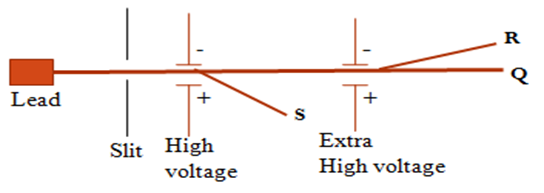
- Identify the rays S, R, and Q.
S – Beta (β) particle or ray
R – Alpha (α) particle or ray
Q – Gamma (γ) particle or ray
(b) State what would happen if an aluminium plate is placed in the path of rays R, S, and Q:
R – is blocked or stopped; does not pass through.
Q – is not blocked; passes through.
S – is blocked or stopped; does not pass through.
(c) The diagram below is the radioactive decay series of nuclide A which is 24194Pu. Use it to answer the questions that follow. The letters are not the actual symbols of the elements.

(a) Which letter represents the:
(i) Shortest lived nuclide
L – has the shortest half-life.
(ii) Longest lived nuclide
P – is stable.
(iii) Nuclide with highest n/p ratio
L – has the shortest half-life, thus most unstable and quickly decays.
(iv) Nuclide with lowest n/p ratio
P – is stable and does not decay.
(b) How long would it take for the following:
(i) Nuclide A to change to B
10 years (half-life of A)
(ii) Nuclide D to change to H
27 days + 162000 years + 70000 years + 16 days = 232000 years and 43 days
(iii) Nuclide A to change to P
232000 years and 43 days


