


CHEMISTRY OF METALS
a) Introduction to metals
The rationale of studying metals cannot be overemphasized. Since ages, metals like gold and silver have been used worldwide for commercial purposes.
The periodicity of alkali and alkaline earth metals was discussed in Year 2 of secondary school education. This topic generally deals with:
- a) Natural occurrence of the chief ores of the most useful metals for industrial/commercial purposes.
- b) Extraction of these metals from their ores for industrial/commercial purposes.
- c) Industrial/commercial uses of these metals.
- d) Main physical and chemical properties/characteristics of the metals.
The metals given detailed emphasis here are: Sodium, Aluminium, Iron, Zinc, Lead and Copper.
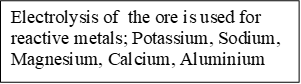
 The main criteria used in extraction of metals is based on their position in the electrochemical/reactivity series and their occurrence in the earth’s crust.


1. SODIUM
1. Natural occurrence
Sodium naturally occurs as:
- (i) Brine – a concentrated solution of sodium chloride (NaCl(aq)) in salty seas and oceans.
- (ii) Rock salt – solid sodium chloride (NaCl(s)).
- (iii) Trona – sodium sesquicarbonate (NaHCO3.Na2CO3.2H2O), especially in Lake Magadi in Kenya.
- (iv) Chile saltpeter – sodium nitrate (NaNO3).
2. Extraction of Sodium from brine / Manufacture of Sodium hydroxide / The flowing mercury cathode cell / The Caster-Keller process
I. Raw materials
- Brine – concentrated solution of sodium chloride (NaCl(aq)) from salty seas and oceans.
- Mercury
- Water from rivers/lakes
II. Chemical processes
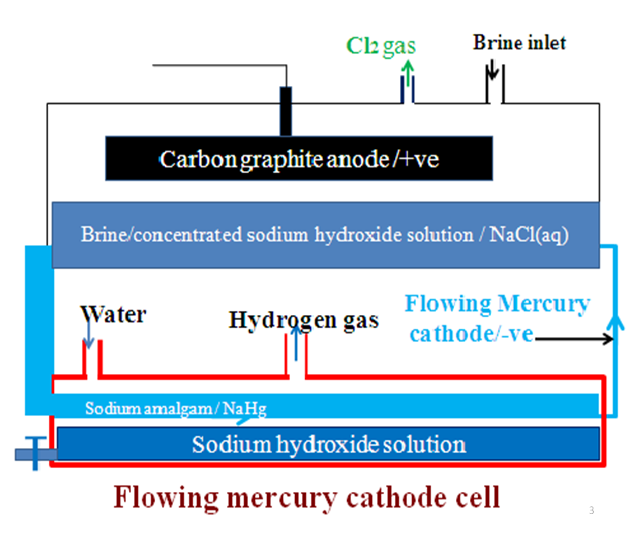
Salty lakes, seas, and oceans contain large amounts of dissolved sodium chloride (NaCl(aq)) solution. This solution is concentrated to form brine, which is fed into an electrolytic chamber made of suspended carbon graphite/titanium as the anode and a continuous flow of mercury as the cathode.
Note: Mercury is the only naturally occurring known liquid metal at room temperature and pressure.
Questions
I. Write the equation for the decomposition of the electrolyte during the electrolytic process.
H2O(l) ⇌ H+(aq) + OH–(aq)
NaCl(aq) ⇌ Na+(aq) + Cl–(aq)
II. Name the ions present in brine that move to the:
- (i) Mercury cathode: H+(aq), Na+(aq)
- (ii) Titanium/graphite anode: OH–(aq), Cl–(aq)
III. Write the equation for the reactions that take place during the electrolytic process at the:
- Cathode: 2Na+(aq) + 2e– → 2Na(s)
- Anode: 2Cl–(aq) → Cl2(g) + 2e–
Note:
- (i) Concentration of 2Cl–(aq) ions is higher than OH– ions causing overvoltage, thus blocking OH– ions from being discharged at the anode.
- (ii) Concentration of Na+(aq) ions is higher than H+ ions causing overvoltage, thus blocking H+ ions from being discharged at the cathode.
IV. Name the products of electrolysis in the flowing mercury-cathode cell.
- (i) Mercury cathode: Sodium metal as grey soft metal/solid
- (ii) Titanium/graphite anode: Chlorine gas as a pale green gas that turns moist blue/red litmus papers red then bleaches both. Chlorine gas is a very useful by-product in:
- making (PVC) polyvinyl chloride (polychloroethene) pipes.
- chlorination/sterilization of water to kill germs.
- bleaching agent.
- manufacture of hydrochloric acid.
Sodium produced at the cathode immediately reacts with the mercury at the cathode forming sodium amalgam (NaHg) liquid that flows out of the chamber.
Na(s) + Hg(l) → NaHg(l)
Sodium amalgam is added to distilled water and reacts to form sodium hydroxide solution, free mercury, and hydrogen gas.
2NaHg(l) + 2H2O(l) → 2NaOH(aq) + 2Hg(l) + H2(g)
Hydrogen gas is a very useful by-product in:
- making ammonia gas in the Haber process.
- manufacture of hydrochloric acid.
- weather balloons to forecast weather.
- rocket fuel.
As the electrolysis of brine continues, the concentration of Cl– ions decreases and oxygen gas starts being liberated. Continuous feeding of the electrolyte is therefore very necessary.
III. Uses of sodium hydroxide
The sodium hydroxide produced is very pure and is used mainly in:
- Making soapy and soapless detergents.
- Making cellulose acetate/rayon.
IV. Diagram showing the Manufacture of Sodium hydroxide from the flowing Mercury-cathode cell
V. Environmental effects of Manufacture of Sodium hydroxide from the flowing Mercury-cathode cell
- Most of the mercury used at the cathode is recycled:
- to reduce the cost because mercury is expensive.
- to reduce pollution because mercury kills marine life.
- because it causes chromosomal/genetic mutation to human beings.
- has a pungent irritating smell that causes headache to human beings.
- bleaches any wet substance.
- dissolves in water to form both hydrochloric acid and chloric(I) acid.
- Both cause marine pollution and stomach upsets.
b) Extraction of sodium from rock salt / The Downs cell / process
I. Raw materials
- Rock salt / solid sodium chloride
- Calcium(II) chloride
II. Chemical processes
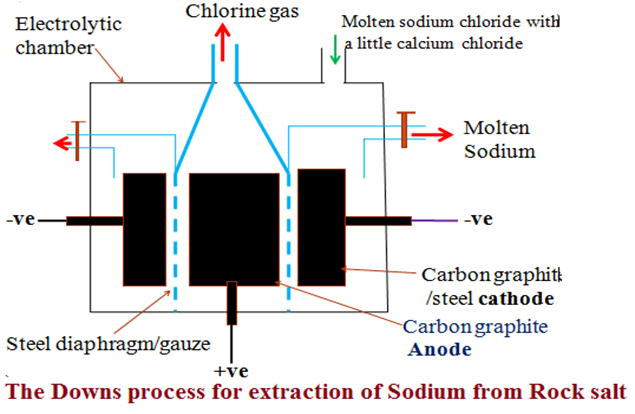
Rock salt / solid sodium chloride is heated to molten state in a chamber lined with fire bricks on the outside. Sodium chloride has a melting point of about 800°C. A little calcium(II) chloride is added to lower the melting point of the electrolyte to about 600°C.
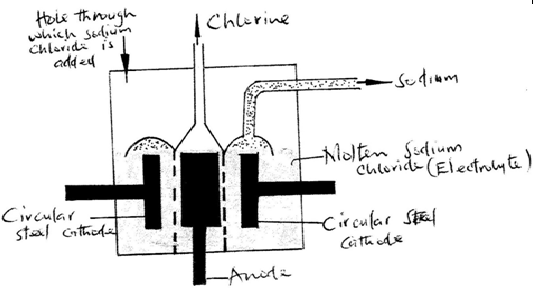
The molten electrolyte is then electrolyzed in a carbon graphite anode suspended at the centre and surrounded by steel cathode.
Questions
I. Write the equation for the decomposition of the electrolyte during the electrolytic process.
NaCl(l) ⇌ Na+(l) + Cl–(l)
Note: In absence of water, the ions are in liquid state.
II. Name the ions present in molten rock salt that move to the:
- (i) Steel cathode: Na+(l)
- (ii) Carbon graphite anode: Cl–(l)
III. Write the equation for the reactions that take place during the electrolytic process at the:
- (i) Steel cathode: 2Na+(l) + 2e– → 2Na(l)
- (ii) Carbon graphite anode: 2Cl–(l) → Cl2(g) + 2e–
IV. Name the products of electrolysis in the Downs cell at:
- (i) Cathode: Grey solid sodium metal is less dense than the molten electrolyte and therefore floats on top of the cathode to be periodically tapped off.
- (ii) Anode: Pale green chlorine gas that turns moist/damp/wet blue/red litmus papers red then bleaches/decolorizes both. Chlorine gas is again a very useful by-product in:
- making (PVC) polyvinyl chloride (polychloroethene) pipes.
- chlorination/sterilization of water to kill germs.
- bleaching agent.
- manufacture of hydrochloric acid.
A steel diaphragm/gauze is suspended between the electrodes to prevent recombination of sodium at the cathode and chlorine gas at the anode back to sodium chloride.
III. Diagram showing the Downs cell / process for extraction of sodium
IV. Uses of sodium
- Sodium vapour is used as sodium lamps to give a yellow light in street lighting.
- Sodium is used in making very useful sodium compounds like:
- Sodium hydroxide (NaOH)
- Sodium cyanide (NaCN)
- Sodium peroxide (Na2O2)
- Sodamide (NaNH2)
V. Environmental effects of Downs cell
- Chlorine produced at the anode:
- has a pungent irritating smell that causes headache to human beings.
- bleaches any wet substance.
- dissolves in water to form both hydrochloric acid and chloric(I) acid.
- Both cause marine pollution and stomach upsets.
VI. Test for presence of Na
If a compound has Na+ ions in solid/molten/aqueous state, then it changes a non-luminous clear/colourless flame to a yellow coloration but does not burn.
Experiment
Scoop a portion of sodium chloride crystals/solution in a clean metallic spatula. Introduce it to a clear/colourless Bunsen flame.
| Observation | Inference |
| Yellow coloration | Na+ |
Practice
(i) Calculate the time taken in hours for 230 kg of sodium to be produced in the Downs cell when a current of 120 kA is used.
(ii) Determine the volume of chlorine released to the atmosphere. (Na=23.0), Faraday constant=96500 C. 1 mole of a gas = 24 dm3 at r.t.p.
Working:
Equation at the cathode:
2Na+(l) + 2e– → 2Na(l)
2 moles of electrons = 2 Faradays = 2 × 96500 C deposits a mass = molar mass of Na = 23.0 g thus;
23.0 g → 2 × 96500 C
(230 × 1000) g → (230 × 1000 × 2 × 96500) / 23
= 1,930,000,000 / 1.93 × 10⁹ C
Time (t) in seconds = Quantity of electricity / Current (I) in amperes
Substituting:
= 1,930,000,000 / (120 × 1000) A
= 16,083,333 seconds / 268,055.6 minutes
= 4.4676 hours
Volume of Chlorine
Method 1
Equation at the anode:
2Cl–(l) → Cl2(g) + 2e–
From the equation:
2 moles of electrons = 2 Faradays = 2 × 96500 C
2 × 96500 C → 24 dm3
1,930,000,000 / 1.93 × 10⁹ C → (1,930,000,000 / 1.93 × 10⁹ C) × 24 / (2 × 96500 C)
Volume of Chlorine = 240,000 dm3 / 2.4 × 10⁵ dm3
Method 2
Equation at the anode:
Cl–(l) → Cl2(g) + 2e–
Mole ratio of products at Cathode: Anode = 1:1
Moles of sodium at cathode = (230 × 1000) g / 23 = 10,000 moles
10,000 moles of Na = 10,000 moles of Chlorine
1 mole of Chlorine gas = 24,000 cm3
10,000 moles of Chlorine → 10,000 × 24 = 240,000 dm3 / 2.4 × 10⁵ dm3
Method 3
Equation at the anode:
Cl–(l) → Cl2(g) + 2e–
Ratio of Faradays of products at Cathode: Anode = 2:2
2 × 96500 C produce 24000 cm3 of chlorine gas. Then:
1,930,000,000 / 1.93 × 10⁹ C → (1,930,000,000 / 1.93 × 10⁹ C) × 24 / (2 × 96500)
= 240,000 dm3
(iii) The sodium metal produced was reacted with water to form 25,000 dm3 solution in a Caster-Keller tank.
(a) Calculate the concentration of the resulting solution in moles per litre.
(b) The volume of gaseous products formed at s.t.p (1 mole of gas = 22.4 dm3 at s.t.p)
Chemical equation at Caster-Keller tank:
2Na(s) + 2H2O(l) → 2NaOH(aq) + H2(g)
Mole ratio Na : NaOH = 2 : 2 → 1:1
Moles Na = 10,000 moles = 10,000 moles of NaOH
25,000 dm3 → 10,000 moles of NaOH
1 dm3 → 10,000 × 1 = 0.4 M / 0.4 moles/dm3
Mole ratio Na : H2 = 2 : 1
Moles Na = 10,000 moles = 5,000 moles of H2
Volume of H2(g) = moles × molar gas volume at s.t.p
= 5,000 moles × 22.4 dm3
= 120,000 dm3
(iv) The solution formed was further diluted with water for a titration experiment. 25.0 cm3 of the diluted solution required 20.0 cm3 of 0.2 M sulphuric(VI) acid for complete neutralization. Calculate the volume of water added to the diluted solution before titration.
Chemical equation:
2NaOH(aq) + H2SO4(aq) → Na2SO4(aq) + 2H2O(l)
Mole ratio NaOH : H2SO4 = 2 : 1
Moles H2SO4 = molarity × volume = 0.2 M × 20 / 1000
= 4.0 × 10⁻³ moles
Moles NaOH = 2 × 4.0 × 10-3 moles = 8.0 × 10⁻³ moles
Molarity of NaOH = Moles × 1000 / volume = 8.0 × 10⁻³ moles × 1000 / 25
= 0.16 moles/dm3 / M
Volume used during dilution:
C1V1 = C2V2 → 0.4 M × V1 = 0.16 M × 25
V1 = (0.16 × 25) / 0.4 = 10 cm3
(a) Below is a simplified diagram of the Downs Cell used for the manufacture of sodium. Study it and answer the questions that follow.
(i) What material is the anode made of? Give a reason (2 marks)
Carbon graphite/Titanium
This is because they are cheap and inert/do not influence/affect the products of electrolysis.
(ii) What precaution is taken to prevent chlorine and sodium from recombination? (1 mark)
Using a steel gauze/diaphragm separating the cathode from anode.
(iii) Write an ionic equation for the reaction in which chlorine gas is formed (1 mark)
2Cl–(l) → Cl2(g) + 2e–
(b) In the Downs process (used for manufacture of sodium), a certain salt is added to lower the melting point of sodium chloride from about 800°C to about 600°C.
(i) Name the salt that is added (1 mark)
Calcium chloride
(ii) State why it is necessary to lower the temperature (1 mark)
To reduce the cost of production.
(c) Explain why aqueous sodium chloride is not suitable as an electrolyte for the manufacture of sodium in the Downs process (2 marks)
The sodium produced reacts explosively/vigorously with water in the aqueous sodium chloride.
(d) Sodium metal reacts with air to form two oxides. Give the formulae of two oxides (1 mark)
Na2O Sodium oxide (in limited air)
Na2O2 Sodium peroxide (in excess air)
2. ALUMINIUM
a) Natural occurrence
Aluminium is the most common naturally occurring metal. It makes up 7% of the earth’s crust as:
- (i) Bauxite ore – Hydrated aluminium oxide (Al2O3.2H2O)
- (ii) Mica ore – Potassium aluminium silicate (K2Al2Si6O16)
- (iii) China clay ore – Aluminium silicate (Al2Si6O16)
- (iv) Corundum – Anhydrous aluminium oxide (Al2O3)
b) Extraction of aluminium from Bauxite / Halls cell / process
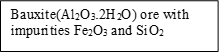
The main ore from which aluminium is extracted is Bauxite ore – hydrated aluminium oxide (Al2O3.2H2O).
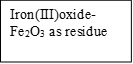
The ore is mined by open-cast mining method/quarrying where it is scooped together with silica/sand/silicon(IV) oxide (SiO2) and soil/iron(III) oxide (Fe2O3) as impurities.
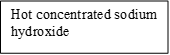
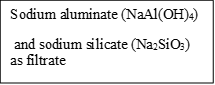
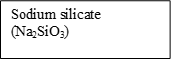
The mixture is first dissolved in hot concentrated sodium/potassium hydroxide solution.
The alkalis dissolve both bauxite and silicon(IV) oxide.
This is because bauxite is amphoteric while silicon(IV) oxide is acidic.
Iron(III) oxide (Fe2O3) is filtered off/removed as a residue.
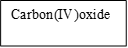
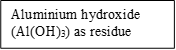
Carbon(IV) oxide is bubbled into the filtrate to precipitate aluminium(III) hydroxide (Al(OH)3) as residue.
The aluminium(III) hydroxide (Al(OH)3) residue is filtered off. Silicon(IV) oxide remains in the solution as filtrate. Aluminium(III) hydroxide (Al(OH)3) residue is then heated to form pure aluminium(III) oxide (Al2O3).
2Al(OH)3(s) → Al2O3(s) + 3H2O(l)
Pure aluminium(III) oxide (Al2O3) has a very high melting point of 2015°C.
A lot of energy is required to melt the oxide.
It is therefore dissolved first in molten cryolite / sodium hexafluoroaluminate (III) / Na3AlF6 to lower the melting point to about 800°C.
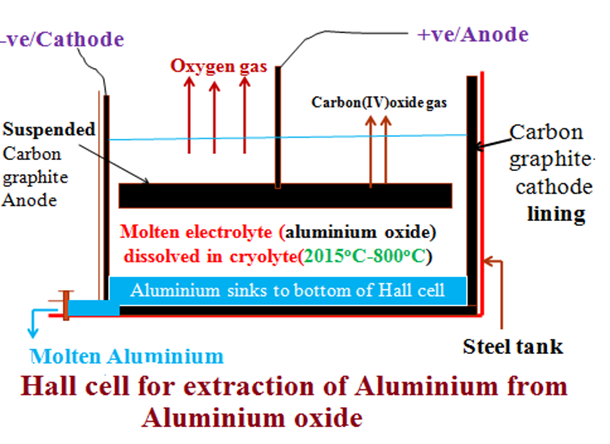
The molten electrolyte is put in the Hall cell made up of a steel tank lined with carbon graphite and an anode suspended into the electrolyte.
During the electrolysis:
- (i) At the cathode:
- (ii) At the anode:
4Al3+(l) + 12e– → 4Al(l)
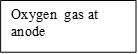
6O2-(l) → 3O2(g) + 12e–
Aluminium is denser than the electrolyte; therefore, it sinks to the bottom of the Hall cell.
At this temperature, the oxygen evolved/produced at the anode reacts with the carbon anode to form carbon(IV) oxide gas that escapes to the atmosphere.
C(s) + O2(g) → CO2(g)
The anode thus should be continuously replaced from time to time.
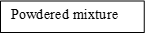
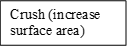
Flow chart summary of extraction of aluminium from Bauxite




c) Diagram showing the Hall cell / process for extraction of Bauxite
d) Uses of aluminium
- In making aeroplane parts, buses, tankers, furniture because aluminium is very light.
- Making duralumin – an alloy which is harder and has a higher tensile strength.
- Making utensils, saucepans, spoons because it is light and a good conductor of electricity.
- Making overhead electric cables because it is light, ductile, and a good conductor of electricity.
- Used in the thermite process for production of manganese, chromium, and titanium.
e) Environmental effects of extracting aluminium from Bauxite
- Carbon(IV) oxide gas that escapes to the atmosphere is a greenhouse gas that causes global warming.
- Bauxite is extracted by open-cast mining that causes soil/environmental degradation.
f) Test for presence of Al3+
If an ore is suspected to contain Al3+, it is:
- added hot concentrated sulphuric(VI)/nitric(V) acid to free the ions present.
- the free ions are then added a precipitating reagent like 2M sodium hydroxide / 2M aqueous ammonia.
| Observation | Inference |
| White precipitate in excess 2M NaOH(aq) | Pb2+, Al3+, Zn2+ |
| White precipitate in excess 2M NH3(aq) | Pb2+, Al3+ |
| No black precipitate on adding Na2S(aq) | Al3+ |
| No white precipitate on adding either NaCl(aq), HCl(aq), H2SO4(aq), Na2SO4(aq) | Al3+ |
Practice
1. An unknown rock X was discovered in Ukraine. Test with dilute sulphuric (VI) acid shows rapid effervescence with production of a colourless gas A that forms a white precipitate with lime water and colourless solution B. On adding 3 cm3 of 2M sodium hydroxide, a white precipitate C is formed that dissolves to form a colourless solution D on adding more sodium hydroxide. On adding 2M aqueous ammonia, a white precipitate E is formed which persists in excess aqueous ammonia. On adding 5 cm3 of 1M Lead(II) nitrate(V) to F, a white precipitate G is formed which remains on heating.
Identify:
- A: Hydrogen / H2
- B: Aluminium sulphate(VI) / Al2(SO4)3
- C: Aluminium hydroxide / Al(OH)3
- D: Tetrahydroxoaluminate(III) / [Al(OH)4]–
- E: Aluminium hydroxide / Al(OH)3
- F: Aluminium chloride / AlCl3
2. Aluminium is obtained from the ore with the formula Al2O3. 2H2O. The ore is first heated and refined to obtain pure aluminium oxide (Al2O3). The oxide is then electrolysed to get aluminium and oxygen gas using carbon anodes and carbon as cathode. Give the common name of the ore from where aluminium is extracted (½ mark).
What would be the importance of heating the ore first before refining it? (1 mark)
To remove the water of crystallization.
The refined ore has to be dissolved in cryolite first before electrolysis. Why is this necessary? (1½ marks)
To lower the melting point of aluminium oxide from about 2015°C to 900°C so as to lower/reduce cost of production.
Why are the carbon anodes replaced every now and then in the cell for electrolysing aluminium oxide? (1 mark)
Oxygen produced at anode reacts with carbon to form carbon(IV) oxide gas that escapes.
State two uses of aluminium:
- In making aeroplane parts, buses, tankers, utensils, saucepans, spoons.
- Making overhead electric cables.
- Making duralumin.
3. IRON
a) Natural occurrence
Iron is the second most common naturally occurring metal. It makes up 4% of the earth’s crust as:
- (i) Haematite (Fe2O3)
- (ii) Magnetite (Fe3O4)
- (iii) Siderite (FeCO3)
b) The blast furnace for extraction of iron from Haematite and Magnetite
a) Raw materials:
- (i) Haematite (Fe2O3)
- (ii) Magnetite (Fe3O4)
- (iii) Siderite (FeCO3)
- (iv) Coke/charcoal/carbon
- (v) Limestone
b) Chemical processes:
Iron is usually extracted from Haematite (Fe2O3), Magnetite (Fe3O4), and Siderite (FeCO3). These ores contain silicon(IV) oxide (SiO2) and aluminium(III) oxide (Al2O3) as impurities.
When extracted from siderite, the ore must first be roasted in air to decompose the iron(II) carbonate to iron(II) oxide with production of carbon(IV) oxide gas:
FeCO3(s) → FeO(s) + CO2(g)
Iron(II) oxide is then rapidly oxidized by air to iron(III) oxide (Haematite):
4FeO(s) + O2(g) → 2Fe2O3(s)
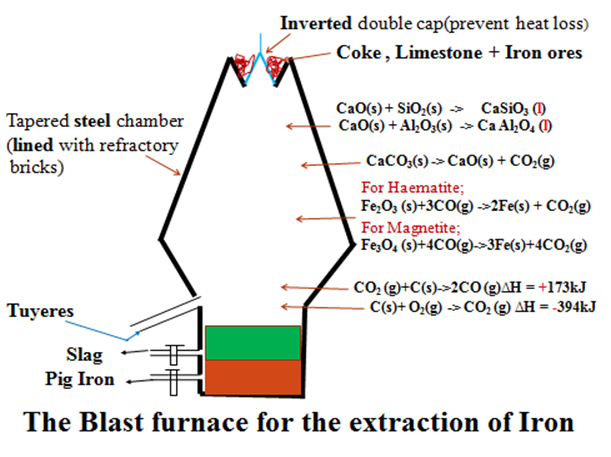
Haematite (Fe2O3), Magnetite (Fe3O4), coke, and limestone are all then fed from the top into a tall (about 30 metres in height) tapered steel chamber lined with refractory bricks called a blast furnace.
The furnace is covered with an inverted double cap to prevent/reduce the amount of any gases escaping.
Near the base/bottom, a blast of hot air at about 1000 K (827°C) is driven/forced into the furnace through small holes called Tuyeres.
As the air enters, it reacts with coke/charcoal/carbon to form carbon(IV) oxide gas. This reaction is highly exothermic:
C(s) + O2(g) → CO2(g) ∆H = -394 kJ
This raises the temperature at the bottom of the furnace to about 2000 K (1650°C). As carbon(IV) oxide gas rises up the furnace, it reacts with more coke to form carbon(II) oxide gas. This reaction is endothermic:
CO2(g) + C(s) → 2CO(g) ∆H = +173 kJ
Carbon(II) oxide gas is a strong reducing agent that reduces the ores at the upper parts of the furnace where temperatures are about 750 K (500°C), i.e.
For Haematite:
Fe2O3(s) + 3CO(g) → 2Fe(s) + 3CO2(g)
For Magnetite:
Fe3O4(s) + 4CO(g) → 3Fe(s) + 4CO2(g)
Iron is denser than iron ore. As it falls to the hotter base of the furnace, it melts and can easily be tapped off.
Limestone fed into the furnace decomposes to quicklime/calcium oxide and produces more carbon(IV) oxide gas:
CaCO3(s) → CaO(s) + CO2(g)
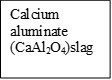
Quicklime/calcium oxide reacts with the impurities silicon(IV) oxide (SiO2) and aluminium(III) oxide (Al2O3) in the ore to form calcium silicate and calcium aluminate.
CaO(s) + SiO2(s) → CaSiO3(l)
CaO(s) + Al2O3(s) → CaAl2O4(l)
Calcium silicate and calcium aluminate mixture is called slag. Slag is denser than iron ore but less dense than iron; therefore, it floats on the pure iron. It is tapped at different levels to be tapped off for use in:
- tarmacing roads
- cement manufacture
- as building construction material
c) Uses of Iron
Iron obtained from the blast furnace is hard and brittle. It is called Pig iron. It is remelted, added scrap steel then cooled. This iron is called cast iron.
Iron is mainly used to make:
- gates, pipes, engine blocks, rails, charcoal iron boxes, lamp posts because it is cheap.
- nails, cutlery, scissors, sinks, vats, spanners, steel rods, and railway points from steel.
Steel is an alloy of iron with carbon, and/or vanadium, manganese, tungsten, nickel, chromium. It does not rust/corrode like iron.
e) Environmental effects of extracting Iron from Blast furnace
- Carbon(IV) oxide (CO2) gas is a greenhouse gas that causes/increases global warming if allowed to escape/leak from the furnace.
- Carbon(II) oxide (CO) gas is a highly poisonous/toxic odourless gas that can kill on leakage.
- It is preferentially absorbed by the haemoglobin in mammals instead of oxygen to form a stable compound that reduces free hemoglobin in the blood.
- Haematite (Fe2O3), Magnetite (Fe3O4), and Siderite (FeCO3) are extracted through quarrying/open cast mining that causes soil/environmental degradation.
f) Test for the presence of Iron
Iron naturally exists in its compound as Fe2+ / Fe3+.
If an ore is suspected to contain Fe2+ / Fe3+, it is:
- added hot concentrated sulphuric(VI)/nitric(V) acid to free the ions present.
- the free ions are then added a precipitating reagent like 2M sodium hydroxide / 2M aqueous ammonia which forms:
- an insoluble green precipitate in excess of 2M sodium hydroxide / 2M aqueous ammonia if Fe2+ ions are present.
- an insoluble brown precipitate in excess of 2M sodium hydroxide / 2M aqueous ammonia if Fe3+ ions are present.
| Observation | Inference |
| Green precipitate in excess 2M NaOH(aq) | Fe2+ |
| Green precipitate in excess 2M NH3(aq) | Fe2+ |
| Brown precipitate in excess 2M NaOH(aq) | Fe3+ |
| Brown precipitate in excess 2M NH3(aq) | Fe3+ |
4. COPPER
a) Natural occurrence
Copper is found as uncombined element/metal on the earth’s crust in Zambia, Tanzania, USA, and Canada. The chief ores of copper are:
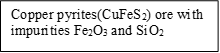
- (i) Copper pyrites (CuFeS2)
- (ii) Malachite (CuCO3.Cu(OH)2)
- (iii) Cuprite (Cu2O)
b) Extraction of copper from copper pyrites
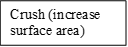
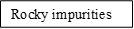
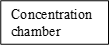
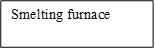
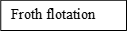
Copper pyrites are first crushed into fine powder. The powdered ore is then added to water and oil. The purpose of water is to dissolve hydrophilic substances/particles. The purpose of oil is to cover copper ore particles so as to make them hydrophobic.
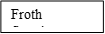
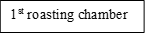
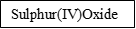
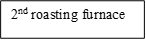
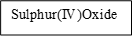
Air is blown through the mixture. Air creates bubbles that stick around hydrophobic copper ore. The air bubbles raise through buoyancy small hydrophobic copper ore particles to the surface. A concentrated ore floats at the top as froth. This is called froth flotation. The concentrated ore is then skimmed off. The ore is then roasted in air to form copper(I) sulphide, sulphur(IV) oxide, and iron(II) oxide.
2CuFeS2(s) + 4O2(g) → Cu2S(s) + 3SO2(g) + 2FeO(s)
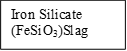
Limestone (CaCO3) and silicon(IV) oxide (SiO2) are added and the mixture heated in absence of air. Silicon(IV) oxide (SiO2) reacts with iron(II) oxide to form iron silicate which constitutes the slag and is removed.
FeO(s) + SiO2(s) → FeSiO3(s)
The slag separates off from the copper(I) sulphide. Copper(I) sulphide is then heated in a regulated supply of air where some of it is converted to copper(I) oxide.
2Cu2S(s) + 3O2(g) → 2Cu2O(s) + 2SO2(g)
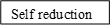
The mixture then undergoes self-reduction in which copper(I) oxide is reduced by copper(I) sulphide to copper metal.
Cu2S(s) + 2Cu2O(s) → 6Cu(s) + SO2(g)
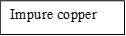
The copper obtained has iron, sulphur, and traces of silver and gold as impurities. It is therefore about 97.5% pure. It is refined by electrolysis/electrolytic method.
During the electrolysis of refining copper, the impure copper is made the anode and a small pure strip is made the cathode.
Electrode ionization takes place where:
At the anode:
Cu(s) → Cu2+(aq) + 2e–
Note: Impure copper anode dissolves/erodes into solution and decreases in size.
At the cathode:
Cu2+(aq) + 2e– → Cu(s)
Note: The copper ions in the electrolyte (CuSO4) are reduced and deposited as copper metal at the cathode. The copper obtained is 99.98% pure.
Valuable traces of silver and gold collect at the bottom of the electrolytic cell as sludge. It is used to finance the extraction of copper pyrites.
c) Flow chart summary of extraction of copper from Copper pyrites











Electrolytic purification of impure copper
d) Uses of copper
Copper is mainly used in:
- making low voltage electric cables, contact switches, sockets, and plugs because it is a good conductor of electricity.
- making solder because it is a good thermal conductor.
- making useful alloys e.g.
- Brass is an alloy of copper and zinc (Cu/Zn).
- Bronze is an alloy of copper and tin (Cu/Sn).
- German silver is an alloy of copper, zinc, and nickel (Cu/Zn/Ni).
e) Environmental effects of extracting copper from Copper pyrites
- Sulphur(IV) oxide is a gas that has a pungent poisonous smell that causes headache to humans in high concentration.
- Sulphur(IV) oxide gas if allowed to escape dissolves in water/rivers/rain to form weak sulphuric(IV) acid lowering the pH of the water leading to marine pollution, accelerated corrosion/rusting of metals/roofs, and breathing problems to human beings.
- Copper is extracted by open-cast mining leading to land/environmental/soil degradation.
f) Test for the presence of copper in an ore
Copper naturally exists in its compound as Cu2+ / Cu+.
Copper(I) / Cu+ is readily oxidized to copper(II) / Cu2+.
If an ore is suspected to contain Cu2+ / Cu+, it is:
- added hot concentrated sulphuric(VI)/nitric(V) acid to free the ions present.
- the free ions are then added a precipitating reagent; 2M sodium hydroxide / 2M aqueous ammonia which forms:
- an insoluble blue precipitate in excess of 2M sodium hydroxide if Cu2+ ions are present.
- an insoluble blue precipitate in 2M aqueous ammonia that dissolves to royal/deep blue solution in excess if Cu2+ ions are present.
| Observation | Inference |
| Blue precipitate in excess 2M NaOH(aq) | Cu2+ |
| Blue precipitate, dissolves to royal/deep blue solution in excess 2M NH3(aq) | Cu2+ |
g) Sample questions
Copper is extracted from copper pyrites as in the flow chart outlined below. Study it and answer the questions that follow.
5. ZINC and LEAD
a) Natural occurrence
Zinc occurs mainly as:
- (i) Calamine – Zinc carbonate (ZnCO3)
- (ii) Zinc blende – Zinc sulphide (ZnS)
Lead occurs mainly as Galena – Lead(II) sulphide mixed with Zinc blende:
b) Extraction of Zinc/Lead from Calamine, Zinc blende and Galena
During extraction of Zinc, the ore is first roasted in air:
For Calamine, Zinc carbonate decomposes to Zinc oxide and carbon(IV) oxide gas.
ZnCO3(s) → ZnO(s) + CO2(g)
Zinc blende does not decompose but reacts with air to form Zinc oxide and sulphur(IV) oxide gas.
Galena as a useful impurity also reacts with air to form Lead(II) oxide and sulphur(IV) oxide gas.
2ZnS(s) + 3O2(g) → 2ZnO(s) + 2SO2(g)
2PbS(s) + 3O2(g) → 2PbO(s) + 2SO2(g)
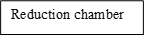
The oxides are mixed with coke and limestone/iron(II) oxide/aluminium(III) oxide and heated in a blast furnace.
At the furnace temperatures, limestone decomposes to quicklime/CaO and produces carbon(IV) oxide gas.
CaCO3(s) → CaO(s) + CO2(g)
Carbon(IV) oxide gas reacts with more coke to form carbon(II) oxide gas.
C(s) + CO2(g) → 2CO(g)
Both carbon(II) oxide and carbon/coke/carbon are reducing agents.
The oxides are reduced to the metals by either coke or carbon(II) oxide.
ZnO(s) + C(s) → Zn(g) + CO(g)
PbO(s) + C(s) → Pb(l) + CO(g)
PbO(s) + CO(g) → Pb(l) + CO2(g)
At the furnace temperature:
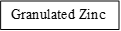
- (i) Zinc is a gas/vapour and is collected at the top of the furnace. It is condensed in a spray of molten lead to prevent reoxidation to Zinc oxide. On further cooling, Zinc collects on the surface from where it can be tapped off.
- (ii) Lead is a liquid and is able to trickle to the bottom of the furnace from where it is tapped off.
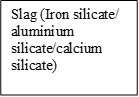
Quicklime/CaO, Iron(II) Oxide, Aluminium(III) oxide are used to remove silica/silicon(IV) oxide as silicates which float above Lead preventing its reoxidation back to Lead(II) Oxide.
CaO(s) + SiO2(s) → CaSiO3(s/l) (Slag – Calcium silicate)
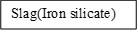
FeO(s) + SiO2(s) → FeSiO3(s/l) (Slag – Iron silicate)
Al2O3(s) + SiO2(s) → Al2SiO4(s/l) (Slag – Aluminium silicate)
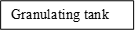
c) Flow chart on extraction of Zinc from Calamine, Zinc blende








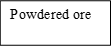
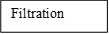
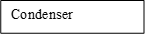
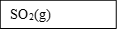
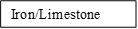
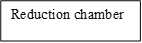
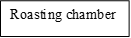
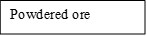
d) Flow chart on extraction of Lead from Galena


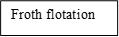
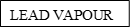
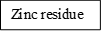

e) Uses of Lead
Lead is used in:
- making gun-burettes.
- making protective clothes against nuclear (alpha rays/particles) radiation in a nuclear reactor.
- mixed with tin (Sn) to make solder alloy.
f) Uses of Zinc
Zinc is used in:
- Galvanization – when iron sheet is dipped in molten Zinc, a thin layer of Zinc is formed on the surface. Since Zinc is more reactive than iron, it reacts with elements of air (CO2/O2/H2O) to form basic Zinc carbonate (ZnCO3.Zn(OH)2). This sacrificial method protects iron from corrosion/rusting.
- As negative terminal and casing in dry/Laclanche cells.
- Making brass alloy with copper (Cu/Zn).
g) Environmental effects of extracting Zinc and Lead
- Lead and lead salts are carcinogenic/causes cancer.
- Carbon(IV) oxide is a greenhouse gas that causes/accelerates global warming.
- Carbon(II) oxide is a colourless odourless poisonous/toxic gas that combines with haemoglobin in the blood to form stable carboxyhaemoglobin reducing free haemoglobin leading to death.
- Sulphur(IV) oxide is a gas that has a pungent poisonous smell that causes headache to humans if in high concentration.
- Any leakages in sulphur(IV) oxide gas escapes to the water bodies to form weak sulphuric(VI) acid lowering the pH of the water. This causes marine pollution/death of aquatic life, accelerated rusting/corrosion of metals/roofs, and breathing problems to human beings.
h) Test for presence of Zinc/Lead
If an ore is suspected to contain Zinc/Lead, it is:
- added hot concentrated Nitric(V) acid to free the ions present.
- the free ions are then added a precipitating reagent mostly 2M sodium hydroxide or 2M aqueous ammonia with the formation of:
Note: Concentrated Sulphuric(VI) acid forms insoluble PbSO4 thus cannot be used to free the ions in Lead salts.
- a soluble precipitate in excess of 2M sodium hydroxide if Zn2+, Pb2+, Al3+ ions are present.
- a white precipitate that dissolves to form a colourless solution in excess 2M aqueous ammonia if Zn2+ ions are present.
- an insoluble white precipitate in excess 2M aqueous ammonia if Pb2+, Al3+ ions are present.
- Pb2+ ions form a white precipitate when any soluble SO42-, SO32-, CO32-, Cl– is added while Al3+ ions do not form a white precipitate.
- Pb2+ ions form a yellow precipitate when any soluble I– (e.g. Potassium/sodium iodide) is added while Al3+ ions do not form a yellow precipitate.
- Pb2+ ions form a black precipitate when any soluble S2- (e.g. Potassium/sodium sulphide) is added while Al3+ ions do not form a black precipitate.
| Observation | Inference |
| White precipitate in excess 2M NaOH(aq) | Zn2+, Pb2+, Al3+ ions |
| White precipitate that dissolves to form a colourless solution in excess 2M NH3(aq) | Zn2+ ions |
| White precipitate in excess 2M NH3(aq) | Pb2+, Al3+ ions |
| White precipitate on adding about 4 drops of either Na2CO3(aq), Na2SO3(aq), Na2SO4(aq), H2SO4(aq), HCl(aq), NaCl(aq) | Pb2+ ions |
| Yellow precipitate on adding about 4 drops of KI(aq), NaI(aq) | Pb2+ ions |
| Black precipitate on adding about 4 drops of Na2S(aq)/K2S(aq) | Pb2+ ions |
6. GENERAL SUMMARY OF METALS
a) Summary methods of extracting metal from their ore

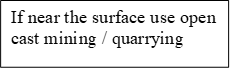

The main criteria used in extraction of metals is based on their position in the electrochemical/reactivity series and their occurrence in the earth’s crust.


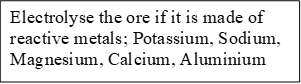
b) Summary of extraction of common metals
| Metal | Chief ore/s | Chemical formula of ore | Method of extraction | Main equation during extraction | |
| Sodium | Rock salt | NaCl(s) | Downs process Through electrolysis of molten NaCl (CaCl2 lowers m.pt from 800°C to 600°C) | Cathode: 2Na+(l) + 2e– → 2Na(l) Anode: 2Cl–(l) → Cl2(g) + 2e– | |
| Sodium / sodium hydroxide | Brine | NaCl(aq) | Flowing mercury cathode cell Through electrolysis of concentrated NaCl(aq) | Cathode: 2Na+(aq) + 2e– → 2Na(aq) Anode: 2Cl–(aq) → Cl2(g) + 2e– | |
| Aluminium | Bauxite | Al2O3.2H2O | Halls process Through electrolysis of molten Al2O3 (Cryolite lowers m.pt from 2015°C to 800°C) | Cathode: 4Al3+(l) + 12e– → 4Al(l) Anode: 6O2-(l) → 3O2(g) + 12e– | |
| Iron | Haematite, Magnetite | Fe2O3, Fe3O4 | Blast furnace Reduction of the ore by carbon(II) oxide | Fe2O3(s) + 3CO(g) → 2Fe(l) + 3CO2(g) Fe3O4(s) + 4CO(g) → 3Fe(l) + 4CO2(g) | |
| Copper | Copper pyrites | CuFeS2 | Roasting the ore in air to get Cu2S. Heating Cu2S ore in regulated supply of air. Reduction of Cu2O by Cu2S | 2CuFeS2(s) + 4O2(g) → Cu2S(s) + 3SO2(g) + 2FeO(s) 2Cu2S(s) + 3O2(g) → 2Cu2O(s) + 2SO2(g) Cu2S(s) + 2Cu2O(s) → 6Cu(s) + SO2(g) | |
| Zinc | Calamine | ZnCO3 | Roasting the ore in air to get ZnO. Blast furnace / reduction of the oxide by Carbon(II) Oxide/Carbon | ZnCO3(s) → ZnO(s) + CO2(g) 2ZnS(s) + 3O2(g) → 2ZnO(s) + 2SO2(g) ZnO(s) + CO(g) → Zn(s) + CO2(g) | |
| Lead | Galena | PbS | Blast furnace – Reduction of the oxide by carbon(II) oxide / Carbon | PbO(s) + CO(g) → Pb(s) + CO2(g) | |
d) Physical properties of metal
Metals form giant metallic structures joined by metallic bonds from electrostatic attraction between the metallic cation and free delocalized electrons.
This makes metals have the following physical properties:
(i) High melting and boiling points
The giant metallic structure has a very close-packed metallic lattice joined by strong electrostatic attraction between the metallic cation and free delocalized electrons. The more delocalized electrons, the higher the melting/boiling points, e.g.
Aluminium has a melting point of about 2015°C while that of sodium is about 98°C. This is mainly because aluminium has more / three delocalized electrons than sodium / has one.
Aluminium has a boiling point of about 2470°C while that of sodium is about 890°C. This is mainly because aluminium has more / three delocalized electrons than sodium / has one.
(ii) High thermal and electrical conductivity
All metals are good thermal and electrical conductors as liquids or solids. The more delocalized electrons, the higher the thermal and electrical conductivity, e.g.
Aluminium has an electrical conductivity of about 3.82 × 10⁻⁹ ohms per metre. Sodium has an electrical conductivity of about 2.18 × 10⁻⁹ ohms per metre.
(iii) Shiny / Lustrous
The free delocalized electrons on the surface of the metal absorb, vibrate, and then scatter/re-emit/lose light energy. All metals are therefore usually shades of grey in colour except copper which is shiny brown, e.g.
Zinc is bluish grey while iron is silvery grey.
(iv) High tensile strength
The free delocalized electrons on the surface of the metal atoms bind the surface immediately when the metal is coiled/folded preventing it from breaking / being brittle.
(v) Malleable
Metals can be made into thin sheets. The metallic crystal lattice on being beaten/pressed/hammered on two sides extends its length and width/breadth and is then immediately bound by the delocalized electrons preventing it from breaking/being brittle.
(vi) Ductile
Metals can be made into thin wires. The metallic crystal lattice on being beaten/pressed/hammered on all sides extends its length and is then immediately bound by the delocalized electrons preventing it from breaking/being brittle.
Revision questions
1. Given some soil, dilute sulphuric(VI) acid, mortar, pestle, filter paper, filter funnel and 2M aqueous ammonia, describe with explanation how you would show that the soil contains Zinc.
Place the soil sample in the pestle. Crush using the mortar to reduce the particle size/increase its surface area.
Add dilute sulphuric(VI) acid to free the ions in soil sample.
Filter to separate insoluble residue from soluble filtrate.
To filtrate, add three drops of aqueous ammonia as precipitating reagent. A white precipitate of Zn(OH)2, Pb(OH)2, or Al(OH)3 is formed.
Add excess aqueous ammonia to the white precipitate. If it dissolves, the Zn2+ ions are present. Zn(OH)2 reacts with excess ammonia to form soluble [Zn(OH)4]2- complex.
2. In the extraction of aluminium, the oxide is dissolved in cryolite.
(i) What is the chemical name of cryolite?
Sodium hexafluoroaluminate / Na3AlF6
(ii) What is the purpose of cryolite?
To lower the melting point of the electrolyte / aluminium oxide from about 2015°C to 900°C.
(iii) Name the substance used for similar purpose in the Downs cell.
Calcium chloride / CaCl2
(iv) An alloy of sodium and potassium is used as coolant in nuclear reactors. Explain.
Nuclear reactors generate a lot of heat energy. Sodium and potassium alloy reduce/lower the high temperature in the reactors.
(v) Aluminium metal is used to make cooking utensils in preference to other metals. Explain.
Aluminium:
- is a very good conductor of electricity because it has three delocalized electrons in its metallic structure.
- is cheap, malleable, ductile, and has high tensile strength.
- on exposure to fire/heat forms an impervious layer that prevents it from rapid corrosion.
3. Study the scheme below and use it to answer the questions that follow.
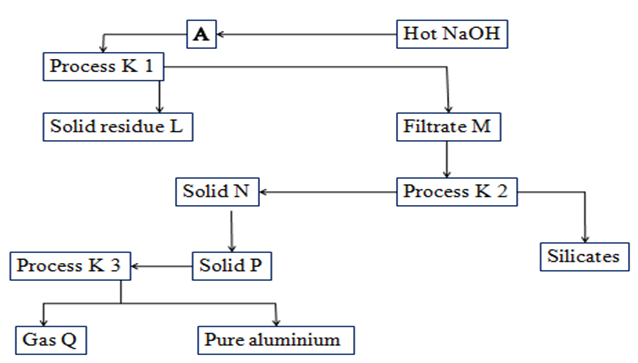
(a) Identify:
(i) solid residue L
Iron(III) Oxide / Fe2O3
(ii) Solid N
Aluminium hydroxide / Al(OH)3
(iii) Filtrate M
Sodium tetrahydroxoaluminate / NaAl(OH)4 and sodium silicate / NaSiO3
(iv) Solid P
Aluminium oxide / Al2O3
(v) Gas Q
Oxygen / O2
(vi) Process K1
Filtration
(vii) Process K2
Electrolysis
(b) Write the equation for the reaction taking place in the formation of solid P from solid N
2Al(OH)3 → Al2O3(s) + 3H2O(l)
(c) Name a substance added to solid N before process K2 takes place.
Cryolite / Sodium tetrahydroxoaluminate / NaAl(OH)4
(d) State the effect of evolution of gas Q on:
(i) process K2
Oxygen produced at the anode reacts with the carbon anode to form carbon(IV) oxide which escapes. The electrolytic process needs continuous replacement of the carbon anode.
(ii) the environment
Oxygen produced at the anode reacts with the carbon anode to form carbon(IV) oxide which escapes to the atmosphere. CO2 is a greenhouse gas that causes global warming.
(e) An aluminium manufacturing factory runs for 24 hours. If the total mass of aluminium produced is 27,000 kg,
(i) Calculate the current used. (Faraday constant=96500 Coulombs, Al=27.0).
(ii) Assuming all the gas produced react with 200 kg of anode, calculate the loss in mass of the electrode. (Molar gas volume at room temperature = 24 dm3, C=12.0)
Working:
Equation at Cathode: Al3+(l) + 3e– → Al(l)
27 g Al → 3 Faradays = 3 × 96500 C
(27,000 kg × 1000) g → (27,000 × 1000) × 3 × 96500 C / 27 g
= 289,500,000,000 Coulombs
Current = Quantity of electricity / Time in seconds = 289,500,000,000 Coulombs / (24 × 60 × 60)
= 3,350,690 Amperes
Working:
Equation at Anode: 2O2-(l) → O2(g) + 4e–
4 Faradays → 4 × 96500 C → 24 dm3 O2(g)
289,500,000,000 Coulombs → 289,500,000,000 × 24 / (4 × 96500)
= 18,000,000 dm3
Chemical equation at anode:
O2(g) + C(s) → CO2(g)
Method 1:
24 dm3 of O2(g) → 12.0 g Carbon
18,000,000 dm3 of O2(g) → 18,000,000 × 12 / 1000 g = 9000 kg
Loss in mass of the carbon graphite anode = 9000 kg
NB: Mass of the carbon graphite anode remaining = 27,000 kg – 9000 kg = 18,000 kg
The flow chart below shows the extraction of iron metal. Use it to answer the questions that follow.

(a) Identify:
(i) gas P
Carbon(IV) oxide / CO2
(ii) Solid Q
Carbon / coke / charcoal
(iii) Solid R
Carbon / coke / charcoal
(iv) Solid V
Limestone / calcium carbonate / CaCO3
(v) Solid S
Iron / Fe
(b) Write the chemical equation for the reaction for the formation of:
(i) Solid S
Fe2O3(s) + 3CO(g) → 2Fe(s) + 3CO2(g)
(ii) Carbon(II) oxide
C(s) + CO2(g) → 2CO(g)
(iii) Slag
SiO2(s) + CaO(s) → CaSiO3(s)
Al2O3(s) + CaO(s) → CaAl2O4(s)
(iv) Gas P
C(s) + O2(g) → CO2(g)
(c) State two uses of:
(i) Solid S
Iron is used in making:
- gates, pipes, engine blocks, rails, charcoal iron boxes, lamp posts because it is cheap.
- nails, cutlery, scissors, sinks, vats, spanners, steel rods, and railway points from steel.
Steel is an alloy of iron with carbon, and/or vanadium, manganese, tungsten, nickel, chromium.
It does not rust/corrode like iron.
(ii) Slag
- tarmacing roads
- cement manufacture
- as building construction material
3. You are provided with sulphuric(VI) acid, 2M aqueous ammonia and two ores suspected to contain copper and iron. Describe with explanation how you would differentiate the two ores.
Crush the two ores separately using a mortar and pestle to reduce the particle size/increase the surface area.
Add sulphuric(VI) acid to separate portions of the ore. Filter.
To a portion of the filtrate, add three drops of 2M aqueous ammonia then excess.
Results:
A green precipitate insoluble in excess 2M aqueous ammonia confirms the ore contains Fe2+ ion.
A brown precipitate insoluble in excess 2M aqueous ammonia confirms the ore contains Fe3+ ion.
A blue precipitate that dissolves in excess 2M aqueous ammonia to form a deep/royal blue solution confirms the ore contains Cu2+ ion.
4. Use the flow chart below showing the extraction of Zinc metal to answer the questions that follow
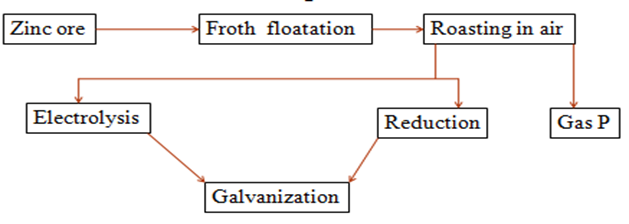
(a) Name:
(i) two ores from which Zinc can be extracted
Calamine (ZnCO3)
Zinc blende (ZnS)
(ii) two possible identities of gas P
Sulphur(IV) oxide (SO2) from roasting Zinc blende
Carbon(IV) oxide (CO2) from decomposition of Calamine
(b) Write a possible chemical equation taking place in the roasting chamber.
2ZnS(s) + 3O2(g) → 2ZnO(s) + 2SO2(g)
ZnCO3(s) → ZnO(s) + CO2(g)
(c) Explain the effect of the by-product of the roasting on the environment.
Sulphur(IV) oxide from roasting Zinc blende is an acidic gas that causes “acid rain” on dissolving in rain water.
Carbon(IV) oxide (CO2) from decomposition of Calamine is a greenhouse gas that causes global warming.
(d) (i) Name a suitable reducing agent used in the furnace during extraction of Zinc.
Carbon(II) oxide
(ii) Write a chemical equation for the reduction process
ZnO(s) + CO(g) → Zn(s) + CO2(g)
(e) (i) Before electrolysis, the products from roasting are added dilute sulphuric (VI) acid. Write the equation for the reaction with dilute sulphuric(VI) acid.
ZnO(s) + H2SO4(aq) → ZnSO4(aq) + H2(g)
(ii) During the electrolysis for extraction of Zinc, state the:
I. Anode used
Aluminium sheet
II. Cathode used
Lead plate coated with silver
(ii) Write the equation for the electrolysis for extraction of Zinc at the:
I. Cathode:
Zn2+(aq) + 2e– → Zn(s)
II. Anode:
4OH–(aq) → 2H2O(l) + O2(g) + 4e–
(f) (i) What is galvanization?
Dipping iron in molten Zinc to form a thin layer of Zinc to prevent iron from rusting.
(ii) Galvanized iron sheet rusts after some time. Explain.
The thin layer of Zinc protects iron from rusting through sacrificial protection. When all the Zinc has reacted with elements of air, iron starts rusting.
(g) State two uses of Zinc other than galvanization.
- Making brass (Zinc/copper alloy)
- Making german silver (Zinc/copper/nickel alloy)
- As casing for dry cells/battery
(h) Calculate the mass of Zinc that is produced from the reduction chamber if 6400 kg of Calamine ore is fed into the roaster. Assume the process is 80% efficient in each stage (Zn=64.0, C=12.0, O=16.0)
Molar mass ZnCO3(s) = 124 g
Molar mass Zn = 64 g
Molar mass ZnO = 80 g
Chemical equation:
ZnCO3(s) → ZnO(s) + CO2(g)
Method 1:
124 g ZnCO3 → 80 g ZnO
(6400 kg × 1000) g ZnCO3 → (6400 × 1000) × 80 / 124 = 512,000,000 g of ZnO
100% → 512,000,000 g of ZnO
80% → 80 × 512,000,000 / 100 = 409,600,000 g of ZnO
Chemical equation:
ZnO(s) + CO(g) → Zn(s) + CO2(g)
80 g ZnO(s) → 64 g Zn(s)
409,600,000 g of ZnO → 409,600,000 × 64 / 80 = 327,680,000 g Zn
80% → 80 × 327,680,000 / 100 = 262,144,000 g of Zn
Mass of Zinc produced = 262,144,000 g of Zn
5. An ore is suspected to be bauxite. Describe the process that can be used to confirm the presence of aluminium in the ore.
Crush the ore to fine powder to increase surface area/reduce particle size.
Add hot concentrated sulphuric(VI)/nitric(V) acid to free the ions.
Filter. Retain the filtrate.
Add excess aqueous ammonia to a sample of filtrate.
A white precipitate confirms presence of either Al3+ or Pb2+.
Add sodium sulphate, dilute sulphuric(VI) to another portion of filtrate.
No white precipitate confirms presence of Al3+.
Or add potassium iodide to another portion of filtrate.
No yellow precipitate confirms presence of Al3+.
6. The flow chart below illustrates the industrial extraction of Lead metal
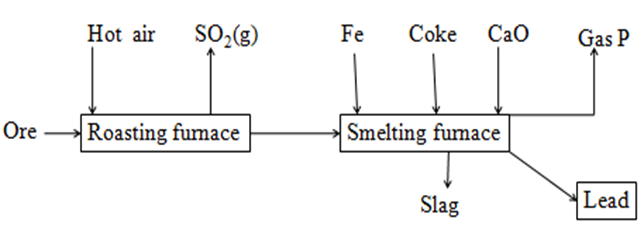
(a) (i) Name the chief ore that is commonly used in this process
Galena (PbS)


