


Water and Hydrogen
A. Water
Pure water is a colourless, odorless, tasteless, and neutral liquid. Pure water does not exist naturally but occurs in varying degrees of purity. The main sources of water include rain, springs, boreholes, lakes, seas, and oceans.
Water is generally used for the following purposes:
- Drinking by animals and plants.
- Washing clothes.
- Bleaching and dyeing.
- Generating hydroelectric power.
- Cooling industrial processes.
Water dissolves many substances (solutes). It is therefore called a universal solvent.
It contains about 35% dissolved oxygen, which supports aquatic fauna and flora.
Water naturally exists in three phases or states: solid ice, liquid water, and gaseous water vapour.
The three states of water are naturally interconvertible. The natural interconversion of these phases forms the water cycle.

Precipitation


Liquid water in land, lakes, seas, and oceans uses solar energy to evaporate or vaporize to form water vapour or gas. Solar energy is also used during transpiration by plants and respiration by animals.
During evaporation, the water vapour rises from the earth’s surface. Temperatures decrease with height above the earth’s surface, so water vapour cools as it rises. At a height where the temperature is below 373 Kelvin (100oC), water vapour loses enough energy to form tiny droplets of liquid.
The process by which a gas or water vapour changes to a liquid is called condensation or liquidification.
On further cooling, the liquid loses more energy to form ice or solid. The process by which a liquid changes to ice or solid is called freezing or solidification. Minute ice particles float in the atmosphere and join together to form clouds. When the clouds become too heavy, they fall to the earth’s surface as rain or snow as the temperature increases during the fall.
Interconversion of the three phases or states of water



Evaporation / boiling / vaporization / condensation / melting / freezing / liquidification / solidification
Pure water has:
- A fixed, constant, or sharp freezing/melting point of 273 K (0oC).
- A fixed, constant, or sharp boiling point of 373 K (100oC) at sea level or 1 atmosphere pressure.
- A fixed density of 1 g/cm3.
This is the criteria for identifying pure water or its purity.
Methods to Test for Presence of Water
a) Using Anhydrous Copper (II) Sulphate (VI)
Procedure: Put about 2 g of anhydrous copper (II) sulphate (VI) crystals into a clean test tube. Add three drops of tap water. Repeat the procedure using distilled water.
Observation: Colour changes from white to blue.
Explanation: Anhydrous copper (II) sulphate (VI) is white. On adding water, it reacts to form hydrated copper (II) sulphate (VI), which is blue. Hydrated copper (II) sulphate (VI) contains water of crystallization. The change from white to blue is a confirmatory test for the presence of water.
Chemical equation:
CuSO4(s) + 5H2O (l) → CuSO4.5H2O(s)
b) Using Anhydrous Cobalt (II) Chloride
Procedure: Put about 5 cm3 of water into a clean test tube. Dip a dry anhydrous cobalt (II) chloride paper into the test tube. Repeat the procedure using distilled water.
Observation: Colour changes from blue to pink.
Explanation: Anhydrous cobalt (II) chloride is blue. On adding water, it reacts to form hydrated cobalt (II) chloride, which is pink. Hydrated cobalt (II) chloride contains water of crystallization. The change from blue to pink is a confirmatory test for the presence of water.
Chemical equation:
CoCl2(s) + 6H2O(l) → CoCl2.6H2O(s)
Burning a Candle in Air
Most organic substances or fuels burn in air to produce water. Carbon (IV) oxide gas is also produced if the air is sufficient or in excess.
Procedure:
- Put about 2 g of anhydrous copper (II) sulphate (VI) crystals in a boiling tube.
- Put about 5 cm3 of lime water in a boiling tube.
- Light a small candle stick. Place it below an inverted thistle or filter funnel.
- Collect the products of the burning candle by setting the apparatus as shown.

Observation: The suction pump pulls the products of burning into the inverted funnel. The colour of anhydrous copper (II) sulphate (VI) changes from white to blue. A white precipitate is formed in the lime water or calcium hydroxide.
Explanation: When a candle burns, it forms water and carbon (IV) oxide. Water turns anhydrous copper (II) sulphate (VI) from white to blue. Carbon (IV) oxide gas forms a white precipitate when bubbled in lime water or calcium hydroxide.
Since:
- Hydrogen in the wax burns to form water:
2H2 (g) + O2 (g) → 2H2O (g/l)
- Carbon in the wax burns to form carbon (IV) oxide:
C(s) + O2(g) → CO2 (g)
The candle before burning therefore contained only carbon and hydrogen. A compound made up of hydrogen and carbon is called a hydrocarbon. A candle is a hydrocarbon.
Other hydrocarbons include petrol, diesel, kerosene, and laboratory gas. Hydrocarbons burn in air to form water and carbon (IV) oxide gas.
Chemical equation:
Hydrocarbons + Oxygen → Water + Carbon dioxide
Water Pollution
Water pollution occurs when undesirable substances are added to water. Sources of water pollution include:
- Industrial chemicals being disposed into water bodies like rivers, lakes, and oceans.
- Discharging untreated or raw sewage into water bodies.
- Leaching of insecticides or herbicides from agricultural activities into water bodies.
- Discharging non-biodegradable detergents after domestic and industrial use into water bodies.
- Petroleum oil spilling by ships and oil refineries.
- Toxic or poisonous gases from industries dissolving in rain.
- Acidic gases from industries dissolving in rain to form “acid rain”.
- Discharging hot water into water bodies, reducing the quantity of dissolved oxygen and killing aquatic fauna and flora.
Water pollution can be reduced by:
- Reducing the use of agricultural fertilizers and chemicals in farming activities.
- Using biological control methods instead of insecticides and herbicides.
- Using biodegradable detergents.
Reaction of Water with Metals
Some metals react with water while others do not. The reaction of metals with water depends on the reactivity series. The higher the metal in the reactivity series, the more reactive it is with water. The following experiments show the reaction of metals with cold water and water vapour or steam.
(a) Reaction of Sodium/Potassium with Cold Water
Procedure: Put about 500 cm3 of water in a beaker. Add three drops of phenolphthalein indicator, litmus solution, universal indicator solution, or methyl orange indicator into the water. Cut a very small piece of sodium. Using a pair of forceps, put the metal into the water.
Observation: Sodium melts to a silvery ball that floats and darts on the surface, decreasing in size. Effervescence or fizzing bubbles of colourless gas are produced. The colour of phenolphthalein turns pink. The colour of litmus solution turns blue. The colour of methyl orange solution turns orange. The colour of universal indicator solution turns blue.
Explanation: Sodium is less dense than water. Sodium floats on water and vigorously reacts to form an alkaline solution of sodium hydroxide and produces hydrogen gas. Sodium is thus stored in paraffin to prevent contact with water.
Chemical equation:
2Na(s) + 2H2O (l) → 2NaOH (aq) + H2(g)
To collect hydrogen gas, sodium metal is forced to sink to the bottom of the trough or beaker by wrapping it in wire gauze or mesh.

Potassium is more reactive than sodium. On contact with water, it explodes or bursts into flames. An alkaline solution of potassium hydroxide is formed along with hydrogen gas.
Chemical equation:
2K(s) + 2H2O (l) → 2KOH (aq) + H2(g)
Caution: The reaction of potassium with water is very risky to try in a school laboratory.
(b) Reaction of Lithium/Calcium with Cold Water
Procedure: Put about 200 cm3 of water in a beaker. Add three drops of phenolphthalein indicator, litmus solution, universal indicator solution, or methyl orange indicator into the water. Cut a small piece of lithium. Using a pair of forceps, put the metal into the water. Repeat with a piece of calcium metal.
Observation: Lithium sinks to the bottom of the water. Rapid effervescence or fizzing bubbles of colourless gas are produced. The colour of phenolphthalein turns pink. The colour of litmus solution turns blue. The colour of methyl orange solution turns orange. The colour of universal indicator solution turns blue.
Explanation: Lithium and calcium are denser than water. Both sink in water and vigorously react to form an alkaline solution of lithium hydroxide or calcium hydroxide and produce hydrogen gas. Lithium is more reactive than calcium. It is also stored in paraffin like sodium to prevent contact with water.
Chemical equations:
2Li(s) + 2H2O (l) → 2LiOH (aq) + H2(g)
Ca(s) + 2H2O (l) → Ca(OH)2(aq) + H2(g)

(c) Reaction of Magnesium/Zinc/Iron with Steam or Water Vapour
Procedure method 1:
- Place some wet sand or cotton or glass wool soaked in water at the bottom of an ignition or hard glass boiling tube.
- Polish magnesium ribbon using sandpaper.
- Coil it at the centre of the ignition or hard glass boiling tube.
- Set up the apparatus as shown.
- Heat the wet sand or cotton or glass wool soaked in water gently to:
- Drive away air in the ignition or hard glass boiling tube.
- Generate steam.
Heat the coiled ribbon strongly using another burner. Repeat the experiment using zinc powder and fresh iron filings.

Observations:
(i) With magnesium ribbon: The magnesium glows with a bright flame (and continues to burn even if heating is stopped). White solid or ash is formed. The white solid or ash dissolves in water to form a colourless solution. Colourless gas is produced or collected that extinguishes a burning splint with a “pop” sound.
(ii) With zinc powder: The zinc powder turns red hot on strong heating. Yellow solid is formed that turns white on cooling. The white solid formed on cooling does not dissolve in water.
(iii) With iron filings: The iron filings turn red hot on strong heating. Dark blue solid is formed. The dark blue solid does not dissolve in water.
Procedure method 2:
- Put some water in a round-bottomed flask.
- Polish magnesium ribbon using sandpaper.
- Coil it at the centre of a hard glass tube.
- Set up the apparatus as shown.
- Heat water strongly to boil so as to:
- Drive away air in the glass tube.
- Generate steam.
Heat the coiled ribbon strongly using another burner. Repeat the experiment using zinc powder and fresh iron filings.

Observations:
(i) With magnesium ribbon: The magnesium glows with a bright flame (and continues to burn even if heating is stopped). White solid or ash is formed. The white solid or ash dissolves in water to form a colourless solution. Colourless gas is produced or collected that extinguishes a burning splint with a “pop” sound.
(ii) With zinc powder: The zinc powder turns red hot on strong heating. Yellow solid is formed that turns white on cooling. The white solid formed on cooling does not dissolve in water.
(iii) With iron filings: The iron filings turn red hot on strong heating. Dark blue solid is formed. The dark blue solid does not dissolve in water.
Explanations:
(a) Hot magnesium burns vigorously in steam. The reaction is highly exothermic, generating enough heat or energy to proceed without further heating. White magnesium oxide solid or ash is left as residue. Hydrogen gas is produced. It extinguishes a burning splint with a “pop” sound.
Chemical equation:
Mg(s) + H2O(g) → MgO(s) + H2(g)
Magnesium oxide reacts or dissolves in water to form an alkaline solution of magnesium hydroxide.
Chemical equation:
MgO(s) + H2O(l) → Mg(OH)2(aq)
(b) Hot zinc reacts vigorously in steam forming yellow zinc oxide solid or ash as residue which cools to white. Hydrogen gas is produced. It extinguishes a burning splint with a “pop” sound.
Chemical equation:
Zn(s) + H2O(g) → ZnO(s) + H2(g)
Zinc oxide does not dissolve in water.
(c) Hot iron reacts with steam forming dark blue tri iron tetra oxide solid or ash as residue. Hydrogen gas is produced. It extinguishes a burning splint with a “pop” sound.
Chemical equation:
2Fe(s) + 4H2O(g) → Fe3O4(s) + 4H2(g)
Tri iron tetra oxide does not dissolve in water.
(d) Aluminum reacts with steam forming an insoluble coat or cover of an impervious layer of aluminum oxide on the surface, preventing further reaction.
(e) Lead, copper, mercury, silver, gold, and platinum do not react with either water or steam.
Hydrogen
Occurrence
Hydrogen does not occur free in nature. It occurs as water and in petroleum.
School Laboratory Preparation
Procedure: Put zinc granules in a round, flat, or conical flask. Add dilute sulphuric (VI) or hydrochloric acid. Add about 3 cm3 of copper (II) sulphate (VI) solution. Collect the gas produced over water as in the setup below. Discard the first gas jar. Collect several gas jars.
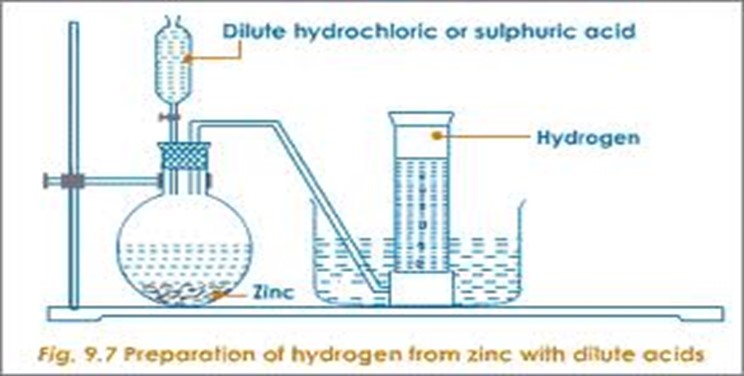
Observation/Explanation: Zinc reacts with dilute sulphuric (VI) or hydrochloric acid to form a salt and produce hydrogen gas. When the acid comes into contact with the metal, there is rapid effervescence, bubbles, or fizzing and a colourless gas is produced that is collected:
- Over water because it is insoluble in water.
- Through downward displacement of air or upward delivery because it is less dense than air.
The first gas jar is impure. It contains air that was present in the apparatus. Copper (II) sulphate (VI) solution acts as a catalyst.
Chemical equations:
(a) Zinc + Hydrochloric acid → Zinc chloride + Hydrogen
Zn(s) + 2HCl (aq) → ZnCl2 (aq) + H2 (g)
Ionic equation:
Zn (s) + 2H+ (aq) → Zn2+ (aq) + H2 (g)
Zinc + Sulphuric (VI) acid → Zinc Sulphate (VI) + Hydrogen
Zn(s) + H2SO4 (aq) → ZnSO4 (aq) + H2 (g)
Ionic equation:
Zn (s) + 2H+ (aq) → Zn2+ (aq) + H2 (g)
(b) Magnesium + Hydrochloric acid → Magnesium chloride + Hydrogen
Mg(s) + 2HCl (aq) → MgCl2 (aq) + H2(g)
Ionic equation:
Mg (s) + 2H+ (aq) → Mg2+ (aq) + H2 (g)
Magnesium + Sulphuric (VI) acid → Magnesium Sulphate (VI) + Hydrogen
Mg(s) + H2SO4 (aq) → MgSO4 (aq) + H2(g)
Ionic equation:
Mg (s) + 2H+ (aq) → Mg2+ (aq) + H2 (g)
(c) Iron + Hydrochloric acid → Iron (II) chloride + Hydrogen
Fe(s) + 2HCl (aq) → FeCl2 (aq) + H2 (g)
Ionic equation:
Fe (s) + 2H+ (aq) → Fe2+ (aq) + H2 (g)
Iron + Sulphuric (VI) acid → Iron (II) Sulphate (VI) + Hydrogen
Fe(s) + H2SO4 (aq) → FeSO4 (aq) + H2 (g)
Ionic equation:
Fe (s) + 2H+ (aq) → Fe2+ (aq) + H2 (g)
Note
1. Hydrogen cannot be prepared from the reaction of:
- Nitric (V) acid and a metal. Nitric (V) acid is a strong oxidizing agent. It oxidizes hydrogen gas to water.
- Dilute sulphuric (VI) acid with calcium, barium, or lead because calcium sulphate (VI), barium sulphate (VI), and lead (II) sulphate (VI) salts formed are insoluble. Once formed, they cover or coat the unreacted calcium, barium, or lead, stopping further reaction and producing very small amounts or volumes of hydrogen gas.
- Dilute acid with sodium or potassium. The reaction is explosive.
Properties of Hydrogen Gas
(a) Physical Properties
- Hydrogen is a neutral, colourless, and odorless gas. When mixed with air, it has a characteristic pungent choking smell.
- It is insoluble in water and thus can be collected over water.
- It is the lightest known gas. It can be transferred by inverting one gas jar over another.
(b) Chemical Properties
(i) Burning
I. Hydrogen does not support burning or combustion. When a burning splint is inserted into a gas jar containing hydrogen, the flame is extinguished or put off.
II. Pure dry hydrogen burns with a blue quiet flame to form water. When a stream of pure dry hydrogen is ignited, it catches fire and continues to burn with a blue flame.
III. Impure hydrogen (air mixed with hydrogen) burns with an explosion. A small amount or volume of air mixed with hydrogen in a test tube produces a small explosion as a “pop” sound. This is the confirmatory test for the presence of hydrogen gas. A gas that burns with a “pop” sound is confirmed to be hydrogen.
(ii) Redox in Terms of Hydrogen Transfer
Redox can also be defined in terms of hydrogen transfer:
- Oxidation is the removal of hydrogen.
- Reduction is the addition of hydrogen.
- Redox is the simultaneous addition and removal of hydrogen.
Example
When a stream of dry hydrogen gas is passed through black copper (II) oxide, hydrogen gas gains the oxygen from copper (II) oxide. Black copper (II) oxide is reduced to brown copper metal. Black copper (II) oxide is thus the oxidizing agent. Hydrogen gas is oxidized to water. Hydrogen is the reducing agent.
Set up of apparatus

(a) Chemical equation
(i) In glass tube:
CuO (black) + H2(g) → Cu (brown) + H2O (l)
(ii) When excess hydrogen is burning:
O2 (g) + 2H2 (g) → 2H2O (l)
(b) Chemical equation
(i) In glass tube:
PbO (brown when hot, yellow when cool) + H2 (g) → Pb (grey) + H2O (l)
(ii) When excess hydrogen is burning:
O2 (g) + 2H2 (g) → 2H2O (l)
(c) Chemical equation
(i) In glass tube:
Fe2O3 (dark grey) + 3H2 (g) → 2Fe (grey) + 3H2O (l)
(ii) When excess hydrogen is burning:
O2 (g) + 2H2 (g) → 2H2O (l)
(iii) Water as an Oxide of Hydrogen
Burning is a reaction of an element with oxygen. The substance formed when an element burns in air is the oxide of the element. When hydrogen burns, it reacts or combines with oxygen to form the oxide of hydrogen. The oxide of hydrogen is called water. Hydrogen is first dried because a mixture of hydrogen and air explodes. The gas is then ignited. The products condense on a cold surface or flask containing a freezing mixture. A freezing mixture is a mixture of water and ice.

The condensed products are collected in a receiver as a colourless liquid.
Tests
- When about 1 g of white anhydrous copper (II) sulphate (VI) is added to a sample of the liquid, it turns blue. This confirms the liquid formed is water.
- When blue anhydrous cobalt (II) chloride paper is dipped in a sample of the liquid, it turns pink. This confirms the liquid formed is water.
- When the liquid is heated to boil, its boiling point is 100oC at sea level or one atmosphere pressure. This confirms the liquid is pure water.
Uses of Hydrogen Gas
- Hydrogenation or Hardening of Unsaturated Vegetable Oils to Saturated Fats or Margarine. When hydrogen is passed through unsaturated compounds in the presence of a nickel catalyst and about 150oC, they become saturated. Most vegetable oils are unsaturated liquids at room temperature. They become saturated and hard through hydrogenation.
- In Weather Forecast Balloons. Hydrogen is the lightest known gas. Meteorological data is collected for analysis by sending hydrogen-filled weather balloons into the atmosphere. The data collected is then used to forecast weather conditions.
- In the Haber Process for the Manufacture of Ammonia. Hydrogen is mixed with nitrogen in the presence of an iron catalyst to form ammonia gas. Ammonia gas is a very important raw material for the manufacture of agricultural fertilizers.
- In the Manufacture of Hydrochloric Acid. Limited amounts of hydrogen are burnt in excess chlorine gas to form hydrogen chloride gas. Hydrogen chloride gas is dissolved in water to form hydrochloric acid. Hydrochloric acid is used in pickling or washing metal surfaces.
- As Rocket Fuel. Fixed proportions of hydrogen and oxygen when ignited explode violently, producing a lot of energy or heat. This energy is used to power or propel rockets into space.
- In Oxy-Hydrogen Flame for Welding. A cylinder containing hydrogen when ignited in pure oxygen from a second cylinder produces a flame that is very hot. It is used to cut metals and for welding.


