


LEARNING OBJECTIVES By the end of this chapter, you should be able to: 1. (a) Define: Pressure and state its S.I unit and other units; (b) State: The conditions for Pressure in liquids. (c) Describe: An experiment to show that liquid pressure depends on depth. How to measure liquid and gas pressure using manometer. (d) State: The applications of liquid pressure. (e) Describe: How to measure Relative Density of liquids using manometer. 2. Solve problems involving pressure: – Exerted by solids on a surface and – In liquids. 3. (a) State: (i) Pascal’s Principle (The law) of equal transmission of pressure in liquids. (ii) Applications of the law of equal transmission of pressure. (b) Describe: The structures and the mechanisms of: – The Hydraulic Press and – The Hydraulic Brake. (c) Solve problems involving pressure, force and area in the Hydraulic Press. 4. (a) Define: Atmospheric Pressure. (b) Describe: (i) Simple experiment to show the effect of atmospheric pressure. (ii) How to measure atmospheric pressure using Mercury Barometer. (c) State: The applications of atmospheric pressure. (d) Describe: The structures and the mechanisms of: – The Lift pump and – The force pump. |
9.1 Pressure
Pressure is defined as: force acting normally (perpendicularly) per unit area.
Mathematically, it is expressed as: Pressure, P = 
P =  Where area A is in m2
S.I Unit of Pressure
The SI unit of pressure is Newton per square metre (Nm-2 or N/m2). It is a derived unit i.e. it is derived from the SI units of the quantities used to define pressure.
From the definition; Pressure, P = 
The SI unit of pressure = 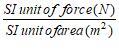 =
=  (N/m2) or Nm-2
Other units of pressure are:
- Pascal (Pa) is also SI unit of pressure. 1 Pa = 1 Nm-2. Therefore, Pascal is also the S.I unit of pressure.
- Atmosphere (atm).
- Millimeter of mercury (mmHg).
1 atm = 101325 Pa or Nm-2
Also 1 atm = 760 mmHg When measured at a temperature of 0°C at sea level.
The larger units of pressure are:
- kiloPascal (kPa) 1 kPa = 1,000 Nm-2
- Mega Pascal (MPa) 1 MPa = 1,000,000 Nm-2
Note that from the formula P =  , it follows that:
- At constant area, P ∝ F, i.e. at constant area, the pressure is directly proportional to force (pressure increases with increase in force).
- At constant force, P ∝ 1/A, i.e. pressure is inversely proportional to area (pressure increases with decreasing area and decreases with increasing area).
Hence;
- Pressure is greatest when area A is smallest.
- Pressure is least when area A is greatest.
Worked Examples
A force of 10,000 N is applied to an area of 2 m2. Calculate the pressure exerted on the area.
Solution: F = 10,000 N, A = 2 m2, P = ?
P =

=
= 5,000 Nm-2
A glass block of mass 60 g exerts a pressure of 1000 Nm-2 on a table top. Determine the area of contact between the glass block and the table top. (Take g = 10 ms-2)
Solution: m = 60 g =
kg, F = ?, g = 10 ms-2, P = 1000 Nm-2, A = ?Hint: Since the force is not given directly, we first find the force F using the formula:
F = mg =
x 10 = 0.6 NNow force F and pressure P are known. We can then use the formula for finding pressure to calculate the area A.
P =
A =
= 0.0006 m2 or 6 x 10⁻⁴ m2
A block of wood of mass 1200 g measures 30 cm by 6 cm by 5 cm. Calculate;
(a) The greatest pressure.
(b) The least pressure exerted by the wood on a flat surface. (Take g = 10 ms-2)
Solution: m = 1200 g =
= 1.2 kg, F = W = mg = 1.2 x 10 = 12 Nl = 30 cm =
= 0.3 m, w = 6 cm = = 0.06 m, h = = 0.05 mFirst calculate the three possible surface areas of the cuboid.
The three possible areas are:
- A(Largest) = l × w = 0.30 × 0.06 = 0.018 m2
- A(Medium) = l × h = 0.30 × 0.05 = 0.015 m2
- A(Smallest) = w × h = 0.06 × 0.05 = 0.003 m2
The greatest pressure:
Since pressure is inversely proportional to area in contact, the greatest pressure acts on the smallest area. So from the three areas calculated above, we select the smallest.
P(Greatest) =
= = 4,000 Nm-2The least pressure:
The least pressure acts on the largest area. So we select the largest area from the three possible areas.
P(Least) =
= = 666.67 Nm-2


 kg, F = ?, g = 10 ms-2, P = 1000 Nm-2, A = ?
 x 10 = 0.6 N

 = 1.2 kg, F = W = mg = 1.2 x 10 = 12 N
 = 0.3 m, w = 6 cm =
  = 0.06 m, h =
  = 0.05 m
 =
=  = 4,000 Nm-2
 =
=  = 666.67 Nm-2
Self-Check 9.0
- A metal cube of density 3,000 kg/m3 is 4 m high and stands on a square base. What is the pressure exerted by the weight of the block on the surface on which it stands?
A. 120,000 N/m2 B. 7,500 N/m2 C. 60,000 N/m2 D. 15,000 N/m2 - The rectangular block has a mass of 3,600 kg and base area of 9 m2. What is the pressure exerted on the ground?
A. 3,000 N/m2 B. 9,000 N/m2 C. 4,000 N/m2 D. 4,500 N/m2 - A block of concrete weighs 900 N and its base is a square of side 3 m. What pressure does the block exert on the ground?
A. 50 N/m2 B. 100 N/m2 C. 200 N/m2 D. 300 N/m2 - A man of mass 80 kg wears snow shoes with a total area of 0.5 m2. What is the pressure exerted by him on the ground?
A. 1,200 Pa B. 1,400 Pa C. 1,600 Pa D. 1,800 Pa - A book weighing 18 N has 0.06 m2 surface area and lies on a table. Calculate the pressure exerted by the book on the table.
A. 1.08 Pa B. 0.3 Pa C. 0.3 kPa D. 0.003 Pa
9.2 Pressure in fluids
A liquid in a container exerts pressure at the bottom of the container. The pressure exerted has the following properties:
The pressure in liquids:
- Is independent of the base area.
- Increases with depth below its surface.
- Increases with the density of liquid.
- At the same point (depth), the pressure is the same and acts equally in all directions.
Experiment 9.0 To show that pressure in liquids depends on the depth
Apparatus: A tall can (tin), a small nail, running water from tap.
Procedure:
- Make three holes A, B and C of the same diameter along a vertical line on one side of the can using a small nail.
- Fill the tall can with water from tap up to a level above hole A as shown in the diagram below.
- Observe the jets of water from the holes.
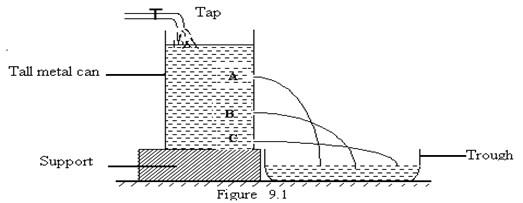
Observation
- Water jets through the holes with different speed.
- The lower hole, C throws water farthest and fastest followed by B and lastly hole A.
- Water leaves the holes at right angles to the wall of the can. This shows that the pressure is perpendicular to the wall of the can.
Conclusion: Pressure due to water at hole C is the greatest and at hole A is the least. Therefore, pressure in liquids depends on depth.
(a) To show that pressure in liquids is independent of base area but depends on the depth and density of the liquid
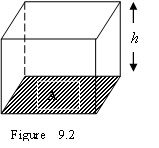 Consider a liquid of mass m kg and density, ρ kg/m3 filled in a container of base area A to a depth, h (metres) as shown in the diagram below.
The liquid exerts pressure, P, on the bottom of the container as a result of its weight.
The volume of the liquid = Volume of the container
= Base area × Height
= A × h
Mass of the liquid = Volume × Density
= A h ρ
Weight of the liquid = Mass × Acceleration due to gravity
= mg But m = A h ρ
Weight of the liquid = A ρ h g
From Pressure =  we have;
= 
Pressure in liquids is given by the formula, P = hρg
Note that the final result does not have A. This shows that:
Pressure in liquid is independent of the base area but depends on the depth of the liquid.
That is pressure is directly proportional to the depth, h, and density ρ of the liquid, since g is a constant.
NB: The same result will be obtained whatever shape of a container is used.
(b) Pressure and liquid density
If the pressure is measured at the same depth below the surface of different liquids we find that: The pressure is proportional to the density of the liquid.
(c) Liquid levels (A liquid finds its own level)
When a liquid is poured into a set of connected tubes of various shapes the liquid flows round the tubes until all the liquid surfaces are the same level, fig. 9.21. We say that a liquid finds its own level.

Fig. 9.21
NB: See the photograph on this book cover.
(d) Calculation of Liquid Pressure
The pressure exerted by a liquid can be calculated using the formula:
P = hρg
Where: P = Pressure, h = height/depth in metres, ρ = density of liquid in kg/m3, g = gravity = 10 m/s2.
Worked Examples
What is the pressure on the bottom of a vessel when it is filled with a liquid of density 800 kg/m3 to a depth of 2 m. (g = 10 m/s2).
Solution: ρ = 800 kg/m3, h = 2 m, g = 10 m/s2, P = ?
P = hρg = 2 × 800 × 10
= 16,000 Nm-2
The pressure at the bottom of a column of mercury is 50 Nm-2. Calculate the height of the mercury column. (Density of mercury = 13,600 kg/m3 and g = 10 m/s2).
Solution: ρ = 13,600 kg/m3, g = 10 m/s2, P = 50 Nm-2, h = ?
P = hρg
50 = 13,600 × 10 × h
h =
= 3.68 m

9.21 Measurement of Pressure in Fluids
Fluid pressure is measured using an instrument called manometer.
- The U-Tube Manometer
A manometer consists of a U-shaped tube with one end connected either directly to the container containing a gas or to a thistle funnel whose base (bottom) is covered with a thin membrane and the other end remains open to the atmosphere. The manometer is filled with a liquid, such as water, oil, or mercury, the difference in the liquid surface levels, h, in the two manometer arms indicates the pressure difference from local atmospheric conditions.
Diagrams showing U-tube manometer

9.22 Measurement of Gas Pressure
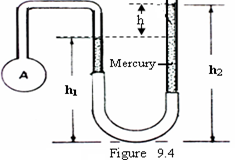 One arm of the manometer is connected to the container in which the gas whose pressure to be measured is kept. The difference in the levels of the two arms of the manometer gives the pressure of the gas.
If the actual pressure is required, then it is calculated from the formula:
Gas pressure =  +
+ 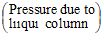
Gas pressure = PA + hρg
Note that: For the case of the above diagram, h = h2 – h1
 Worked Examples
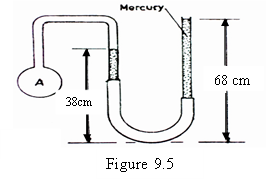
(a) In figure 9.5, a fixed mass of dry air is trapped in bulb A. If the atmospheric pressure is 76 cm of mercury.
Calculate the total pressure of the air in A, in:
(i) mmHg
(ii) Pa (atm. pressure = 101325 Pa, ρ of mercury = 1.36 × 10⁴ kg/m3, g = 10 ms-2)
Solution: Atmospheric Pressure = 76 cmHg = 760 mmHg
h1 = 38 cm = 380 mm, h2 = 68 cm = 680 mm
(i) Pressure due to mercury column, h = h2 – h1 = 680 – 380 = 300 mmHg
Gas pressure = PA + Pressure due to liquid column = 760 + 300 = 1060 mmHg
(ii) Pressure, P, due to mercury column = hρg = 0.3 × 13600 × 10 = 40,800 Pa
Gas pressure = PA + Pressure due to liquid column = 101,325 + 40,800 = 142,125 Pa
(a) Figure 9.6 below shows a gas trapped by a mercury column in a J-tube. If the atmospheric pressure is 1.0 × 10⁵ Pa and the density of mercury is 1.36 × 10⁴ kg/m3, find the pressure at which the gas is. (g = 10 m/s2)
(b) What would happen if the closed end of the J-tube was opened?
(c) Would it have been better to use water instead of mercury in the J-tube? Give a reason for your answer.
Solution: Mercury column = 25 cm = 0.25 m, ρ of mercury = 1.36 × 10⁴ kg/m3, g = 10 ms-2, Atm. pressure = 1 × 10⁵ Pa
(a) Pressure, P, due to mercury column = hρg = 0.25 × 13600 × 10 = 34,000 Pa
Gas pressure = PA + Pressure due to liquid column = 100,000 + 34,000 = 134,000 Pa
- The gas trapped would escape. This would reduce the pressure inside the J tube.
The mercury column on the right arm would fall while the one on the left arm would rise until the two levels become the same level.
- No. Reason: Water is less dense than mercury. Therefore, to balance the same pressure, it would require a large volume of water which in turn would need a manometer with a very long arm to hold the higher water column.
(b) Measurement of Pressure in a liquid
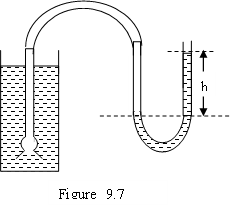 In measuring the liquid pressure, one arm of the manometer is connected to a thistle funnel covered with a thin membrane.
The thistle funnel is immersed into the liquid to the point where the pressure is to be measured.
The difference in the levels of the liquid in the two limbs of the manometer gives the pressure at that point. Since the pressure in a liquid is proportional to the depth below the surface, pressures can be measured in terms of the height of a liquid.
The diagram above shows how liquid pressure at different points in a liquid can be measured using a manometer.
 Note:
Note:
- Manometers can be used to measure pressure both above and below atmospheric pressure.
- Mercury is used as manometer liquid unless the pressure being measured is close to the atmospheric pressure, in which case a liquid of lower density (e.g oil or water) is more suitable.
- The pressure registered by the manometer, hρg, is known as the gauge pressure. Gauge pressure is the excess pressure i.e. the amount by which the pressure measured in a fluid exceeds the atmospheric pressure.
- It is often convenient to express the gauge pressure simply in terms of the liquid column, h, of the liquid used in the manometer only.
- In this case the units generally used are:
- mmH2O and mmHg, read as millimeters of water and
- millimeters of mercury respectively.
Where H2O is the chemical formula of water and Hg is the chemical symbol of mercury.
- The actual pressure, PA + hρg, is called the absolute pressure.
Actual Pressure = Atmospheric pressure + Pressure due to liquid column
= PA + hρg
9.23 Pressure due to flow of liquid in a pipe
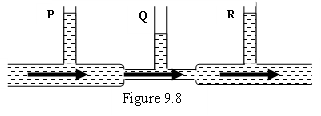 Liquid flowing in a pipe has kinetic energy due to its speed, potential energy due to its position, and pressure energy because it is under pressure. The sum of these energies is a constant.
Consider water flowing in a pipe with a constriction at one point as shown in the diagram.
Facts about the flow of the liquid
- Pressure of water changes with its rate of flow in the pipe.
- The speed of water is much greater at the constriction; as a result its kinetic energy is greater.
- Its pressure energy is less since its potential energy is constant.
- Pressure is highest in tubes P and R and lowest in Q (i.e. at the constriction).
9.24 Application of Liquid Pressure
Liquid pressure is applied in:
- Measurement of relative density of liquids
- Water supplies
Measurement of Relative Density of Liquids
 (i) Determination of Relative Density of liquids that are Miscible with water
The Relative density of a liquid that is miscible with water is determined by balancing a column of small volume of the liquid with water on mercury surface in a manometer until the mercury levels in the two limbs of the manometer are at the same level as shown in figure 9.8 below.
Facts in calculating the Relative Density from the above diagram
- The pressure acting on the two surfaces of the mercury is the same.
- The pressure due to the liquid column is equal to the pressure due to the water column.
Calculation: Let pressure, Pl, due to the liquid column = hlρlg and Pressure, Pw, due to the water column = hwρwg
But Pl = Pw
hlρlg = hwρwg
hlρl = hwρw
 =
=  But
But  = R.D (See chapter 3)
R.D of the liquid = 
I.e R.D = 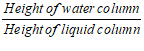
(ii) Determination of Relative Density of liquids that are Immiscible with water e.g. Carbon tetrachloride
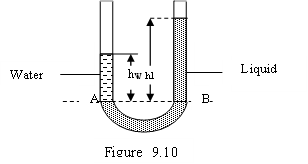 The Relative density of liquids that are immiscible with water is determined by balancing the columns of small volume of the liquid and water in a manometer as shown in figure 9.9 below.
By placing a ruler at the position AB, the liquid columns hl and hw are measured.
 Points to note:
- Point A is called the interface of the two liquids.
- Points A and B are at the same levels so they are at the same pressure.
- The liquid column, hl, balances the column of water, hw.
Calculation: Pressure due to liquid column = Pressure due to water column
hlρlg = hwρwg
hlρl = hwρw
 =
=  But
But  = R.D
= R.D
R.D of the liquid = 
Worked Example
An open U-tube contains columns of water and kerosene over mercury as shown in figure 9.12 below. Calculate the relative density of kerosene.
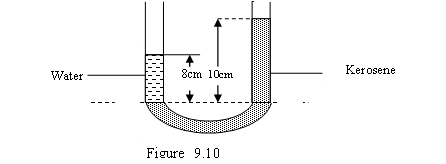

Solution: Height, hw, of water column = 8 cm, Height, hk, of kerosene column = 10 cm.
Relative Density, R.D = 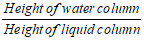 =
=  =
=  = 0.8
= 0.8
(b) Water Supply
Facts about Water Supply
There must be:
- A water pump situated near the water source to pump water to;
- A large reservoir situated on top of a hill or mountainside to create a pressure difference between it and the taps to be supplied in the neighborhood.
In water supply, water is pumped against gravity using a water pump (generator) to a reservoir or water tower high up on a hill or a mountainside. Due to the pressure difference that exists between the water in the reservoir and the taps to be supplied, the water in the reservoir is supplied to houses, factories and other buildings.
Note: In some large blocks or flats there is/are large water tank(s) on the roof or on a high support. The main reservoir supplies water to this/these tank(s) which then supplies water to the taps in the building.
9.25 (a) The Law of Equal Transmission of Liquid Pressure (Pascal’s Principle)
The law states that:
Pressure applied to a liquid is transmitted equally throughout the liquid in all directions.
Experiment To show that pressure applied to a liquid is transmitted equally throughout the liquid in all directions
Apparatus: A round bottom flask with holes of same size on its surface, a tight fitting plunger and water.
Procedure:
- Fill a round bottom flask with holes on the round surface with water.
- Insert a plunger and
- Push the plunger towards the bottom of the flask in the direction shown in figure 9.11.

- Application of the Law of Equal Transmission of Hydraulic Pressure
The principle of equal transmission of pressure in liquids is applied in the following machines:
- The Hydraulic Press (Braham’s Press).
- The Hydraulic brake.
- The Hydraulic jack.
9.26 The Hydraulic Press
The hydraulic press is a machine which uses the principle of equal transmission of pressure in fluids. It works on the principle that the effort required to move something is the product of the force and the distance through which the object is moved.
(a) The structure of the Hydraulic press
It consists of:
- Two pistons (of different diameters) that move up and down in two cylinders (pump cylinder and ram cylinder) of different diameters connected by a pipe.
- Incompressible fluid,
- A reservoir and
- Two valves (inlet valve and return valve).
The diagram showing the cross section of a Hydraulic Press

(b) How it works
Effort is applied at the smaller piston and moves it through a large distance in the pump cylinder. The hydraulic pressure acting on the liquid surface in the pump cylinder is transmitted equally through the liquid to the larger piston in the ram cylinder and a large force is applied over a small distance. A heavy load is raised by the force produced by the pressure acting on the ram piston.
Note: In this way, a small hand pump may be used to lift an automobile. In order to fill the large cylinder under the car with fluid, however, the small pump must be operated many, many times.
When the return valve is opened, the fluid flows back to the reservoir.
For simplicity, the above cross section is drawn excluding the reservoir.
Problems involving Hydraulic Press are solved by using the following formulae.
(i) Using force:  =
=  or
or  =
= 
(ii) Using mass:  =
=  or
or  =
= 
Derivation of the above formulae
Let:
- the area of the piston in the pump cylinder = a
- the area of the piston in the ram cylinder = A
- the mass placed at the pump cylinder = m
- the mass placed at the ram cylinder = M
- the acceleration due to gravity = g
Force at the pump piston, f = mg
Force at the ram piston, F = Mg
Pressure, P1 exerted at the pump cylinder = f/a = mg/a
Pressure, P2 exerted at the ram cylinder = F/A = Mg/A
By the principle of equal transmission of pressure in fluids;
Pressure exerted at the pump cylinder = Pressure exerted at the ram cylinder
P1 = P2 or f/a = F/A
mg/a = Mg/A Using forces we have: f/a = F/A
f/a = F/A = Mg/A
NB: Using the above formulae,
- The force at the pump piston or ram piston can be calculated when the areas of the pistons are given.
- The area of the pump piston or ram piston can be calculated when the forces or masses are given.
Worked Examples
The area of the large piston of a hydraulic press is 10 m2 and that of the smaller one is 0.25 m2. A force of 100 N is applied on the smaller piston. Calculate the force produced at the larger piston.
Solution
Data: a = 0.25 m2, A = 10 m2, f = 100 N, F = ?
From f/a = F/A
F = f × (A/a)
= 100 × (10 / 0.25)
= 4,000 N
The area of a smaller piston of a hydraulic press is 0.5 m2. If an effort of 250 N is applied on the smaller piston and raises a load of 20,000 N, calculate the area of the large piston.
Solution: a = 0.5 m2, A = ?, f = 250 N, F = 20,000 N
From f/a = F/A
A = (F × a) / f
= (20,000 × 0.5) / 250 = 40 m2
In a hydraulic press a force of 400 N is applied to a piston of area 0.1 m2. The area of the other piston is 4 m2. Calculate:
(i) The pressure transmitted through the liquid.
(ii) The force on the other piston?
Solution: f = 400 N, F = ?, a = 0.1 m2, A = 4 m2
(i) Pressure = f/a = 400 / 0.1 = 4,000 N/m2
(ii) F = Pressure × A = 4,000 × 4 = 16,000 N
The Hydraulic brake
(i) Structure of Hydraulic Brake
A hydraulic brake system consists of the following features.
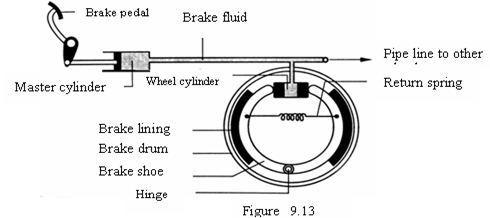
- Master cylinder: Contains two pistons and is connected to wheel cylinders by steel tubes called brake lines.
- Wheel cylinders: They are found in the wheels and also contain two pistons.
- Return spring: Returns the brake shoe back to its position hence forcing the brake fluid back to the master cylinder.
- Brake line: Steel tubes that connect the master cylinder to the wheel cylinders and is filled with the brake fluid.
- Brake fluid: Special incompressible non-freezing liquid.
- Brake lining: A thin, replaceable strip of material attached to a brake shoe. It makes contact with the brake drum thus stopping the rotation of the wheel.
- Brake shoes: These are two curved blocks to which the brake linings are attached and they press against the brake drum thus slowing down the rotation of the wheel.
- Brake drum: A metal cylinder attached to the wheel of a vehicle. They slow down the rotation of the wheel when the brake is applied.
- Brake pedal: Lever operated by the foot that powers the mechanism of brake system.
A diagram showing Hydraulic Brake system
(ii) How the Hydraulic Brake System works
When the driver steps on a brake pedal, the pedal pushes a piston inside the master cylinder. This squeezes the fluid inside the master cylinder, creating hydraulic pressure which is transmitted through the brake lines to additional pistons inside each wheel cylinder in each brake. The pistons in the brake cylinder push the hinged brake shoes. The shoes pivot outward pressing the brake linings attached to them against the brake drum. The contact between the brake lining and the brake drum stops the rotation of the wheels and retards the motion of the car and the car slows down.
NB:
- When the pedal is released, the return springs cause the brake fluid to return to the master cylinder.
- Some braking systems use disc system in which the force resulting from the hydraulic pressure pushes the brake pads in the caliper against the rotor, thus slowing the rotation of the wheel.
9.3 ATMOSPHERIC PRESSURE
Atmosphere refers to mixture of gases surrounding any celestial object that has a gravitational field strong enough to prevent the gases from escaping; especially the gaseous envelope of Earth.
In reference to the earth, atmosphere refers to the air that surrounds the earth.
The atmosphere exerts pressure called atmospheric pressure on the earth surface and the objects found in the pool of the air surrounding the earth. The atmospheric pressure is due to the weight of the air.
Variation of Atmospheric Pressure with altitude
Pressure in fluids depends on the depth or height of the fluid column, the atmospheric pressure therefore, depends on the altitude (height above sea level). As a result of this, at low altitude (high air column), pressure is greatest while at higher altitude (low air column), like mountain peaks, pressure is lower than at low altitude.
Effect of atmospheric pressure on boiling
Boiling takes place when the vapour pressure from a boiling liquid equals the atmospheric pressure. Due to the variation in atmospheric pressure, a liquid will boil at different boiling points. At higher altitudes where atmospheric pressure is low, water boils at low boiling point. Therefore, at higher altitudes, cooking takes longer than at low altitudes where the atmospheric pressure is high.
The large forces which can be produced by atmospheric pressure may be demonstrated by means of a metal can fitted with an airtight stopper.
(a) Crushing can experiment
Apparatus: A metal can with a lid, water and source of heat.
Procedure:
- Fill a metal can with some water.
- Heat the water until steam drives out the air from the can.
- Close the can tightly.
- Remove the can and simultaneously put off the flame.
- Pour cold water on to the can.
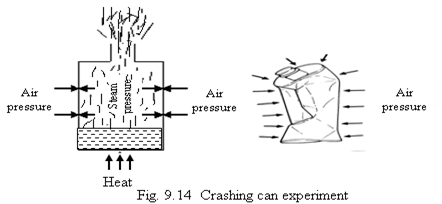
Observation: The metal can crushes inwards.
Explanation: The cold water poured caused the steam to condense, producing water and water vapour at a very low pressure. Consequently, the excess atmospheric pressure outside the can causes it to collapse inwards.
(b) Measurement of atmospheric pressure
The atmospheric pressure is measured by using the following instruments:
- Barometer (Mercury/water barometer)
- Bourdon gauge
A simple Barometer
Barometer is an instrument used for measuring atmospheric pressure.
Types of Barometer
Barometers are named according to the type of liquid used in it. The common liquids used are water and mercury. As a result of this we have:
- Water barometer – Not convenient to be used.
- Mercury barometer – The most convenient to be used.
Mercury barometer
Mercury is 13.6 times as heavy as water, and the column of mercury sustained by normal atmospheric pressure is only about 760 mm (0.76 m) high. It is more convenient to use mercury barometer than water barometer which sustains extremely high column of water.
An ordinary mercury barometer consists of:
- A glass tube about 840 mm (0.84 m) high, closed at one end.
- A glass beaker or glass trough.
- A pool of mercury.
How to measure Atmospheric pressure using mercury barometer
- Fill the glass tube with mercury up to brim.
- Cover the open end of the tube with a finger or small glass plate.
- Invert the tube and place it vertically with its end well below the surface of the mercury in the beaker.
- Remove your finger.

Observation
The mercury level in the tube drops for some time and then remains constant.
The constant level is when the pressure due to the mercury column balances the atmospheric pressure acting on the mercury surface in the beaker.
Read and record the two levels of the mercury (i.e. top in the tube and down in the trough).
The mercury column is given by the formula:
Mercury column, h = Upper reading – Lower reading
At sea level, the mercury column = 760 mm (76 cm or 0.76 m).
Therefore, the atmospheric pressure is recorded as: 760 mmHg at sea level.
NB:
- The falling of the mercury level leaves almost a perfect vacuum called Torricellian vacuum, named after an Italian scientist who lived in Pisa.
- When the mercury level is read with a form of gradated scale, known as a vernier attachment, and suitable corrections are made for:
- Altitude and latitude (because of the change of gravity), and
- Temperature (because of the expansion or contraction of the mercury).
Variation of the Mercury column with altitude
When the set up is taken to different places with different atmospheric pressure, the variation in the atmospheric pressure causes the liquid in the tube to rise or fall by small amounts, rarely below 737 mm (0.737 m) or above 775 mm (0.775 m) at sea level.
Bourdon gauge
Bourdon gauge, (named after the French inventor Eugène Bourdon), is an instrument used to measure higher pressures e.g. steam pressure and water pressure.
It consists of a hollow metal tube with an oval cross section, bent in the shape of a hook or question mark. One end of the tube is closed, the other open and is connected to the measurement region. If pressure (above local atmospheric pressure) is applied, the oval cross section becomes circular, and at the same time the tube will straighten out slightly. The resulting motion of the closed end which is proportional to the pressure, can then be measured via a pointer or needle connected to the end through a suitable linkage.
NB: Gauges used for recording rapidly fluctuating pressures commonly employ piezoelectric or electrostatic sensing elements that can provide an instantaneous response.
Other instruments for measuring atmospheric pressure are:
- The Fortin Barometer.
- Aneroid barometer.
- Altimeter.
Application of atmospheric pressure
Atmospheric pressure is applied in:
- The lift pump (the common pump).
- The force pump.
(a) The lift Pump
The lift pump consists of:
- A handle – which helps to move the piston up and down.
- A piston – which reciprocates (moves back and forth) in a cylinder.
- A pipe – which helps water to flow from underground.
- Two one-way valves – which regulate the flow of water into and out of the cylinder.
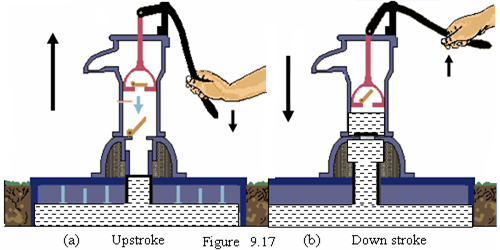
Diagram showing parts of the lift pump

A lift pump is a reciprocating pump which draws fluid (water) in at one end and discharges or expels it at the other end as described in the mechanism below.

Points to note:
- A stroke refers to the up and down movement.
- The up and down movement considered is of the piston not of the handle.
- The handle and the piston move antagonistically. I.e. when the piston moves up, the handle moves down and vice versa.
Mechanism of Lift Pump (How a Reciprocating Pump Works)
Up-stroke
During the up stroke, the piston moves up reducing the air pressure in the cylinder. A partial vacuum is formed beneath the piston making the outside air have greater pressure than the inside. Atmospheric pressure then pushes water up the pipe. The rising water opens the inlet valve, and the water passes to the space above the inlet valve.
Down-stroke
During down stroke, the handle is pulled up, the piston moves down, the outlet valve opens and the inlet valve closes, preventing water from falling back down the pipe.
In the next repeated strokes, the water resting on top of the piston pours out of the spout. At the same time, more water is drawn up through the inlet valve.
Limitation of the Lift pump
Water is pushed up into the pump by the pressure of the atmosphere on the water in the well. This limits the distance through which water can be raised using a lift pump to about 8 meters.
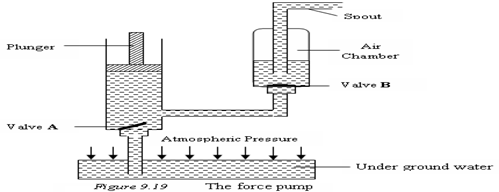
The force pump The force pump barrel contains a tightly fitting piston and two valves as shown in figure 9.18 below.
Mechanism of the Force Pump (How the Force pump Works)


Up stroke
During up stroke, the piston moves up reducing the air pressure in the cylinder. Valve A opens while valve B remains closed then atmospheric pressure forces water into the barrel.
Down stroke
During down stroke, the water in the barrel is compressed; valve A closes, B opens and water is forced along the spout into the air chamber compressing the air in the chamber. During the next up stroke, Valve A opens and valve B remains closed. The compressed air forces water out of the air chamber along the spout. The result is a continuous delivery of water through the spout.
Other applications of atmospheric pressure include the following.
- The syringe.
- The drinking straw.
- The bicycle pump.
- Siphon.
Self-Check 9.1
- A tank is filled with water to a depth of 3 m. What is the pressure at the bottom of the tank due to the water alone? (dwater = 1000 kg/m3)
A. 30 kPa B. 15 kPa C. 3,000 Pa D. 1,500 Pa - A diver is searching for treasure at a depth of 40 m below the surface. What is the pressure exerted on the diver? (Patm = 100,000 N/m2, dwater = 1000 kg/m3)
A. 400,000 N/m2 B. 200,000 N/m2 C. 500,000 N/m2 D. 50,000 N/m2 - What is the pressure at the bottom of a 3 km deep oil well filled with oil of density 860 kg/m3?
A. 5,400 kPa B. 1,080 kPa C. 10,800 kPa D. 25,800 kPa - What is the total pressure on a fish swimming in the sea at a depth of 2 m below the surface? (dsea = 1,125 kg/m3, Patm = 101,300 Pa)
A. 22.5 kPa B. 123.8 kPa C. 32.6 kPa D. 132.5 kPa - The piston of a hydraulic automobile lift has 0.48 m2 area. What pressure is required to lift a car of mass 1,200 kg?
A. 25 kPa B. 12 kPa C. 30 kPa D. 60 kPa - In the hydraulic lift, the area of the smaller piston is one fourth that of the larger piston. If 40 N force is applied on the smaller piston, what is the force on the bigger piston?
A. 640 N B. 160 N C. 10 N D. 320 N - In a hydraulic press a force of 40 N is applied to a piston of area 0.1 m2. The area of the other piston is 4 m2. What is the pressure transmitted through the liquid and the force on the other piston?
A. 800 N/m2 3,200 N B. 400 N/m2 1,600 N C. 400 N/m2 400 N D. 800 N/m2 1,600 N - A hydraulic jack is made with a small piston 12 cm2 that is used to move a large piston 108 cm2. If a man can exert a force of 270 N on the small piston, how heavy a load can he lift with the jack?
A. 1,215 N B. 2,430 N C. 4,860 N D. 3,645 N - A hydraulic press has a large piston with a cross-sectional area of 250 cm2 and a small piston with a cross-sectional area of 1.25 cm2. What is the force on the large piston when a force of 1,250 N is applied to the small piston?
A. 375,000 N B. 125,000 N C. 500,000 N D. 250,000 N - In a liquid, pressure is:
A. Transmitted in a specific direction B. Transmitted in all directions C. Decreased with depth D. Decreased with density - Pressure in a liquid is independent of the:
A. density of the liquid B. depth below the surface of the liquid C. pressure exerted on the surface of the liquid above D. cross-sectional area and the shape of the vessel containing the liquid - A rectangular block of metal weighs 3 N and measures (2 × 3 × 4) cm3. What is the greatest pressure it can exert on a horizontal surface?
A. 5.0 × 10³ Nm-2 B. 3.75 × 10³ Nm-2 C. 2.5 × 10³ Nm-2 D. 7.5 × 10⁻¹ Nm-2 - The mass of a cuboid of dimensions 4 m × 2 m × 3 m is 48 kg. The minimum pressure it can exert is:
A. 20 Nm-2 B. 40 Nm-2 C. 60 Nm-2 D. 80 Nm-2 - In a hydraulic machine:
A. an object displaces its own weight of fluid B. the pressure transmitted in the fluid is the same in all directions C. the volume of fluid compressed is proportional to the applied force D. an object experiences an upthrust equal to the weight of fluid displaced - Which one of the following is true about a manometer?
(i) It uses mercury because mercury is a good conductor of heat.
(ii) It is used for measuring gas pressures.
(iii) The maximum height of mercury it can support is 760 mm.
A. (i) and (ii) only B. (i) and (iii) only C. (ii) only D. (ii) and (iii) only. - What is 730 mm Hg in Nm2?
A. B. C. D. - A metal cylinder contains a liquid of density 1100 kg/m3. The area of the base of the cylinder is 0.005 m2 and the height of liquid is 5 m. Calculate the force exerted by the liquid on the base of the cylinder.
A. 27.5 N B. 55 N C. 220 N D. 275 N - 18. A uniform tube with a narrowed middle part has three identical manometers attached to it as in figure 9.21 below. If a steady flow of a liquid is maintained in the direction indicated by the arrows, the height of the liquid will be:
A. greatest in X and Y B. greatest in Y C. greatest in Z D. equal in X, Y and Z - Which one of the following are true about a hydraulic brake?
(i) It uses water.
(ii) The brake pedal is connected to the master cylinder.
(iii) The return spring returns the brake drum in position.
(iv) The return spring returns the brake shoe in position.
A. (i) (ii) and (iii) B. (ii) (iii) and (iv) C. (ii) and (iv) D. (iii) and (iv) only. - Which one of the following statements is false? The pressure in a liquid:
A. at any one point in a liquid would not change even when more liquid is added.
B. at any one point depends only on the depth and density.
C. at any one point acts equally in all directions.
D. increases with depth. - When the handle, H, of the force pump shown in figure 9.22 below is moved upwards, the valves at:
A. F and G will both close
B. F and G will both open
C. F will close, and G will open
D. F will open and G will close - A rectangular block of dimensions 4 cm × 2 cm × 1 cm exerts a maximum pressure of 200 Nm-2 when resting on a table. Calculate the mass of the block.
A. 4 g B. 16 g C. 40 g D. 400 g - Calculate the increase in pressure which a diver experiences when he descends 30 m in sea water of density 1.2 × 10³ kg/m3.
A. 3.0 × 10² Nm-2 B. 1.2 × 10⁴ Nm-2 C. 3.6 × 10⁴ Nm-2 D. 3.6 × 10⁵ Nm-2 - In a hydraulic press, the area of the piston on which the effort is applied is made smaller in order to:
A. facilitate the movement of the piston downwards
B. transmit a force as large as possible to the load
C. transmit pressure equally throughout the liquid
D. obtain a pressure as large as possible. - Which of the following is true about pressure in liquids? It:
A. increases with the surface area of the liquid
B. is directly proportional to the depth
C. depends on the shape of the container
D. is the same at equal depths in all liquids
 B.
B. 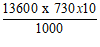 C.
C.  D.
D. 
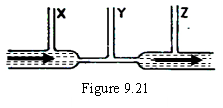 18. A uniform tube with a narrowed middle part has three identical manometers attached to it as in figure 9.21 below. If a steady flow of a liquid is maintained in the direction indicated by the arrows, the height of the liquid will be:
SECTION B
26. (a) (i) Define pressure and state its units.
(ii) With the aid of a diagram, describe how you would show that the pressure of a liquid is independent of cross-sectional area and shape of a container.

(b) Two manometers P and Q contain a liquid X, and water respectively at the same level. They are then connected to a thistle funnel covered with a rubber membrane as shown in figure 9.23. When the thistle funnel is lowered into a beaker containing a dilute acid of density 1200 kg/m3, the heights h1 and h2 are 15 cm and 12 cm respectively.
Find the: (i) Ratio of the density of liquid X to that of water,
(ii) Depth d of the thistle funnel below the surface of the dilute acid.
(iii) Explain why a ship floats in water although it is made mainly of metal.
27. (a) (i) State the principle of transmission of pressure in fluids.
(ii) Give one assumption on which the principle is based.
(iii) State two applications of the principle.
(iv) In a hydraulic press the smaller piston has a diameter of 14 cm while the larger has a diameter of 280 cm. If a force of 77 N is exerted on the smaller piston, calculate the force exerted on the larger piston.
(b) With the help of a diagram, describe how hydraulic brake works.
28. (a) Explain why large water reservoirs are much wider at the base than at the top.
(b) Figure 9.24 shows the structure of a force pump.
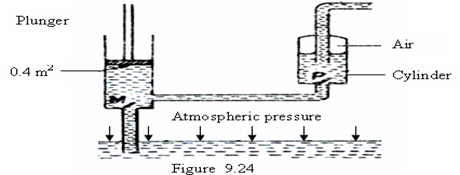
(i) Describe the action of the pump.
(ii) If a downward force of 500 N is exerted on the plunger whose surface area is 0.4 m2, calculate the pressure which forces water into cylinder C.
29. (a) Define the term pressure and state its unit.
(b) (i) Describe how a simple mercury barometer can be set up to measure the atmospheric pressure.
(ii) The difference between the atmospheric pressure at the top and bottom of a mountain is 1 × 10⁴ N/m2. If the density of air is 1.25 kg/m3, calculate the height of the mountain.


