

LEARNING OBJECTIVESBy the end of this chapter, you should be able to:
|
11.1 Speed, Velocity, and Acceleration
(a) Speed
Speed is defined as the rate of change of distance moved with time.
OR Speed is the distance traveled in a unit time.
Mathematically, it is expressed as: Speed = 
The S.I unit of speed is m/s or ms-1.
(b) Displacement
Displacement is defined as distance moved in a specified direction.
For example, if a body moves along a straight line in a given direction such as 100 m due east or 50 m due north.
(c) Velocity
Velocity is defined as the rate of change of displacement with time.
Or Velocity is the rate of change of distance moved with time in a specified direction.
Or Velocity is defined as speed in a specified direction.
The S.I unit of velocity is ms-1 or m/s.
Difference between speed and velocity
Velocity is a vector quantity whereas speed is a scalar quantity.
NB: Vector quantity is a quantity that has both magnitude and direction.
Scalar quantity is a quantity that has magnitude only.
Uniform Velocity
Uniform velocity is the velocity when the rate of change of displacement is constant.
Non-uniform Velocity
Non-uniform velocity is the velocity when the rate of change of displacement is not constant.
Acceleration
Definition: Acceleration is defined as the rate of change of velocity with time.
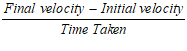
Acceleration = 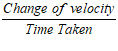
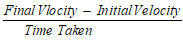
= 
The S.I unit of acceleration is m/s2 or ms-2, read as metres per second squared.
When the velocity of a body is changing, the body is said to be accelerating.
Acceleration is positive if the velocity is increasing and negative if the velocity is decreasing.
A negative acceleration is called deceleration or retardation.
Uniform Acceleration
Uniform acceleration is the acceleration when the rate of change of velocity is constant.
11.2 The Equations of Linear Motion
The following are the equations for a uniformly accelerated body.
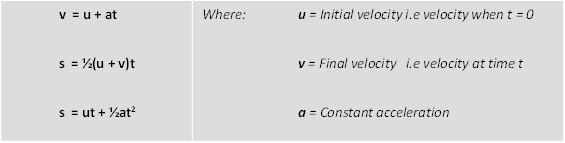
Notes:
- When using the equations, it is necessary to bear in mind that u, v, a, and s are vectors. If, say, the positive direction is taken to be up, then:
- The velocity of a body moving down (i.e., in the opposite direction) is negative.
- Points below the starting point have negative values of s.
- Downward directed accelerations are negative.
These facts help in understanding velocity-time graphs with negative values of velocity.
Derivation of the Equations of Motion
Suppose a body is moving with constant acceleration a and in a time interval t its velocity increases from u to v and its displacement increases from 0 to s. From the definition of acceleration:
Acceleration = Rate of change of velocity
Acceleration = 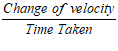
= 
a = 
v = u + at


