


BIOLOGY PAPER 231/2 K.C.S.E 2002
PRACTICAL MARKING SCHEME
1. You are provided with specimens labeled D1, D2, D3, and D4. Examine them.
(a) Draw and label specimens D1 and D2.
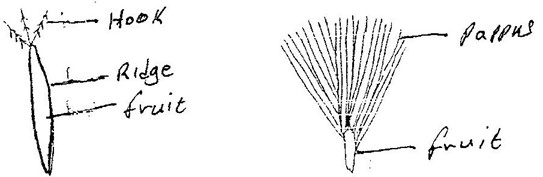
Magnification X3 – X7
(b) Giving reasons, state the agent or method of dispersal of the specimens.
| Specimen | Agent or method of dispersal | Reasons |
|---|---|---|
| D1 | Animal/man | Presence of hooks, e.g., hook-like structures (reject spikes, spines, thorns, etc.) |
| D2 | Wind | Presence of pappus; light/air-like extensions |
| D3 | Wind | Presence of wings; light/wing-like structures |
| D4 | Explosive | Line of weakness along the ovary wall |
(c) State the types of gynoeciums and placentation of specimen D4.
Type of (i) Gynoecium: Monocarpous
(ii) Placentation: Marginal
2. You are provided with olive oil, liquids labelled L1 and L2, and an Irish potato.
Label two test tubes A and B. Place 2 cm3 of water into each test tube. To test tube labelled A, add 8 drops of liquid L1. Shake both test tubes. Allow to stand for five minutes.
(a) (i) Record your observations:
Test tube A:
Oil is broken up into small droplets which are dispersed/spread throughout in liquid; oil becomes emulsified; tiny droplets form a suspension; becomes cloudy/turbid; forms a white precipitate.
Test tube B:
Oil floats on water; no mixing takes place; two separate immiscible layers are seen.
(ii) Name the process that has taken place in test tube A.
Emulsification
(iii) State the significance of the process named in (a)(ii) above to increase surface area.
- Name the digestive juice in humans that has the same effect on oil as liquid L1:
- Bile
Region of alimentary canal into which the juice is secreted:
II – Duodenum
(b) Label two test tubes C and D. Place 2 cm3 of liquid L2 into each. Add a drop of iodine into each test tube.
(i) Record your observation:
Blue-black/black/bluish/blue/grayish/purple-blue
(ii) Suggest the identity of L2:
Starch
Cut out a cube whose sides are 1 cm from the Irish potato provided. Crush the cube to obtain a paste. Place the paste into a test tube labelled C. Leave the setup for at least 30 minutes.
(iii) Record your observation:
Contents of D remain unchanged/blue-black; blue-black in C disappears/fades to light yellow/brown/orange.
(iv) Account for the results in (b)(iii) above:
Enzyme amylase in potato breaks down starch into sugars that do not give blue-black colour with iodine.
(c) (i) Cut another cube whose sides are 1 cm from the Irish potato. Crush the cube. Place the crushed paste into a test tube. Carry out food test with the reagent provided. Record the procedure and results.
Procedure:
Add equal amount of Benedict’s solution to the paste and boil/warm.
Results:
Grey/yellow/orange/brown/brick-red precipitate
(ii) Account for the results in (c)(i) above:
Starch in potato is converted to maltose/reducing sugar/simple sugar by enzyme amylase.
3. You are provided with specimens labelled Q and R. Examine them.
(a) Giving reasons, state the phylum of the specimens:
Phylum: Arthropoda
Reasons: Exoskeleton/chitinous
(b) (i) Name the class to which the specimens belong:
Insecta
(ii) State the features common to both specimens that are characteristics of the class mentioned in (b)(i) above:
- 3 body parts
- 3 pairs of legs
- A pair of antennae


